

 Google has announced that it has settled the “book search” class action lawsuits filed against it in 2005 by the Authors Guild and the Association of American Publishers. The complaint in The Authors Guild, Inc., et al. v. Google Inc., filed in the Southern District for the District of New York, accused Google of massive copyright infringement by reproducing works that were not in the public domain in violation of the Copyright Act, 17 USC § 101 et seq. Google Book Search, which scans books and then distributes them online, was accused of violating the copyrights of publishers and authors. The settlement, which is subject to final court approval, calls for Google to pay $125 million to litigants. It also clears the way for Google to continue scanning books and establishes some novel services and distribution mechanisms for the future.
Commenting on blog posts requires an account.
Login is required to interact with this comment. Please and try again.
If you do not have an account, Register Now.
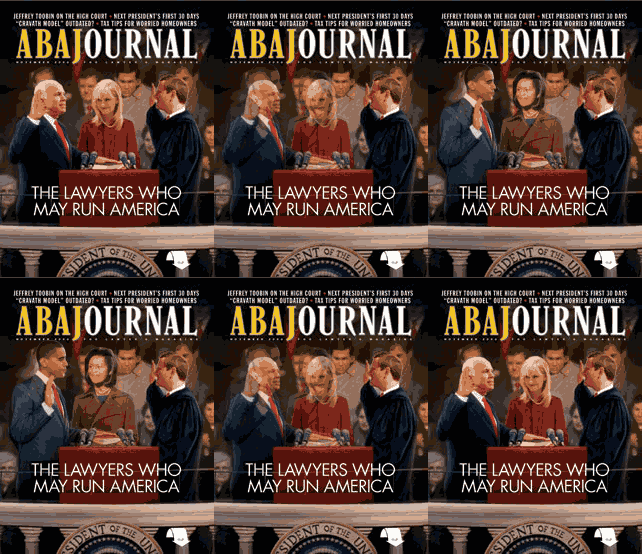 The November issue of the ABA Journal has two covers: the front cover features a painting of John McCain taking the oath of office and the back cover features Barack Obama taking the oath. The main story behind the dueling covers is titled The Lawyers Who May Run America and lists the attorneys who may be appointed to senior positions in a McCain or Obama administration including possible nominees to open seats on the US Supreme Court.
The article lists attorneys who are favorites to join the administration of the winning candidate, according to interviews with people who know each candidate well. If Obama wins the election, you can see the lawyers who may hold key positions by clicking here. For a look at the lawyers who may join a McCain administration, click here.
Commenting on blog posts requires an account.
Login is required to interact with this comment. Please and try again.
If you do not have an account, Register Now.
Scotusblog includes New York Law Publishing Company, et al., v. Jane Doe, et al. in its “Petitions to Watch” with the issue being whether, under the First Amendment, the blanket sealing of a case is presumptively unconstitutional. The case involves the Legal Intelligencer, the oldest daily legal newspaper in the United States, which has asked the U.S. Supreme Court to overturn a decision that allowed all records in a federal employment discrimination case to be hidden from the public.
According to the Legal Intelligencer, the documents in the case of Doe v. C.A.R.S. Protection Plus Inc., 527 F.3d 358 (3d Cir. 2008) have been under seal for more than seven years. The case came to light in May, when the Third Circuit unanimously reversed the trial court’s dismissal of a sex discrimination suit brought by a woman who claims she opted to have an abortion after tests showed that her baby had severe deformities, and that she was fired three days later – the day she attended the funeral for the baby. The case raises a question of first impression as the 3rd Circuit held that Title VII, as amended by the Pregnancy Discrimination Act, protects a worker’s right to terminate a pregnancy because an abortion qualifies as a “related medical condition.” The 3rd Circuit’s decision was significant because it held for the first time that a woman’s decision to terminate a pregnancy is protected under Title VII.
The 3rd circuit’s ruling left in place the trial judge’s decision to seal all documents in the case. In a separate motion, the newspaper asked the 3rd Circuit to unseal the case at the appellate level where all documents and the court’s docket are likewise under seal The Third Circuit Court of Appeals rejected the newspaper’s request to intervene in to unseal the docket and record in a two page order ruling that the entire file in the case may be sealed. The newspaper has now filed a Petition for a Writ of Certiorari with the US Supreme Court challenging the constitutionality of such a blanket sealing order. The newspaper relies on a Second Circuit opinion, Hartford Courant Co. v. Pellegrino, 380 F.3d 83 (2d Cir. 2004), for the principle “that the public and press have a qualified First Amendment right to inspect docket sheets, which provide an index to the records of judicial proceedings”.
The brief noted “This case has been conducted for seven years in complete secrecy, a testament to the need for the Court’s guidance regarding the right of access to civil hearings and records.” The brief urged the Court to accept review to correct the mistakes below and “clarify that the public has a constitutional right of access to civil proceedings and records, because civil proceedings implicate precisely the same concerns about the fairness of the justice system that underlie the right of access to criminal proceedings.”
Commenting on blog posts requires an account.
Login is required to interact with this comment. Please and try again.
If you do not have an account, Register Now.
The American Civil Liberties Union (ACLU) has named BLS Prof. Susan N. Herman as its new president. The organization issued a press release on the election of Prof Herman on Saturday, October 18. A constitutional and civil rights scholar, Herman previously served as the ACLU’s general counsel and succeeds former ACLU president Nadine Strossen who held the position since 1991. Prof. Herman has had a long affiliation with the ACLU having worked as an ACLU intern while still in law school She has also served on its board of directors, written Supreme Court briefs for the organization and lobbied Congress on the group’s behalf.
Prof. Herman is an expert on the US Supreme Court expert with a focus on criminal procedure. She participated in a BLS Library Blog podcast in August of 2008 when she discussed the Tenth Annual Supreme Court Review sponsored by the Practicing Law Institute (PLI) in New York, NY. The BLS Library catalog lists seventeen items (print, video and audio) where Prof. Herman contributed as an author or as a participant. Professor Herman’s scholarly and legal writings are available on her Selected Works page.
Commenting on blog posts requires an account.
Login is required to interact with this comment. Please and try again.
If you do not have an account, Register Now.
A major case pending before the US Supreme Court on this issue is Wyeth v. Levine which will decide this term whether federal law preempts state torts claims imposing liability on drug labeling that the FDA had previously approved. The case involves a jury verdict in a failure-to-warn product liability case in amount of $6.5 million in favor of plaintiff Diana Levine, who suffered severe injury and the amputation of her arm as a result of being injected with the defendant’s drug Phenergan directly into her artery as a treatment for nausea from a migraine headache. The pharmaceutical company defendant argues that Vermont’s stricter regulations on administering the drug are preempted by less stringent federal regulations. The Supreme Court of Vermont issued its opinion in favor of the plaintiff in October 2006. For more on the Wyeth case, read former BLS Prof. Anthony Sebok’s FindLaw article More on the Upcoming Supreme Court Case of Wyeth v. Levine and the Preemption Temptation.
 For reading on the issue, see in the BLS Library collection Federal Preemption of State and Local Law: Legislation, Regulation, and Litigation by James T. O’Reilly (Call # KF4600 .O74 2006) with chapters including: The basics on preemption — Preemption categorizations — Constituencies for preemption — Constitutional background — Political and policy debates — Federal mechanisms for agency preemption — Express congressional decisions to preempt — Implied forms of preemption — Defensive use of federal preemption in civil litigation.
Commenting on blog posts requires an account.
Login is required to interact with this comment. Please and try again.
If you do not have an account, Register Now.
The end of the long presidential campaign is just three weeks away. There is some possibility that the campaign will continue beyond election day with litigation similar to that which resulted in the US Supreme Court decision in Bush v. Gore, 531 U.S. 98 (2000). Both major party candidates have had to respond to lawsuits challenging their eligibility for the Office of the President under Article II, Section I of the US Constitution which reads:
No Person except a natural born Citizen, or a Citizen of the United States, at the time of the Adoption of this Constitution, shall be eligible to the Office of President; neither shall any Person be eligible to that Office who shall not have attained to the Age of thirty five Years, and been fourteen Years a Resident within the United States.
At issue is the term “natural born Citizen”. Three cases have challenged Sen. John McCain’s eligibility on the ground that he is ineligible due to his birth in the Panama Canal Zone: the first was Inland Empire Voters v. United States, filed in the US District Court for the Central District of California; the second was Hollander v. McCain, filed in the US District Court for the District of New Hampshire; and the third, Robinson v. Bowen, was filed in the US District Court for the Northern District of California in August 2008. All cases were dismissed due to the plaintiff’s lack of standing. Interestingly, District Court Judge William Alsup in his September 16 opinion dismissing the Robinson case stated:
It is clear that mechanisms exist under the Twelfth Amendment and 3 U.S.C. § 15 for any challenge to any candidate to be ventilated when electoral votes are counted, and that the Twentieth Amendment provides guidance regarding how to proceed if a president elect shall have failed to qualify. Issues regarding qualifications for president are quintessentially suited to the foregoing process. Arguments concerning qualifications or lack thereof can be laid before the voting public before the election and, once the election is over, can be raised as objections as the electoral votes are counted in Congress. The members of the Senate and the House of Representatives are well qualified to adjudicate any objections to ballots for allegedly unqualified candidates. Therefore, this order holds that the challenge presented by plaintiff is committed under the Constitution to the electors and the legislative branch, at least in the first instance. Judicial review–if any–should occur only after the electoral and Congressional processes have run their course.
The September 2008 issue of First Impressions, the online companion to the Michigan Law Review has an Online Symposium on Senator John McCain and Natural Born Citizenship with five scholarly articles debating the issue.
Now a new suit, Berg v. Obama, has been filed in the US District Court for the Eastern District of Pennsylvania alleging that Sen. Barack Obama is not eligible to be President on the natural born citizen issue. A Motion to Dismiss the complaint is pending before the Court. The motion is grounded on the plaintiff’s lack of standing and cites as authority the dismissed cases that were filed against Sen. McCain.
Whatever the election results, the possibility of the final outcome being resolved in the US Supreme Court may not be so far-fetched.
Commenting on blog posts requires an account.
Login is required to interact with this comment. Please and try again.
If you do not have an account, Register Now.
On June 9, 2008, the US Supreme Court issued a unanimous decision in Allison Engine Co., Inc. v. United States, ex rel. Sanders, strictly construing the language of the False Claims Act (“FCA”). The case involved two FCA suits alleging fraud in the negotiation and execution of subcontracts relating to the construction of Navy destroyers for components for the ships costing nearly $1 billion. The issue before the Court was whether the FCA covered false claims presented not to the Government, but to a contractor or other recipient of federal funds. The Court held that mere proof that a false or fraudulent claim was paid using government funds is not sufficient to establish liability under the law. Instead, the Court held that the FCA imposed a presentment requirement on plaintiffs to show that a defendant intended for the government to pay the claim, or that the government actually paid the specific claim.
 See the library’s recent acquisition The 7th Annual National Institute on Civil False Claims Act and Qui Tam Enforcement (Call # KF849 .C58 2008) for additional reading on the topic. This item has a CD component for study of the civil False Claims Act, one of the fastest growing areas of federal litigation, because of its unique qui tam enforcement mechanism. It brings together experts from all areas – healthcare, defense, pharmaceutical, oil and gas, accounting and consulting, construction, higher education and grant recipients – in which qui tam lawsuits under the FCA have been filed.
Commenting on blog posts requires an account.
Login is required to interact with this comment. Please and try again.
If you do not have an account, Register Now.
Today, the Connecticut Supreme Court issued its opinion in Kerrigan v. Commissioner of Public Health ruling that same-sex couples have the right to marry. The case began in 2004 with the filing of a complaint by same-sex couples claiming that their constitutional rights to equal protection and due process were violated when they were denied marriage licenses. In April 2005, the Connecticut General Assembly enacted Public Act 05-10 to allow same-sex couples to obtain civil union licenses. Section 14 of that law reads:
Parties to a civil union shall have all the same benefits, protections and responsibilities under law, whether derived from the general statutes, administrative regulations or court rules, policy, common law or any other source of civil law, as are granted to spouses in a marriage, which is defined as the union of one man and one woman.
The plaintiffs filed a motion for summary judgment and its supporting memorandum on the merits of the case. The Attorney General, in opposition, filed a reply brief and sought summary judgment on behalf of the State. On June 12, 2006, Judge Pittman denied the plaintiff’s motion, in an opinion ruling that the exclusion of same-sex couples from marriage did not violate the Connecticut Constitution.
The Supreme Court reversed the trial court agreeing with the plaintiffs that the state’s marriage law discriminates against them because it applies only to heterosexual couples, therefore denying gay couples the financial, social and emotional benefits of marriage.
The trial court rendered summary judgment in favor of the defendant state and local officials upon determining that, because this state’s statutes afford same sex couples the right to enter into a civil union, which affords them the same legal rights as marriage, the plaintiffs had not established a constitutionally cognizable harm. We conclude that, in light of the history of pernicious discrimination faced by gay men and lesbians, and because the institution of marriage carries with it a status and significance that the newly created classification of civil unions does not embody, the segregation of heterosexual and homosexual couples into separate institutions constitutes a cognizable harm. We also conclude that (1) our state scheme discriminates on the basis of sexual orientation, (2) for the same reasons that classifications predicated on gender are considered quasi-suspect for purposes of the equal protection provisions of the United States constitution, sexual orientation constitutes a quasi-suspect classification for purposes of the equal protection provisions of the state constitution, and, therefore, our statutes discriminating against gay persons are subject to heightened or intermediate judicial scrutiny, and (3) the state has failed to provide sufficient justification for excluding same sex couples from the institution of marriage. In light of our determination that the state’s disparate treatment of same sex couples is constitutionally deficient under an intermediate level of scrutiny, we do not reach the plaintiffs’ claims implicating a stricter standard of review, namely, that sexual orientation is a suspect classification, and that the state’s bar against same sex marriage infringes on a fundamental right in violation of due process and discriminates on the basis of sex in violation of equal protection. In accordance with our conclusion that the statutory scheme impermissibly discriminates against gay persons on account of their sexual orientation, we reverse the trial court’s judgment and remand the case with direction to grant the plaintiffs’ motion for summary judgment.
The decision makes Connecticut the third state where the highest court has ruled to legalize same-sex marriage, following the Supreme Courts of Massachusetts (Goodridge v. Dept. of Public Health) and California (In re Marriage Cases). The constitutionality of prohibiting marriage to same-sex partners has come before the Court of Appeals in New York (Hernandez v. Robles) and the New Jersey Supreme Court (Lewis v. Harris) but those courts decided to defer to their respective state legislatures.
This November, voters in several states will cast their ballots on the issue of same-sex marriage. California voters will decide on Proposition 8 which changes the California Constitution to eliminate the right of same-sex couples to marry in California. Arizona will vote on Propostion 102 which will “amend the Arizona Constitution to provide that only a union of one man and one woman shall be valid or recognized as a marriage”. Florida has Amendment No. 2 on its ballot. The Florida Marriage Protection Amendment states “Inasmuch as marriage is the legal union of only one man and one woman as husband and wife, no other legal union that is treated as marriage or the substantial equivalent thereof shall be valid or recognized.”
 For more reading, see Same-Sex Marriage and the Constitution: We All Deserve the Freedom to Marry by Evan Gerstmann (Call # KF539 .G47 2008) in the BLS collection. Chapters include: Reason and prejudice: is the heterosexual monopoly on marriage rational? — Looking for stricter scrutiny: sexism, heterosexism, and class-based equal protection — The fundamental right to marry — Same-sex marriage and the fundamental right to marry — Should courts create new rights?
 See also, Beyond Straight and Gay Marriage: Valuing All Families under the Law by Nancy D. Polikoff (Call # 38 .P65 2008) which has chapters: The changing meaning of marriage — Gay rights and the conservative backlash — Redefining family — The right and the marriage movement — LGBT families and the marriage-equality movement — Countries where marriage matters less — Valuing all families — Domestic partner benefits for all families — Coping with illness : medical care and family and medical leave
Commenting on blog posts requires an account.
Login is required to interact with this comment. Please and try again.
If you do not have an account, Register Now.
The 2d Circuit Court of Appeals, in a 69 page decision, vacated the 75 year prison sentence of a Yemeni cleric (Sheik Mohammed Ali Al-Moayad) and the 45 year prison sentence of his assistant (Mohammed Zayed) imposed in 2005 by the Federal District Court in Brooklyn. The defendants were convicted of violating 18 U.S.C. § 2339B (a) (1), providing material support (primarily financing) to designated terrorist organizations (in this case, Hamas and Al-Qaeda). The Circuit Court’s reversal, stating that the defendants were deprived of a fair trial, detailed inadmissible evidence that the government erroneously presented in its case against the defendants.
The government’s case was based in large part on an FBI sting operation which relied heavily on the assistance of a confidential informant named Mohammed Al-Anssi, a Yemeni national who, in difficult financial circumstance, approached the FBI seeking compensation in exchange for information. According to the opinion:
Al-Anssi initially asked the FBI for 5 million dollars in exchange for his assistance, “hoping that it will go up, no problem.” He also requested United States citizenship and that his family be brought to the United States from Yemen. In describing his motive for seeking compensation, Al-Anssi testified, “the issue was the truth, the whole issue, and after I chase the terrorists and to bring him here to America, I deserve even 10 million dollars.”
Al-Anssi stated that he was paid $100,000 by the FBI for his assistance. However, he believed that he deserved millions, “[a]nd I expect more than that.” Al-Anssi admitted that, because he was upset about his small payment from the FBI, he falsely told the Washington Post that the FBI promised to pay him 5 million dollars. He also testified that in November 2004, in an attempt to coerce the FBI into paying him more money, he set himself on fire in front of the White House. With regard to this incident, Al-Anssi testified that he did not intend to commit suicide, but that he “wanted to put the government and the world on notice,” and that “[i]t is my right to get as much as I can from the FBI.”
Choosing not to call the confidential informant as a witness in its case in chief, the US Attorney instead presented the informant’s written notes and a series of video tapes that he made of the defendant Al-Moayad to prove that he was funding terrorist organizations. One of the tapes was of a speech given by a guest at a wedding in Yemen hosted by Al-Moayad where a Hamas related guest made reference to another wedding ceremony in Tel Aviv on the same day where a terrorist attack occurred.
The government also relied on the testimony of a young Scottish law student named Gideon Black that a suicide bombing occurred on a bus in Tel Aviv that same day. Black was a passenger on the bus along with his cousin Yoni, who was killed in the attack. Over defense objections that it was unrelated to the charges and highly prejudicial, the trial judge permitted Black’s lengthy and detailed testimony about the bombing.
The Circuit Court opinion lists other examples of how the Justice Department undermined its own case with questionable evidence, use of entrapment techniques and other sensational tactics. It implicitly criticized the trial judge, the Hon. Sterling Johnson Jr. saying:
The district court’s cumulated errors in admitting Al-Anssi’s notes and the testimony of Gideon Black and Yahya Goba “cast such a serious doubt on the fairness of the trial” as to warrant reversal of the defendants’ convictions. That doubt is especially grave when we also take into account the district court’s erroneous admission of the mujahidin form, the wedding video, and the Croatian last will and testament, as well as its questionable handling of the derivative entrapment issue.
In reversing the convictions, the appeals court in an unusual directive remanded the case “to the district court for further proceedings consistent with this opinion before a different district court judge”.
See the NY Times article on the ruling.
The NY Times article Cuomo Asks for Pay Data From Banks reports that the New York Attorney General has joined Rep. Henry A. Waxman in seeking greater oversight of nine big financial institutions (Citigroup, Bank of America, Bank of New York Mellon, Goldman Sachs, JPMorgan Chase & Co., Merrill Lynch, Morgan Stanley, State Street Corporation and Wells Fargo) that received government aid under the recent bailout to be sure that they do not use the money for bonuses or other payments. According to the article, “bonus payments are already expected to be as much as 50 percent smaller than last year and perhaps even far smaller at banks that posted big losses. The New York State comptroller estimated that Wall Street paid $33.2 billion in bonuses for 2007, compared with $33.9 billion the year before.”
The NY Attorney General’s letter asks the banks for “detailed accounting regarding your expected payments to top management in the upcoming bonus season.” In the letter, Cuomo suggest that such payments may violate N.Y. Debtor & Creditor Law § 274 as illegal fraudulent conveyances.
Rep. Waxman’s letters requesting compensation and bonus information for employees of major banks are available at the Committee on Oversight and Government Reform webpage.
Commenting on blog posts requires an account.
Login is required to interact with this comment. Please and try again.
If you do not have an account, Register Now.