The Brooklyn Law School logo

BLS Library Blog

Showing 10 of 15 Results

With most local political attention focused on Mayor Michael Bloomberg’s efforts to gain a third term as mayor of the City of New York, the fall ballot’s two other citywide offices, Public Advocate and City Comptroller, remain largely under the radar. Current Comptroller William Thompson is not seeking re-election and is running against Mayor Michael Bloomberg so the Comptroller’s office is an open seat. The Comptroller is the city’s chief fiscal officer and chief auditing officer. September 15th is the date of the Primary Election. The four major candidates seeking the Democratic nomination for Comptroller are all current members of the City Council: Melinda Katz (District 29 – Queens), John Liu (District 20 – Queens), David I. Weprin (District 22 – Queens) and David Yassky (District 33 – Brooklyn).

Besides being the only Council member from Brooklyn, representing Brooklyn Heights, Greenpoint; parts of Williamsburg, Park Slope, and Boerum Hill, Yassky once was on the faculty of Brooklyn Law School teaching courses in Administrative Law, Constitutional Law, Criminal Law, and Federalism. Last week, WABC TV along with the League of Women Voters of the City of New York held the first of two debates among the candidates for Comptroller before the Primary Election. NY1 News will broadcast the second debate on Thursday, September 10 at 7pm. The first debate’s video is here:

This post has no comments.
08/28/2009
profile-icon BLS Reference Desk

Earlier BLS Library Blog posts here and here addressed the issue of searching travelers’ laptop computers at airport security checkpoints. This week, the American Civil Liberties Union (whose President is BLS Professor of Law Susan N. Herman) issued a press release about its lawsuit against the Department of Homeland Security (DHS) over the issue which it filed this past Wednesday in the US District Court of the Southern District of New York. The suit seeks an Order directing the DHS to comply with the ACLU’s Freedom of Information Act (FOIA) request for access to documents related to the US Customs and Border Protection (CBP) policy regarding laptop searches. The ACLU alleges that the laptop search policy violates travelers’ Fourth Amendment protections against unreasonable searches and seizures because laptops are searched without “individualized suspicion” of wrongdoing. 

The ACLU is seeking information related to the criteria for selecting who will be searched, how many searches have been conducted and what types of devices or documents CPB has retained. Last year when introducing the Travelers Privacy Protection Act in the 110th Congress, Sen. Russ Feingold (D-WI) criticized the CBP’s warrantless searches and seizures of travelers’ laptops and other digital devices at the US border, calling them an unacceptable invasion of privacy. That bill, which sought to require CPB agents to “have reasonable suspicion of illegal activity before searching the contents of laptops or other electronic devices carried by U.S. citizens and legal residents”, died in committee in the last Congress.

In the current 111th Congress, the Senate Judiciary Committee addressed the issue at a hearing in May. DHS Secretary Janet Napolitano testified that her agency, which oversees Customs, would be revising its policy to address privacy concerns. She told the committee that the relatively low number of laptop searches has uncovered significant criminal activity and that the practice would continue. This video clip shows Sen. Feingold questioning Secretary Napolitano on border searches of laptop computers and other electronic devices without any suspicion of wrongdoing.

This week, the DHS Privacy Office released a Privacy Impact Assessment in connection with new CPB directives to enhance public understanding of the authorities, policies, procedures and controls employed by DHS during border searches.
This post has no comments.
08/28/2009
profile-icon BLS Reference Desk

Many BLS students are beginning to research international law-related articles and seminar papers.  Below are some starting points for international law research:

A core group of international law treatises and handbooks are available in BLS Library’s first-floor Reserve collection, including:

  • Anthony Aust, Modern Treaty Law and Practice, 2d ed. (2007)
  • Ian Brownlie, Principles of Public International Law, 7th ed. (2008) (noted treatise)
  • Ian Brownlie, ed., Basic Documents in International Law, 6th ed. (2009) (collection of selected international law documents)
  • Richard Gardiner, Treaty Interpretation (2008)
  • Mark Janis, International Law, 5th ed. (2008) (handbook authored by a U.S. law professor who teaches international law)
  • Malcolm Shaw, International Law, 6th ed. (2008)
  • Bruno Simma, ed., The Charter of the United Nations: A Commentary, 2d  ed. (2002)
  • Mark Villiger, Commentary on the 1969 Vienna Convention on the Law of Treaties (2009)
  • Gerhard von Glahn & James Taulbee, Law Among Nations: An Introduction to Public International Law, 9th ed. (2009)
  • Rebecca Wallace & Olga Martin-Ortega, International Law, 6th ed. (2009) (handbook authored by U.K. law professors who specialize in international law and international human rights law)
  • Andreas Zimmermann, ed., The Statute of the International Court of Justice: A Commentary (2006)
  • Restatement of the Law, Third: The Foreign Relations Law of the United States, also available in Westlaw database: REST-FOREL

Max Planck Encyclopedia of Public International Law (the online, updated version of this encyclopedia includes nearly 850 articles on key international law topics—authors are international law scholars or practitioners)

American Society of International Law’s Insights on hot topics & ASIL’s International Law in Brief (biweekly newsletter)

Web guides that Maria Okonska and I created for BLS students:

Also, feel free to discuss your research with me when I am on duty at the reference desk on Monday (3-4 PM), Tuesday (1-3 PM) and Thursday (1-3 PM).

This post has no comments.
08/27/2009
profile-icon BLS Reference Desk

The BLS Library catalogers, Maria Okonska and Jeff Gabel, as part of their commitment to library patrons, periodically compile a new book list by subject. The new book list is accessible from SARA, the library’s public access catalog, using the link New Book Lists at the bottom of the page. The catalogers have also added to SARA a feature called Selected New Titles where library users can view images of book covers which link to the corresponding book record in the online catalog. As the law school moves to its new portal site, BLSConnect, the BLS library catalogers have now included the New Titles list there under the Library tab. Users of the portal can click on any book cover image to go to the corresponding book record in the library catalog.

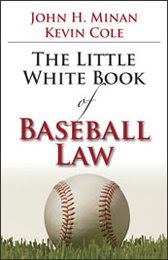
One item of interest in the most recent new book list for August 13, 2009 is an appealing book in the ABA “little books of”series, The Little White Book of Baseball Law, by John H. Minan and Kevin Cole. This brief book is an enjoyable, short read that may be of interest to fans of America’s favorite past time as the major league season winds down. The book, divided into innings as opposed to chapters, discusses cases (with citations provided) relating to new stadium construction, ownership of baseball memorabilia, injured spectators, media contracts and even cases about rules of the game of baseball.

The publisher states that the book “is written in a short-story format with additional references to movies, songs, history, and other asides that will add to the reader’s enjoyment.” For example, there is a reproduction of the indictment against Barry Bonds for steroid use included to stress the point that the market value of baseball memorabilia is tied to the reputation of the player to whom the memorabilia is related.

Another book from the series that is part of the BLS collection is The Little Red Book of Wine Law. A review of this book by Heather A. Phillips is available at the LLRX, the free Web journal dedicated to providing legal and library professionals with up-to-date information on Internet research, resources and tools. One additional book in the series that is not part of the BLS collection is The Little Green Book of Golf Law.
This post has no comments.
08/26/2009
profile-icon BLS Reference Desk

Today’s Wall Street Journal has an article Fight Brews as Proxy-Access Nears. It is worth reading to contrast the reactions of companies, on the one hand, and shareholder activists, on the other, to a proposed SEC plan for greater accountability in corporate governance. Whether shareholders should be allowed to nominate and elect their own candidates as company directors is not a new topic. For some time, proponents of “shareholder democracy” have advocated more shareholder input in the nomination of directors. Typically, in large companies, the company management, not the shareholders, controls the nominating process, so that directors become loyal to the company and often lose sight of shareholder interests. If shareholders want to nominate their own candidate for the board of directors, they have to send separate ballots to all other shareholders at their own expense. Although obligated by law to provide shareholder lists, often company management makes that process as difficult as possible. As a result, when shareholders do nominate their own candidates as company directors, they often spend tens of thousands of dollars in a proxy battle to inform shareholders that there is a contested election.

In an effort to make companies more accountable and responsible to shareholders, the SEC voted earlier this year to enact a proposed rule change to the federal proxy rules that would permit shareholders to nominate directors as part of a corporation’s annual proxy solicitation process. In explaining the need for the reform, the SEC cited the current economic crisis suggesting that the crisis has led many to raise serious concerns about the accountability and responsiveness of some companies and boards of directors to the interests of shareholders, and has resulted in a loss of investor confidence. Under the new rules, shareholders could also modify a company’s nomination procedures or disclosure about elections, subject to applicable state law requirements.

There are certain complexities in the proposed rule change. For example, 14a-11 would allow large shareholders to include nominations in the company’s proxy statement. The proposed change sets thresholds that would allow shareholders to organize and put together groups for submitting nominations to the board (1% for companies above $750 million; 3% for companies above $75 million; 5% for companies below $75 million) without triggering most of the requirements of the proxy rules. 

For greater detail on the topic of the SEC’s access proposal, see several excellent postings in The Race to the Bottom that provides an analysis of laws and regulatory measures that govern today’s corporations. One of those posts, Access and Its Opponents: An Overview, includes contrasting views by legal practitioners and the legal academy in submissions made during the recently ended comment period regarding the proposed rule change. The two comment of special interest are the one letter from seven large law firms that took the unusual step of submitting a joint letter opposing the idea; the other letter from 80 law professors, including BLS Law Professors James A. Fanto and Arthur r. Pinto, supported the SEC’s proposal.

This post has no comments.
08/22/2009
profile-icon BLS Reference Desk

Welcome, Class of 2012 and Class of 2013! In the coming days, the reference librarians will host a series of library orientation sessions to help you navigate through your first year of law school. The reference librarians, the technical services librarians, the members of the acquisitions department along with the public service staff are all here to support you and answer any questions that you may have.

Much useful material is available online but also in print at the reference desk and at the circulation desk. One newly published journal that may be helpful is the latest edition of the Legal Reference Services Quarterly. Volume 28 Issues 1 & 2 (2009) is devoted to Teaching Legal Research Part I of II. The print version of Issue I is available at the circulation desk and has a very useful article for 1Ls: Best Practices: What First-Year Law Students Should Learn in a Legal Research Class by Nancy P. Johnson. The article has useful information about developing best practices in the legal research process, including a discussion of case law research and how to find cases online. It also discusses using citators not only as an updating tool but as a useful way to find relevant case law. Finally, it addresses the importance of using statutory research and administrative publications as well as secondary sources, such as law reviews, American Law Report annotations and the Restatements as part of an effective plan.
 
For online access, see the library database page at http://www.brooklaw.edu/librarylinks/dbjournals.php. The journal is listed alphabetically by title under Online Journals.
The reference librarians have developed several research guides using software created by LibGuides in order to help 1Ls and other law students in their law school careers. Of special interest to incoming students is 1L Resources, Tips and Tools which the reference librarians will feature during the 1L Library Orientation sessions during the next few weeks.

This post has no comments.
08/21/2009
profile-icon BLS Reference Desk

While the BLS Library contains thousands of books and journals, there may be times when the title you need is not available in our library.  What to do?

One option is to make an interlibrary loan request through a database called FirstSearch.

You also have the option of visiting another law school, college or university library in the area.  While you can’t charge the item out in this situation, you can read and/or photocopy what you need.

How do you go about doing this?  If you want to go to the New York Law School Library at 185 West Broadway in Manhattan or the CUNY Law School Library at 65-21 Main Street in Flushing, Queens, all you need to do is present your valid BLS ID card at either of these law schools to enter their library.  ID card access to these libraries is made possible through our membership in the Joint International Law Project (JILP).

If you want to visit any of the other law school libraries in the area to look at a specific book or journal, the reference librarian can issue a one day pass to you which is called a “green letter.”  These letters are a benefit of our library’s membership in the “Conference of Law School Library Directors of Greater New York.”  The member law schools include Cardozo, Columbia, Fordham, Hofstra, New York University, Pace, St. John’s and Touro.

For the libraries listed above, we are also able to issue letters for semester passes, with the exception of Columbia, which does not participate in the semester pass program.  Semester pass letters are available on the first day of classes each semester at the reference desk.  Get there early because we have a limited number of passes for each school.

If you find that you need to look at a non-legal title which is available at a college or university library, you should go to the reference desk and request a METRO Referral Card.  Our library belongs to the Metropolitan New York Library Council, commonly referred to as METRO.

METRO is a consortium of over 400 academic, public and special libraries.  One of the benefits of membership in METRO is our ability to refer users to any library that is a member with the issuance of a METRO Referral Card.  The METRO cards, as they are called, are good for one day’s use at another library.

And, of course, in the greater New York area there are many public libraries whose doors are already open to you — so the library world is your oyster!

This post has no comments.
08/21/2009
profile-icon BLS Reference Desk

The New York Times’ City Room has an article about the Brooklyn Public Library removing from its open shelves a copy of Tintin au Congo written and illustrated by the Belgian writer and illustrator Hergé and first published in 1931. The cause: its illustrations of African natives in a racially insensitive way. The action comes in response to a patron complaint of “the art depiction of black people looking like monkeys” and led the library to keep the book in a collection that is kept under lock and key. To view the item, patrons must make an appointment days in advance. The Times article includes graphic samples from the work supporting that conclusion. Years after creating the work, Hergé stated that he regretted the presentation claiming that his editor pushed him to depict the glories of Belgian colonialism in Africa through the Tintin books.

The Times article cites other offensive titles that remain in the generally accessible collection, for example, Mein Kampf by Adolf Hitler, Tropic of Capricorn by Henry Miller, Beloved by Toni Morrison and Looking for Alaska by John Green. Brooklyn Public Library’s book removal policy favors access to controversial materials but Tintin au Congo did not survive the process. The Times article is interesting to read to see how public libraries respond to complaints about controversial titles.

Controversy over Tintin has been around for years and will likely continue given the upcoming film version of the work by Steven Spielberg. Listen to leading British Tintinologist Michael Farr’s interview in this two part video clip for more.

This post has no comments.
08/20/2009
profile-icon BLS Reference Desk

On May 22, 2009, President Obama signed the Credit Card Accountability Responsibility and Disclosure Act of 2009 (Public Law 111-24, the Credit CARD Act) into law. The Credit CARD Act, which Congresswoman Carolyn Maloney of New York introduced as the “Credit Cardholders’ Bill of Rights” in January of this year, was intended to protect consumers from the credit card industry’s worst abuses. The new law has five Titles:

  • Title I: Consumer Protection
  • Title II: Enhanced Consumer Disclosures
  • Title III: Protection of Young Consumers
  • Title IV: Gift Cards
  • Title V: Miscellaneous Provisions

Starting today, some consumer protections provisions in Title I go into effect. Among them is §101 which changes the amount of advance notice that card issuers are required to give card holders for rate increases and other changes. The section obligates creditors to provide at least 45 days notice before raising interest rates or making any other significant changes in the terms of customer accounts. In the past, card providers were required to give just 15 days notice.

Under §101 (b) (2), creditors may not change the terms governing repayment of an outstanding balances depending on whether the credit card account is a variable rate or a fixed-rate. The creditor is required by §101 (b) (3) to inform the cardholder of the right to cancel the credit card account before the rate increase takes effect. If the cardholder does cancel, payment of the outstanding balance is at the old rate — not the new, higher rate that the card company is assessing. Another additional change made by §106 (a) is that the creditor is required to send bills at least 21 days before a payment is due, up from 14 days prior to the new law.

Most of the Credit CARD Act’s other protections start in February, 2010 although a few — such as requiring cards to reduce interest rates for consumers with improving credit reports — will not be effective until Aug. 22, 2010. When all the provision of the new law are fully implemented, many of the worst abuses that credit card companies have relied such as double cycle billing, universal default and increasing rates on existing balances will be prohibited. The law does not allow for private enforcement although §511 authorizes a state, as parens patriae, to “bring a civil action on behalf of the residents of the State in an appropriate district court of the United States or other court of competent jurisdiction (A) to enjoin that practice; (B) to enforce compliance with the rule; (C) to obtain damages, restitution, or other compensation on behalf of residents of the State; or (D) to obtain penalties and relief provided by the Federal Trade Commission Act and such other relief as the court considers appropriate.”

Given the limited enforcement provisions, the new law’s value in advancing consumer protection is open to question. Moreover, most cardholders have already begun to see higher interest rates as many credit card companies, in anticipation of the new law, have raised interest rates before the first changes took effect. At the same time, many consumers have seen their credit limits reduced before the law took effect.

One unexpected provision included in the Credit CARD Act of 2009 is in Title V, namely §512 titled Protecting Americans from Violent Crime and §512 (b) titled Protecting the Right of Individuals to Bear Arms in Units of the National Park System and the National Wildlife Refuge System.

This post has no comments.
08/19/2009
profile-icon BLS Reference Desk

BLS Adjunct Assistant Clinical Professor of Law Jonathan M. Kirschbaum began the Habeas Corpus Blog in April of 2009. Prof. Kirshchbaum is also a senior appellate counsel at the Center for Appellate Litigation (“CAL”), a private, non-profit organization that represents indigent criminal defendants in their appeals after conviction in state court in Bronx and New York Counties. Of interest to researchers practicing criminal law, the blog has a number of useful features including Habeas Corpus FAQs, a list of goals that the blog hopes to achieve and a list of Habeas Corpus Abbreviations.

One recent entry at the Habeas Corpus Blog reports that the US Court Of Appeals for the Second Circuit issued a Summary Order affirming a district court’s grant of habeas in the case of Espinal v. Bennett, 09-0398-pr, on August 18, 2009. The issues raised in the habeas application were Ineffective Assistance of Counsel based on counsel’s failure to investigate a police report which corroborated petitioner’s claim that he was not at the scene of the crime. The court ruled that the error prejudiced the petitioner since it prevented counsel from discovering a potential alibi witness, whose testimony would have probably changed the outcome of the trial. The district court opinion in Espinal v. Bennett was written by Judge David G. Trager (former Dean at Brooklyn Law School from 1983-1993) and is available at 588 F.Supp.2d 388 (EDNY 2008). It was also reported in the NY Law Journal as a Decision of Interest.

One additional Brooklyn Law School connection in this case is that BLS Professor of Law William E. Hellerstein was Counsel on the case for petitioner before the Second Circuit.

This post has no comments.
Field is required.