The Brooklyn Law School logo

BLS Library Blog

Showing 10 of 16 Results

12/29/2009
profile-icon BLS Reference Desk

While Jean J. Davis, Brooklyn Law School’s Foreign and International Law Reference Librarian and Adjunct Assistant Professor of Law, is touring law libraries in China, Harold V. O’Grady, Reference Librarian and Adjunct Assistant Professor of Law at BLS, is visiting law libraries in South America. Interestingly, Chile’s President Michelle Bachelet just inaugurated the exhibition, “The Ancient China and the Terracotta Army,” in the central hall of the Cultural Center La Moneda Palace in Santiago.

Today’s post updates the one here about the law library in Buenos Aires with news that he met today not only with law library personnel at the Facultad de Derecho of the University of Chile in Santiago but also with a distinguished alumnus of the law school and an American law professor on the campus for a visit. Caroline Maulin, Law Librarian, who led the tour of the Biblioteca on behalf of Director Nora Carrion, explained that because of Chile’s smaller population, as compared to Argentina, the law school in Santiago is much smaller than the one in Buenos Aires. Here the school has about 1,300 law students who study law over a period of five years and students are required to complete three major components to earn a degree: a practicum, a thesis and an examination. For more detailed reading on the subject, see Antonio Bascunan Valdes, Legal Education in Chile, 43 S. Tex. L. Rev. 683 (2001-2002) in HeinOnline available to BLS law school community on the Library’s A-Z List of subscription databases. Caroline explained that there were two libraries at the University, the central library for most of the law students and another for the exclusive use of post grads. 

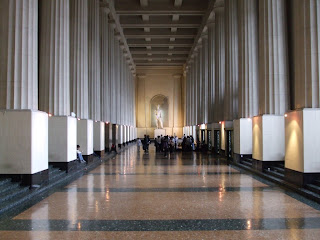
While the tour was in progress, the law students at the University of Chile were in the middle of their final exams which take place in December and January just before the summer recess. The photo here shows that whatever differences there are in legal education in Chile and the US, law students have one thing in common: exhaustion.

The library collection consists of about 50,000 print volumes of which about 6,000 are on reserve and about 3,300 are reference material. The collection also contains more than 14,000 theses completed by graduate and post graduate students as well as more than 650 legal periodicals, mostly from South America but also from North America and Europe. There is also a special collection of about 19,000 volumes that is one of the most valued in the country especially its historical collection. Chileno law students, like their Argentine counterparts, have access to electronic databases without charge only in the law library.

Also in attendance on the tour was Daniel Friedenzohn, J.D., M.A., Assistant Professor of Law who teaches Aviation Law at Embry-Riddle Aeronautical University in Daytona Beach FL. The alumnus responsible for the tour was Guillermo Aguero, who earned his law degree from the University of Chile thirty years ago and a graduate law degree in labor law a dozen years ago. Aguero is now a member of the municipal council of Ciudad Santiago and discussed the upcoming presidential run-off election in Chile between the two candidates who received the most votes on December 13 — center-right Sebastián Piñera and center-left Eduardo Frei Ruiz-Tagle. The run-off will be held on January 17 with the winner to replace President Michelle Bachelet, the first woman to hold the position in the country’s history. She won the 2006 presidential election in a runoff and is ineligible to run for a second consecutive term under Chilean law.

This post has no comments.
12/26/2009
profile-icon BLS Reference Desk

Last night, Eric, Grace, Jane and Nina, four exceptional students in Peking University’s international M.B.A. program, honored Ken and me by dining with us at Quan Ju De in the TUS (Tsinghua University Science) Park. The students selected this restaurant–Quan Ju De serves exceptional Beijing roast duck. In an elegant private dining room, we talked for hours and enjoyed wonderful food. Our duck was outstanding, and it even had a pedigree! Eric kindly showed us how to maximize our enjoyment of the roast duck by adding sweet onions and sauce, and wrapping everything in a thin pancake. Also, I have become a huge fan of flower tea.

Our student hosts work for multinational corporations such as Deloitte, International Systems and Röder. Like some BLS students I know, these students balance demanding full-time jobs and graduate course work. Grace even carved out time to learn traditional Chinese drumming so that she could perform (with other classmates) in the school’s New Year’s celebration. In future, Grace hopes to study finance at Fordham University’s graduate business school, so I might be able to show her some of the highlights of NYC.

These students explained that their “working language” is English. Many of the contracts that they review (as part of their work for multinationals) are written in English. The students noted that Chinese characters can have different meanings and need to be read in context. Thus, sometimes it avoids ambiguity to draft documents in English. We had an interesting discussion in which we compared features of civil law and common law-oriented systems.

Since BLS law students and their future clients will be sitting across the negotiating table from Eric, Grace, Jane and Nina, I want to emphasize that these Peking University graduate M.B.A. students are poised, friendly, bright, hard-working and fluent in English. They are well-prepared to serve as China’s future business leaders. I plan to remain in e-mail contact with these students, so that when some of them have the opportunity to travel to New York, I can arrange for them to meet BLS law students.

Thank you, Jane, for organizing such a wonderful dinner meeting!
 

Eric, Grace, Nina, Jean, Ken and Jane enjoy a memorable dinner together


This post has no comments.
12/20/2009
profile-icon BLS Reference Desk

On Tuesday, Law Library Director Zhihong Chen and her senior staff gave Ken and me a fascinating tour of the Law Library of Peking University Law School. We reviewed the library’s diverse collection of international and foreign law periodicals, and noted the availability of HeinOnline’s legal databases. Director Chen graciously permitted us to examine legal texts that were hundreds of years old. These were part of the library’s rare books collection. They were beautifully preserved texts in old-style Chinese calligraphy. My law student friend and guide, Jenny, explained that one of the texts described Chinese criminal investigation procedures.

Following our tour, Director Chen and her entire staff treated Ken and me to a sumptuous feast of Chinese delicacies in Peking University’s faculty dining hall. The librarians expressed great interest in the BLS faculty/librarian liaison program.

At Director Chen’s request, I will make a presentation to leading Chinese law librarians this coming Thursday. I will speak about trends in U.S. academic law librarianship, and will highlight some of the services that our staff provides to faculty.
 

China-U.S. Summit: Law Library Director Chen and Prof. Ken Davis discuss China's legal system


This post has no comments.
12/18/2009
profile-icon BLS Reference Desk

Today is one of a number of days in December and througout the year when students from the University of Buenos Aires (UBA) School of Law (Facultad de Derecho) take part in graduation ceremonies. UBA is the largest university in Argentina and the largest university by enrollment in Latin America. The BLS Library Blog was present to witness the awarding of dipolmas to the more than 200 law students along with their family and friends. The reason there are several graduation ceremonies is that the student body at the Facultad de Derecho consists of 35,000 students who study over a period of 7 years, according to Silvia Abadal, Vicedirectora of the Biblioteca Central at UBA who gave me a tour of the law school and the library on behalf of the Director, Corrina Tiribelli.

The ceremony took place in the Aula Magna under a magnificient painting of the founding of the UBA in 1825. In attendance were professors who provide legal instruction as part of a faculty of 3,000 members under the leadership of the Dean, Atilio Anibal Alterini, el Decano de la Facultad de Derecho.
 
Vicedirectora Abadal led a tour of the library which contains 300,000 volumes along with about 3,000 legal periodicals mostly from Latin America but also many international legal periodicals including several from the US. At this time, there are none from Brooklyn Law School. One item of interest is that legal periodicals at UBA are not operated by student run organizations but rather by the faculty. There are many other differences in legal education in Argentina. For example, besides the 7 year course of study, most student take three courses per quarter during two quarters per year and attend class about 6 hours per week. The basic law degree comes at not cost to the students as it is paid for by the State. The doctoral degree is very costly. Most students live off campus, as there are no university dorms, and nearly all students are full time employees while attending law school. The library is able to provide students with free access to legal databases but only in a designated room operated by the two major legal database publishers, La Ley and Lexis. Students have to pay for off campus access as the cost of providing access off campus to so many students is prohibitive.
 
In addition to electronic databases, the library´s print collection is housed in two large rooms, a circulation room and a Reading Room (la Sala Silenciosa) which can accommodate less than 500 of the student body. Our tour of the library took place when it was closed and no students were using it as final exams took place in the past two weeks. With the closing the library, law students working for the library were engaged in an annual inventory of the collection. With my limited Spanish language skills, I was able to communicate with some of the student workers, who, while not fluent in English, were able to communicate with me. Most of the students with whom I spoke were about half way through their studies and had not yet decided their area of interest. Grading is on a scale of 1 to 10 with the average grade at 5. The library student workers I met were above average students with a grade of 7 and planned to pursue a graduate law degree depending on the availability of money from family or jobs as financial aid and student loans are not common in Argentina.

The classrooms in the enormous building total about 140 most of which have about 40 seats each. That helps explain the limited class time for most students and the length of study over 7 years. On leaving the vast entry hall, I had to work my way through the enormous crowd of family and friends of the graduates. The school will close for the month of January although there will be summer courses beginning the following month.

This post has no comments.
12/17/2009
profile-icon BLS Reference Desk

Check out this new search engine called Xyggy Legal. It went live on November 16, 2009. Xyggy offers more than just general legal searches, so you can reach Xyggy Patent, which covers United States patents from 1976 to present. Xyggy Articles searches through archived news articles of the New York Times from 1987 – 2007. Thanks to Cleveland Marshall Law Library Blog and Out of the Jungle Blog for the heads up on this resource.

Xyggy Logo

Tips on Using Xyggy

Enter a case by citation or party name into Xyggy Legal and get a list of similar cases in ranked order. If you enter more than one case, the search engine will determine what those cases have in common and return even more precise results. It does not necessarily pull up cases that have cited the case you type in, but searches the text and metadata to attempt to find similar cases.

The idea is somewhat similar to More Like This Headnote in Lexis or natural language search in Lexis or Westlaw by cutting and pasting a block of text from a case.  Xyggy Legal’s results seem to improve when several cases citations are entered. When entering more than one citation, users must enter citation without punctuation, i.e. US instead of U.S. also F2d works, but F.2d does not. Also enter each citation then wait for the auto complete feature to identify the citation.  Click the auto complete result to add it to search box, then add next citation. Also note that you need to type in the citation or case name, cut and paste do not seem to work.

Coverage of Xyggy

Currently, Xyggy Legal only has complete case coverage for:

• Supreme Court decisions in US. Reports volumes 1 – 544 (Oct. Term 2004).
• Federal Circuit Courts of Appeal in F.2d, volumes 178 – 999 (January, 1950 to July – August, 1993) and F.3d vol. 1 – 491 (September, 1993 to June – July, 2007).

Please note that case coverage is incomplete for recent years and Xyggy is working on completing their case collection.

Xyggy Legal is still in beta, and hopes to improve coverage of recent cases.

Reviews of Xyggy

Ryan, from At You Say Too Blog flushes out Xyggy searching process. He notes that Xyggy not only searches the text but also the metadata. They have carefully selected a few databases, open source databases from the government. They have also purchased a dataset from the New York Times. All of these datasets already have metadata added. In addition, Xyggy searches the full text of the case opinion. This is a very interesting development. Ryan notes that it is similar to Google Scholar Legal Opinions and Journals.

Law librarians at Cleveland Marshall took a more measured approach to Zyggy. Users will not get good results until more than one case is added to the search box. They used for their test searches Furman v. Georgia, 408 US 238 (1972) (Death penalty sentences in three criminal cases constituted cruel and unusual punishment because it was imposed in an arbitrary manner. Allegations of racism were raised but not proven). Xyggy provided 19 pages of result, with approximately 10 citations per page. Cleveland Marshall only considered the first five results (see below).

1. United States v. Moore, 486 F.2d 1139 (D.C. Cir. 1973) concerns whether the Eighth Amendment prohibited sentencing a drug addict for possession.
2. Smith v. Turner, 48 US 238 (1849), dealt with constitutionality of a tax statute and has nothing to do with the death penalty or Eighth Amendment.
3. Compassion for Dying v. Doe, 79 F.3d 790 (1996), a right to die case.
4. McGautha v. California, 402 U.S. 183 (1971) a capital punishment case.
5. United States v. Banks, 540 U. S. 31 (2003) a search and seizure case.

In Cleveland Marshall’s test, they entered three citation: Furman v. Georgia, 408 US 238 (1972); McCleskey v. Kemp, 481 U.S. 279 (1987) and Maxwell v. Bishop, 398 U.S. 262 (1970).  Cleveland Marshall only considered the first five results. The first result was the Moore case again, the second hit had to do with race and the death penalty, the third hit did not have to do with the death penalty, the fourth hit was McCleskey, and the fifth hit was a death penalty case that said that race was not raised as an issue.

If others have tried this service, please comment on your results.

This post has no comments.
12/14/2009
profile-icon BLS Reference Desk

Here is the second installment from Jean J. Davis, our Foreign and International Law Reference Librarian and Adjunct Assistant Professor of Law, who is in Beijing, China with her husband, Kenneth R.  Davis:

My adventures continue…I am a little afraid to return to the convenience store in this housing project, after my husband Ken tried to pay for bottled water with the equivalent of a Macy’s coupon…  (In his defense, the coupon does look somewhat similar to the old 5 yuan paper bill previously printed in China.)  I am expecting a “wanted” poster of J & K Davis to be plastered to the wall.  

 This will interest the students of BLS:  Nick is a kind and helpful graduate mathematics and finance student who often accompanies me on excursions.  Yesterday I told him that I thought that he spoke English very well, and I asked how he had practiced his pronunciation.  He proudly told me that he had learned by watching episodes of  “Desperate Housewives” and “The Apprentice.”  Nick was intrigued when I explained that a BLS student had been a contestant on “The Apprentice.”  I gave him permission to tell me “you’re fired” when I mispronounce Chinese phrases.  (I get fired a lot…)  Nick explained to me that English is now compulsory for Chinese students.  The students begin studying English at age 6, and continue studying throughout the equivalent of high school.  Nick’s girlfriend is majoring in English.  One interesting result of this educational requirement–Chinese university students understand my attempts to say hello, thank you, how are you, excuse me, etc. in Chinese.  (I very much appreciate my lessons, Annie, Shing and Mr. Chung!)   I have more difficulty making myself understood in restaurants in which none of the staff members or managers speak English.  I am sure that this is because my intonation is incorrect, although I am trying to do better…  I am so grateful to Dean Gerber for providing me with some menu recommendations, and for providing me with my “restaurant phrases” in Chinese and English!

 Nick will interview for a job tomorrow.  (He is completing his last year of graduate school.)  Nick is from a northern province.  He explained that it is harder for a student who is not a native of Beijing and who does not have a network of contacts here to obtain a position in this city.  I hope that his interview goes well–he would be an asset to any corporation!  

 It is cold today (in the twenties right now).  I am off to take some photographs with my magic Blackberry, Jean

This post has no comments.
12/14/2009
profile-icon BLS Reference Desk

Listen to this episode on BrooklynWorks.

In this pod cast, Brooklyn Law School Professor of Law Derek Bambauer discusses his latest paper Cybersieves recently published at 59 Duke L.J. 101 (2009). Prof. Bambauer, who teaches Internet law and intellectual property, is also one of the co-authors of the Berkman Center for Internet and Society at Harvard Law School’s Info/Law, a popular blog that addresses Internet law, intellectual property, and information law. In his article, Prof. Bambauer discusses a framework for internet filtering and censorship that draws on procedural values respected in democratic societies. The abstract for the article reads:

This Article offers a process-based method to assess Internet censorship that is compatible with different value sets about what content should be blocked. Whereas China’s Internet censorship receives considerable attention, censorship in the United States and other democratic countries is largely ignored. The Internet is increasingly fragmented by nations’ different value judgments about what content is unacceptable. Countries differ not in their intent to censor material—from political dissent in Iran to copyrighted songs in America—but in the content they target, how precisely they block it, and how involved their citizens are in these choices. Previous scholars have analyzed Internet censorship from values-based perspectives, sporadically addressing key principles such as openness, transparency, narrowness, and accountability. This Article is the first to unite these principles into a coherent methodology. Drawing upon scholarship in deliberative democracy, health policy, labor standards, and cyberlaw, this Article applies this new framework to contentious debates about sales of censorship technology by Western companies, public law regulation of these transactions, and third-party analysis of Internet censorship.

Prof. Bambauer’s other scholarly publications are available on his publications page.

This post has no comments.
12/12/2009
profile-icon BLS Reference Desk

Earlier this month BeSpacific linked to the U.S. Debt Clock, a site designed to inform the public of the US financial condition. “The numbers are laid out so as to give a complete real-time snap-shot of the country’s balance sheet. . . All the debt clocks are updated continuously.” The site uses government data to show different measures of the national debt. For example, the total US national debt now exceeds $12 trillion, with debt per each citizen approaching $40K and more than $110K per each taxpayer. In addition to US federal tax revenue of almost $2 trillion, the site lists the largest budget items for the federal government: $712 billion for Medicare/Medicaid, $642 billion for Social Security, $603 billion for defense/wars and $363 billion for interest on debt. The site also lists state revenues of just over $1 trillion along with state debt of an almost equal amount. In addition, there is data on money creation, trade numbers, business assets and employment statistics. 

To deal with the growing national debt, the House leadership plans to raise the debt ceiling to nearly $14 trillion as part of a $626 billion bill next week to pay for the wars in Afghanistan and Iraq and other military programs in 2010. President Obama is expected to seek an additional $30 billion early next year to pay for the 30,000 troop buildup in Afghanistan with another $50 billion to pay for a six-month extension of unemployment benefits and health care insurance subsidies for the long-term jobless. With growing concern about the federal budget deficit, more than half of senior executives surveyed by the Tax Governance Institute expect some type of value-added tax (VAT) to be introduced in the US within five years according to a press release. A recent NY Times Many See the VAT Option as a Cure for Deficits explains why a value-added tax may be good for economic purposes but bad politics. A Congressional Research Service report A Value-Added Tax Contrasted With a National Sales Tax addressed the recommendations of President Bush’s Advisory Panel on Federal Tax Reform’s final report with analyses of both a national sales tax (NST) and a value-added tax (VAT). How the VAT works is explained in this short video:

The Brooklyn Law School Library has in its collection the print version of Value Added Tax: A Model Statute and Commentary by the ABA, Alan Schenk, Reporter (Call #KF6598.A95 1989) which contains the report of the ABA Section Committee on Value Added Tax, an introduction to value added tax, the text of a model statute, and commentary on the statutory language. It is available on Westlaw (Database ID:ABA-VALADTAX). See also Reducing the Deficit through Better Tax Policy by Diane Lim Rogers published by the Brookings Institution (Call #HJ2051 .R64 2007) (INTERNET).

This post has no comments.

Just in time for the Brooklyn Law School final examination period, the WSJ Law Blog has posted two items that BLS students may want to review. The first was a post called What Makes a Good Law School Exam Answer? Law Profs Weigh In with thoughts by six noted law professors that might shed some light on what professors lookfor. Next is On Crushing Your First-Year Exams: Advice From Some Who Did with responses from half a dozen students who finish this sentence: “The smartest thing I did while preparing for my 1L first-semester exams was . . .” Among the student responses was one from Max Shifrin, BLS Class of 2010 and a member of Brooklyn Law Review, who offered this advice:

The most crucial thing to do as a 1L, in my opinion, is start outlining early in the semester and finish [your outlines] early enough to take as many practice exams as possible in real time. Professors test the exact same things year in and year out. If you do enough exams, you’ll begin to see a pattern which will give you a huge advantage on exam day.

Those who have been less diligent in preparing for exams throughout the semester may want to check out A Law School Slacker’s Guide to Cramming at Nuts & Boalts. To take a break from study, today’s Law Librarian Blog in a posting under the category “Exams – Studying” about movies, A Tribute to the Movies, urges law students to give the brain cells a break and completely relax in order to be able to go back to the books refreshed.

This post has no comments.
12/11/2009
profile-icon BLS Reference Desk

Here is a post from Jean J. Davis, our Foreign and International Law Reference Librarian and Adjunct Assistant Professor of Law, who is in Beijing, China with her husband, Kenneth R.  Davis:

Beijing, China – 12/11/2009

Hello Everyone:

The excellent administrators of Beijing University’s International M.B.A. Program have greatly eased our transition to life in this exciting city. Professors have a high status here–students refer to my husband, Ken, as “Dr. Davis.”

A group of people posing for a photo

AI-generated content may be incorrect.
Jean and Ken Davis with the extremely helpful staff of Beijing University's International MBA program.

The university students of China are wonderful ambassadors!  They began helping me from the moment that I sought a place to rest my bulging backpack in the full tram at the airport.  Nick, a graduate mathematics student who speaks very good English, is our assigned assistant.  Today, he accompanied Ken and me to the administrative office of the M.B.A. program.  Then, he took us to a local shopping mall so that I could buy a pair of running shoes.  The mall offered everything from a Sephora cosmetics store to (sadly) a Kentucky Fried Chicken franchise.

The administrators are trying to arrange for me to meet librarians at the business school and the law school, as well as a Chinese professor who studied law in the U.S. and has a scholarly interest in U.S. corporate law and mergers/acquisitions.

I am going to relinquish the netbook to Ken now, so that he can prepare for his first classes tomorrow.

More later, Jean

This post has no comments.
Field is required.