The Brooklyn Law School logo

BLS Library Blog

Showing 10 of 14 Results

01/29/2010
profile-icon BLS Reference Desk

One of the many services available to the BLS community is our interlibrary loan program. Using the World Cat service, students and faculty can expand their research beyond Brooklyn Law School and searches the catalogs of thousands of libraries around the world. If you find something you like, a copy of the article or the physical book can be sent to you upon request. To enable you to run these searches, the Library purchases “blocks of searches” in bulk. In this academic year, we have purchases 4,500 searches to date. Last year, for the entire academic year, we purchased and used a little under 2,000 searches. The year before, the number was under 1,000.

So what is going on?

There are a few possible explanations.

First, our students and faculty are just busier than ever. Your research takes you in many directions and often involves scholarship in disciplines outside the law.

Second, prior to last year, the physical virtual location of the World Cat database was known, primarily, only to journal students who were source checking and law librarians. A liaison program between the library and the faculty at BLS has brought the World Cat database to light. Now professors, as well as their research assistants, are happily plugging away on World Cat (well, I am not sure how happy the research assistants are but their professors are happy about it).

A third contribution to the growth of World Cat use at BLS is our new web site.

The new BLS Library web site was rolled out right before Thanksgiving with a search box for World Cat placed squarely in the middle of the Library web site. You cannot miss it! In the period following Thanksgiving, more than 1,000 World Cat searches were performed at BLS.

Getting the word out and the redesign of our web page makes finding these resources easier than ever and is evidence of just how busy our students and faculty are these days. The Library is happy to be the onramp to your successful research mission!

This post has no comments.
01/28/2010
profile-icon BLS Reference Desk

A NY Times article, New Rule Allows Use of Partial DNA Matches, reports that this spring New York authorities will implement partial DNA matching to identify potential suspects. The practice, approved in December, could allow law enforcement officers to pursue suspects if the DNA evidence closely resembles someone’s genetic code. If DNA evidence is found at a crime scene and is a close match to another person’s in the DNA database, authorities can use the partial match to see if the person who committed the crime is a relative of the close genetic match. The Gothamist states: “Under the old rules, police could only pursue a suspect using DNA found at a crime if the recovered DNA is an exact match with one of the 343,000 genetic profiles contained in a state database of convicts.” Law enforcement officers view this as a 21st Century weapon in fighting crime and see partial the DNA match as an effective tool because family members share genetic traits that would appear when the DNA is analyzed. The NYS DNA Databank became operational in 1999 and, according to the Division of Criminal Justice Services website (last updated 1/12/2009), is extensive:
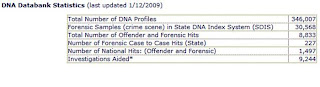
The Times article discusses the reasons for and against this new policy. Proponents view partial DNA matching as giving officers one more piece of evidence to help them with unsolved crimes. The New York deputy secretary for public safety and the chairwoman of the Commission on Forensic Science, Denise E. O’Donnell said, “You could have a horrific crime – a serial rapist or killer – and you could have a clue in a lab that could identify the killer or rapist that we’re currently not allowed to use”. Opponents believe that the practice violates a person’s right to privacy and that the practice is overbroad and can lead to innocent people being treated as suspects.

The use of DNA profiles has led to the practice of issuing so-called John Doe warrants or no-name warrants getting around statute-of-limitation issues. See the FindLaw article DNA and Cold Cases: Indicting John Doe. This week, the California Supreme Court upheld the rape conviction of Paul Robinson, who was arrested one month after the expiration of the six-year statute of limitations. The justices, in a 5-2 decision, said an arrest warrant without Robinson’s name but with his DNA profile issued before the expiration is valid.

This post has no comments.
01/27/2010
profile-icon BLS Reference Desk

According to ABA statistics, half of all law school graduates are women and have been since 1992. Yet it seems that, in the legal profession, women, as a group, have a “problem.” The traditional power dynamic where men teach and women learn, and men are superior and women subordinate, still survives and women do not have equality in terms of the gender break-down of judges, partners and senior attorneys. A Law.com article N.Y. State Bar Revises All-Male Panel on Women in Law reports that, faced with a call for a boycott of a discussion at its annual meeting, the New York State Bar Association revised its plans to have a panel of “distinguished gentlemen” expound on the “strengths and weaknesses” of women in the legal profession. The Committee on Women in the Law planned to sponsor a day-long program for female lawyers, beginning with a panel titled “What’s Our Problem: Current Issues Facing Women,” with a group of female attorneys discussing practicing law in a changing legal market. Immediately afterward was to be another panel “Their Point of View: Tips From the Other Side,” in which a “distinguished panel of gentlemen” were to opine on the strengths and weaknesses of women’s legal work.

After a threatened boycott from female attorneys, the Bar Association scrapped the all-male feature. Among the women lawyers expressing their disapproval was Brooklyn Law School Professor of Law Anita Bernstein who objected to the description of the panel and its all-male composition saying “The notion of men evaluating women to ask whether they are good enough is just too familiar for women lawyers. I don’t think they intended to make women ‘the other’ and ask whether they were good enough, but that was the reading that one could make of it.” The well-intentioned panel, with members who would have likely offered great advice on how to succeed, showed a lack of awareness that having a group of men tell an audience of women how to succeed reinforces the idea that lawyering is a man’s job and that it reinforces the falsehood that female attorneys are somehow not as good as their male counterparts.

This post has no comments.
01/26/2010
profile-icon BLS Reference Desk

The ABA Journal’s story titled Exclusive: Inside the New Westlaw, Lexis & Bloomberg Platforms discusses the new research interfaces for Westlaw and LexisNexis The New Lexis platform is expected some time later this year. WestlawNext – the public name for Cobalt – is due February 1. Some of the New Lexis’ features cited in the article include: 
 

  • no more Boolean search; natural language only with an algorithm boosted by artificial intelligence to help get the most relevant information;
  • results broadened beyond Lexis’ own proprietary databases to include relevant open source legal information from across the Web;
  • results page is dramatically revamped, to include folders along the margins containing categories of relevant results, such as cases, statutes, and regulations;
  • pop-up preview panes containing summaries when you hover over a result and integrated Shepherd’s results for each case;
  • graphical presentation of Shepherd’s results and the history and timeline of cases;
  • collaboration tools and the ability to store results in folders for later use;
  • productivity tools to assist in evaluating the strength of a case, the costs, and potential value to lawyer and client.

WestlawNext will have similar features, using a simple search box for a natural language query that does not require identifying a desired database up front. West has not decided yet to drop Boolean searching Searches can filter results by jurisdiction, type of content and other factors The service will allow bookmarking of favorite databases. KeyCite will also be incorporated directly into the results. There will be similar collaboration features, such as saving work in folders by client. Researchers can use these folders to review their own search history. West also will incorporate some editing features, such as highlighting and noting on cases.

Bloomberg Law is in the process of being tested in a small number of law firms and schools, including Brooklyn Law School. While there are noted limitations in the beta version with respect to the scope of accessible materials, testers are giving the product high marks for intuitiveness and ease of use. Plus, a docket search feature distinguishes Bloomberg from Westlaw and LexisNexis.

The Big Three legal research databases are blending their vast information resources with slick, modern interfaces and productivity tools. These databases will however face strong competition now that free Google offers a viable option especially as legal professionals look to minimize costs.

This post has no comments.
01/26/2010
profile-icon BLS Reference Desk

In 2009, Brooklyn Law School (BLS) launched BLSConnect. It has quickly become the primary means of communication with our internal community of students, faculty, and staff.

BLS Connect is the Brooklyn Law School intranet. It provides easy access to campus e-mail, announcements, registration for classes, grades, financial aid accounts, career and library resources. BLS Connect keeps the BLS community connected and informed about every aspect of campus life.

On January 26, 2010, Jason Buschel has been named BLSConnect Program Administrator. Jason Buschel joined BLS in August 2005. He has worked in the Office of the Resigtrar as the Student Database Information & Faculty Evaluations Student Data Specialist. Buschel holds a B.A. in English from The University of Vermont.

According to Joan G. Wexler, Joseph Crea Dean and Professor of Law, “Buschel will work with members of the BLS community to ensure that the information on the portal is both current and displayed in a way that is most useful to everyone. He will also work on implementing additional features over time.”

Please connect Buschel with any suggestions or with problems you have encountered. Lloyd Carew-Reid will continue to train personnel on the use of the portal, and you should continue to contact Carew-Reid for advice.

This post has no comments.
01/22/2010
profile-icon BLS Reference Desk

Listen to this episode on BrooklynWorks. 

This podcast features Michael Pope, Brooklyn Law School’s Class of 2010 who recently received an Equal Justice Works Fellowship to provide civil legal representation to New York’s indigent youth reentering society after a criminal or juvenile delinquency conviction. The conversation explains how the Community Youth Reentry Project will work. The New York law firm of Morrison and Foerster LLP will sponsored the project which is hosted by Youth Represent, founded and directed by Laurie Parise, Class of 2004. While Pope and Parise spent a great deal of time and effort developing the project, Brooklyn Law School Professors Michael Cahill, Susan Herman and Cynthia Godsoe and Elizabeth Kane, director of public service programs, provided much needed support and guidance. To read more about the project, see the BLS New & Events page announcing this year’s Award of the Equal Justice Works Fellowship.

This post has no comments.
01/16/2010
profile-icon BLS Reference Desk

The Google Public Policy channel has released Google D.C. Talk: ACTA—The Global Treaty That Could Reshape the Internet, moderated by Washington Post consumer technology columnist Rob Pegoraro on the Anti-Counterfeiting Trade Agreement (ACTA) which will have profoundly shift US policy on enforcement of copyright law. The participants in the debate were Steven J. Metalitz, a lawyer and lobbyist representing the International Intellectual Property Alliance; Jamie Love, an activist with Knowledge Ecology International; Jonathan Band, a lawyer representing a coalition of library groups and a variety of tech and Internet companies and Ryan Clough from Silicon Valley Congresswoman Zoe Lofgren’s office.

The panel addresses important questions: Will ACTA preserve the existing balance in intellectual property laws, providing not just enforcement for copyright holders but also appropriate exceptions for technology creators and users? Will it undermine the legal safe harbors that have allowed virtually every Internet service to come into existence? Will it encourage governments to endorse “three strikes” penalties that would take away a user’s access to the Internet? 

This 90 minute video will be of interest to anyone interested in the future of copyright law. A posting at BoingBoing by Cory Doctorow, former European director of the Electronic Frontier Foundation, has a number of observations about substantive questions of law, jurisdiction, economics and ethics raised in the ACTA debate stating that ACTA is a profoundly undemocratic undertaking with the public frozen out of the debate. Also worth reading is commentary at Techdirt by Mike Masnick who was present at the debate.

This post has no comments.
01/13/2010
profile-icon BLS Reference Desk

The US Supreme Court’s 5-4 decision in Hollingsworth vs. Perry, denying Chief U.S. District Judge Vaughn Walker’s plans to televise the Proposition 8 trial, is worth reading for a number of reasons. The opinion acknowledges that the question whether courtroom proceedings should be broadcast has prompted considerable national debate and that reasonable minds differ on the proper resolution of that debate and on the restrictions, circumstances, and procedures under which such broadcasts should occur. While the per curiam decision prevents Judge Walker’s plans for transmission of the proceedings of the case to five other federal courthouses located in Seattle, Pasadena, Portland, San Francisco, and Brooklyn, (and also, on a delayed basis, to allow the video to be posted on YouTube) it does so on procedural grounds stating that is does not “express any views on the propriety of broadcasting court proceedings generally”. The opinion lays out some interesting procedural aspects of the case. For example, page 3 of the opinion states: “The State of California declined to defend Proposition 8, and the defendant-intervenors (who are the applicants here) entered the suit to defend its constitutionality.” While the decision takes pains to side step the controversy, it makes references to claims by the proponents of Proposition 8 that a televised trial would subject them to harassment. For example, at pages 2 to 3, the decision addresses the concerns of the proponents of Proposition 8:

Its advocates claim that they have been subject to harassment as a result of public disclosure of their support. For example, donors to groups supporting Proposition 8 “have received death threats and envelopes containing a powdery white substance.” Some advocates claim that they have received confrontational phone calls and e-mail messages from opponents of Proposition 8 and others have been forced to resign their jobs after it became public that they had donated to groups supporting the amendment. Opponents of Proposition 8 also are alleged to have compiled “Internet blacklists” of pro-Proposition 8 businesses and urged others to boycott those businesses in retaliation for supporting the ballot measure. And numerous instances of vandalism and physical violence have been reported against those who have been identified as Proposition 8 supporters (citations omitted).

Pages 15-16 of the opinion make reference to the fact that the SDNY and the EDNY allow trials to be broadcast, see Civ. Rule 1.8 (SDNY 2009); Civ. Rule 1.8 (EDNY 2009), but that they recognize that a district judge’s discretion to broadcast a trial is limited. See also Second Circuit Guidelines for Cameras in the Courtroom. Opinions on the propriety of broadcasting court proceedings fill the blogosphere. For example, at Above the Law, David Lat offers support for the idea in his post Cameras in the Prop 8 Courtroom: Why Not?.

The discussion has been ongoing for years as evidenced by Brooklyn Law School Library’s collections with titles such as TV or Not TV: Television, Justice, and the Courts by Ronald L. Goldfarb (Call # KF8725 .G65 1998) with chapters The trial of the century; The free press, the fair and public trial: a constitutional conundrum; Cameras in the courts: the experiment; A thing observed, a thing changed: what is the impact of television on trials? The crucible: court TV; Conclusion: TV or not TV.


See also Cameras in the Courtroom: Television and the Pursuit of Justice by Marjorie Cohn and David Dow (Call #KF8725 .C63 1998).


Judge Alex Kozinski, in his letter dated January 10 defending the Ninth Circuit pilot program for TV broadcasting, may have summed up the argument best by writing “”Like it or not, we are now well into the twenty-first century, and it is up to those of us who lead the federal judiciary to adopt policies that are consistent with the spirit of the times and the advantages afforded us by new technology. If we do not, Congress will do it for us.” In fact, in the last session of Congress, Sen. Grassley and Sen. Schumer introduced the Sunshine in the Courtroom Act of 2009 to authorize the televising to the public of court proceedings. A Congressional Research Service Report entitled Televising Supreme Court and Other Federal Court Proceedings: Legislation and Issues discusses the issue at length.

This post has no comments.
01/13/2010
profile-icon BLS Reference Desk

With the launch of Brooklyn Law School’s new website this past fall, came new and improved ways of searching and accessing the library’s broad array of resources.  These new search capabilities, which include the ability to search across databases for both journal titles and articles, help to make research more efficient.

One new enhancement is the ability to search for an electronic version of a journal across all of the library’s subscription databases.  To do so, click on the E-Journals link from the library’s main page.  By doing so, you are taken to the E-Journal Portal.  From this page, you can type the title of a journal in the search box and find a list of the different databases which publish that journal, along with the coverage dates.  For example if you were to search for the title, Tobacco Control, your result list will show you that the databases, PubMed Central, JSTOR, Health and Wellness Resource Center, Health Reference Center Academic and Proquest Central carry the title.  You will also see the coverage dates for the various databases.  For example, JSTOR contains issues of Tobacco Control dating from 1992 to 2005.  This new search capability will aid those researchers who need to cite check.

Besides being able to search for journal titles across the library’s electronic resources, researchers can search all of the library’s electronic resources for citations, abstracts, full text articles, and records in the library’s catalog.  This new “360° Search” allows a researcher to further sort their results by date, author, title or source.  It also gives users the ability to refine their search by a pre-populated list of topics, by date, by journal title or by author.  To access the “360° Search,” go to the library’s main page and click on the hyperlinked text, “multiple BLS databases,” which is located near the top of the page, under the “Cross Searching” heading.   This great new tool is a one stop shop that simplifies and consolidates the process of research.   For example, if you were to do a keyword search for “’regional greenhouse gas initiatives’ or RGGI” combined with a subject search for “climate change”, you receive 209 results.  You can then refine your search by one of the topics provided, such as “Auction” which then limits your results to 36 hits from a variety of databases including Proquest Central, LegalTrac, Business and Company Resource Center, and Custom Newspapers.  This is a much more thorough and efficient way to research rather than searching within each individual database to determine what it contains on a given topic.

This post has no comments.
01/12/2010
profile-icon BLS Reference Desk

Listen to this episode on BrooklynWorks.

A recent post at Simple Justice titled Haiti: No Call For Lawyers laments the limited role that lawyers can play when disaster strikes, offering the observation “Notice how important Doctors Without Borders is in a disaster. Notice there is no Lawyers Without Borders?” Observing that emergent desperation calls for certain abilities, the post states that lawyers cannot offer the help that people need in their desperation, whether it is in easing their pain, feeding the hungry children or building them shelter. Simply stated, the lawyer’s skills are limited in the midst of catastrophes like those in Haiti. While the WSJ Law Blog has a post called BigLaw (Still) Stepping Up on Haiti Aid, most of that aid has come in the form of donations to organizations like Doctors Without Borders and the American Red Cross.

For a different view of what lawyers can do to help with human tragedies, see the article by Michael Boyajian on the NY political blog called Room Eight which tells how one graduate of Brooklyn Law School is making a difference. The article, Brooklyn Attorney Helps Forgotten Victims of the Haitian Earthquake, describes the efforts of Thomas K. Small, Class of 1993, to work with Portlight Strategies to meet the specific needs of underserved, unserved and forgotten victims of the quake, the disabled.

T.K. Small operates a law office in Brooklyn Heights. He specializes in helping people with disabilities, whether receiving homecare under the Medicaid program or gaining access to governmental services or public entities. His motto, “Think Big, Call Small”, comes from his own personal experience fighting for his own rights as a disabled person with Muscular Dystrophy which might easily have led to a life in a nursing home. Instead, T.K. wanted to go to college and, although he was accepted into Hofstra University, he was denied admission to the dorms because of the medical device on his back. Instead of suing Hofstra, T.K. attended SUNY Farmingdale and went on to SUNY Albany eventually graduating from Long Island University’s Brooklyn campus and later from Brooklyn Law SchoolAs Boyajian notes in his article about T.K., “Rather than make the big bucks as a corporate attorney T.K. choose to help those in need. He is famous in Brooklyn for helping to get wheelchair lifts installed on MTA buses. He did this with some friends also in wheelchairs who blocked one downtown Brooklyn street in the 1990s with their chairs bringing rush hour traffic to a grinding halt. Soon after, lifts were installed on MTA buses. . . In other instances though people will tell him that he is a miracle and heroic and that is the contrasts T.K. lives within his most fulfilling of lives.”

TK stopped by the library to have a conversation about his efforts on behalf of Haitians with disabilities during the current crisis there. He also talked about his practice on behalf of the disabled as well as his radio program on WBAI called The Largest Minority. He plans to participate in the Haitian Relief effort organized by BLS students scheduled for February 18.

This post has no comments.
Field is required.