The Brooklyn Law School logo

BLS Library Blog

Showing 10 of 15 Results

07/30/2010
profile-icon BLS Reference Desk

If you are an incoming first year student, the reference librarians and the entire library staff look forward to meeting you in August.

You should have received in the mail an envelope from the BLS Admissions Office which includes your Lexis activation code and your Westlaw password.  Lexis and Westlaw are the two major legal databases that you will have access to as law students.  There will be many other databases available to you as BLS students, but more about those when you get here!

Please make sure you register your Lexis activation code and your Westlaw password before school begins.  The registration instructions were included in the mailing you received, as well as some basic information about both systems.  You will be introduced to Lexis and Westlaw by your legal writing instructors, but the reference librarians will give you a “peek” at both systems during your orientation sessions. 

If you are an incoming first year student and did not get your Lexis and Westlaw numbers in the mail for some reason, please stop by the first floor library reference desk and we will assist you.  See you soon!

This post has no comments.

Legal researchers interested in UK legislation now have a new online tool as the UK government has launched a website with public access to UK legislation dating back to 1267 providing 743 years of legislation (with a few exceptions) in one database. The new website of the National Archives, the UK government’s official archive, brings together every single piece of UK legislation, from the Magna Carta (1215) to the present day, in one place for the first time free of charge. With 6.5 million PDF documents and original versions of UK legislation covering England, Scotland, Wales and Northern Ireland along with details of any amendments, the site provides an interactive browse facility and timeline.

Oliver Morley of the National Archives described the launch of the site as “a bold statement of transparency”. He said: “By using the latest technology and opening up the raw data underpinning legislation.gov.uk, The National Archives has given global access to the nation’s ‘operating system’. I’m proud to say this website is the only example of its kind in the world. It provides access to an invaluable and historical resource for anyone wanting to know what the law actually says.”

A post at the Resource Shelf has answers to FAQs about the site. Going back to the 13th century, the site makes if easy to view historical Acts of Parliament, such as the Act of Union in 1707, the Libraries Offences Act 1898 and the Public Records (Scotland) Act 1809. New legislation such as the Criminal Procedure (Amendment) Rules 2010 is included along with the archived material.
This post has no comments.
07/28/2010
profile-icon BLS Reference Desk

The 21st Annual Public Interest Career Reception takes place on Wednesday, September 1, 2010 from 6:00 – 8:30 p.m. at the New York City Bar Association, 42 West 44th Street, New York, NY, between 5th and 6th Avenue. The Reception is co-sponsored by twenty law schools in New York, New Jersey, Connecticut and Pennsylvania, including Brooklyn Law School.

Employers are expected to bring materials about their organizations. The format of the Reception is informal with tables set up for representatives of employers to talk about their work. First, second, third-year and fourth year evening students, LL.M. students, as well as alumni are welcome to attend. Employers who plan to attend are asked to RSVP by Friday, August 6th by clicking on the “Register” button at the Fordham Law School website and filling out the form found there.

Students can register at the door on arrival and do not need to register ahead of time. For more information contact Albilda Hernandez at (212) 636-6952 or by emailing her at ahernadez@law.fordham.edu. According to her, last year there were 79 Public Interest Employers that attended the reception. This year, those who have already RSVP’d are:

ACLU Women’s Rights Project
Advocates for Children of New York, Inc.
American University Washington College of Law
ATF – Bureau of Alcohol, Tobacco, Firearms and Explosives
Brennan Center for Justice
Bronx County District Attorney’s Office
Catholic Charities Community Svc
Children’s Rights
City Bar Justice Center
Civilian Complaint Review Board
Consumers Union
Essex-Newark Legal Services
FDIC
Federal Bureau of Prisons
Global Justice Center
HUDSON RIVER PARK TRUST
Human Rights Watch
LATINOJUSTICE PRLDEF
Legal Information for Families Today
Legal Outreach
Legal Services NYC
Legal Services NYC – Bronx
Legal Services of the Hudson Valley
Local Initiatives Support Corporation
Medicare Rights Center
National Advocates for Pregnant Women
Neighborhood Defender Service
New Jersey Judiciary
New Jersey Office of the Attorney General, Division of Law
New York City Fire Department
New York City School Construction Authority
New York Civil Liberties Union
New York County District Attorney’s Office
New York Lawyers for the Public Interest
New York Legal Assistance Group
New York State Division of Human Rights
NJ State Judiciary
NY County Defender Services
NYC Department of Social Services
NYC Dept. of Buildings
NYLAG
NYPD Legal Bureau
NYS Attorney General’s Office
Office of Attorney Recruitment & Management
Pro Bono Partnership
Public Defender Service for the District of Columbia
SAFE HORIZON Domestic Violence Law Project
Sanctuary for Families’ Center for Battered Women’s Legal Services
The Door – A Center of Alternatives, Inc.
The Legal Aid Society
U.S. Department of Justice
U.S. Nuclear Regulatry Commission
UN Employment Information & Assistance
United States Postal Service
Urban Justice Center, Mental Health Project
US EEOC

This post has no comments.
07/26/2010
profile-icon BLS Reference Desk

On July 26, 1990, the Americans With Disabilities Act of 1990 became law when President George H.W. Bush signed the bill enacted by Congress enacting Public Law 101-336. On September 25, 2008, President George W. Bush signed into law the ADA Amendments Act of 2008 (ADAAA). Congress passed the ADAAA to give broader protections for disabled workers and “turn back the clock” on court rulings which Congress deemed too restrictive. These included Sutton v. United Air Lines, Inc., 527 U.S. 471 (1999), which narrowed the broad scope of protection intended to be afforded by the ADA, and Toyota Motor Manufacturing, Kentucky, Inc. v. Williams, 534 U.S. 184 (2002), which further narrowed the broad scope of protection intended to be afforded by the ADA.

The ADA’s mission is to “make it possible for everyone with a disability to live a life of freedom and equality.” This video from the ADA National Network features Dr. Temple Grandin and others discussing the importance of this landmark legislation. 

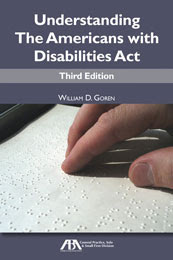
The Brooklyn Law School Library has in its collection several titles on the subject of the Americans with Disabilities Act of 1990 including Understanding the Americans with Disabilities Act by William D. Goren, 3d ed. (Call #KF480.G67 2010) with these chapters: Concepts underlying the ADA and key definitions — Essential functions of the job — Concept of undue hardship and reasonable accommodation in the employment context — Treatment of alcoholics and drug addicts — Pre-employment medical exams/disability-related inquiries — The ADA, health insurance, and the Genetic Nondiscrimination Act — ADA and the public sector (Title II of the ADA) — Places of public accommodations and commercial facilities — The ADA and the health care provider — The interrelationship between the ADA and other laws — Remedies and procedural issues — ADA and sports — Hot areas — Are you ready to rock and roll with your ADA case?

This post has no comments.
07/25/2010
profile-icon BLS Reference Desk

Although school is out for most students, it is wrong to think that school is out for your librarians. In fact, the summer months are busier than ever for your crackerjack library staff. We spend the summer getting it all ready for everyone to return to school in the fall, students and faculty. It is called planning ahead – and it encompasses hours spent at conferences, local educational sessions, meetings with librarians at firms and other schools, and getting to know the research agendas for other faculty members at Brooklyn Law School.

Many of our professional conferences are held in the summer to accommodate academic summer schedules and the usual slow down in business at firms and court libraries. The two major conferences that BLS Librarians attend in the summer are the Computer Assisted Legal Instruction conference (also known as CALI), and the Annual Meeting of the American Association of Law Libraries  (AALL), which typically attracts about 2,000 of our colleagues to a single venue.

Frightening, isn’t it?

We go to professional conferences to hear from our colleagues about new ways they are helping you – our clientele – to discuss products with our vendors (like Westlaw, Lexis, BNA, CCH, and Bloomberg), and, to share our own knowledge with others. For example, Jean Davis spoke at AALL about preparing students to work at clinic offices in foreign venues. This was based on her experience working with BLS students who were doing internships at South Africa and Hong Kong. Kathy Darvil, as a newish law librarian (less than 5 years), is charing a committee to welcome new law librarians into the profession. Interestingly, I have spoken to three BLS grads in the last month about becoming law librarians. I personally moderated a well attended panel discussion on how law firms and academic institutions are going to have to change to meet the economic pressures felt on Main St. (and Wall St.).

We also use this time to do some housekeeping. Just a small sample includes:

  • Associate Director Linda Holmes, along with Acquisitions Librarian Singh and several members of the paraprofessional staff, are painstakingly going through our physical collection to get rid of materials that are no longer relevant or needed. This will free up shelf space, and ultimately study space, for more productive use.
  • Hainan Yu and his staff are replacing workstations in the computer labs to accommodate faster processing speeds and newer Office applications.
  • Jeff Gabel is going through our database subscriptions to ensure we do not violate our copyright restrictions when printing or lending to other libraries.
  • Rosemary Campagna is designing new library maps to help orient our entering class and possibly even our returning students.
  • Librarians Maria Okonska and Karen Schneiderman are experimenting with building mobile applications to allow students and faculty to use library resources easily on their handheld devices.
  • Harold O’Grady built a new online research guide to accommodate his new course on Securities Law research. And of course, all librarians are updating their research guides, contacting faculty members about their research projects, and helping with expanding the library collection to meet your research needs.

Finally, the best thing that librarians are doing is taking a vacation because all of this summer work is exhausting  – and they want to be ready to greet with energy and enthusiasm in August! (VS)

This post has no comments.
07/22/2010
profile-icon BLS Reference Desk

Listen to this episode on BrooklynWorks. 

This podcast features Brooklyn Law School Associate Professor Jonathan Askin who talks about the legal work performed by the Brooklyn Law Incubator and Policy Clinic (BLIP) which Professor Askin began in 2008. In this conversation, he discusses the recent news that the Entertainment Consumers Association (ECA) has drafted BLIP as a contributor to its amicus brief to be submitted to the Supreme Court in the case of Schwarzenegger v EMA. Students from the Clinic will work with ECA and the law firm of Hughes Hubbard & Reed LLP on the brief for the case which the Supreme Court will consider in the fall term.

Professor Askin was recently quoted as saying “It is important to ensure that the rights of both the producers and consumers of video games are guaranteed in this modern day challenge to the First Amendment. We relish this opportunity to help create the best legal understanding at the intersection of law and emerging technology.” In the podcast, he also talks about other types of matters where the Clinic has helped new entrepreneurs.

This post has no comments.
07/20/2010
profile-icon BLS Reference Desk

An article entitled Libraries Reach FY2011—Some Relieved, All Wary in American Libraries, the online magazine of the American Library Association News, reports on recent funding activity for New York area public libraries. To summarize:

  • The New York Public Library staff members averted a catastrophic $37-million budget cut. The NYPL web page says that 130,000 people wrote letters and made phone calls toprotest. The library also received $144,000 in online donations. All of this will allow the library to stay open at least five days a week.
  • Queens Library’s web page gave public thanks to elected officials and supporters alike for restoring $17 million to the budget, thus “making libraries a priority, for ensuring every one of our libraries remains open an average of five days a week.” This means that its 62 libraries will remain open and that it can maintain an average service schedule of five days a week.
  • Brooklyn Public Library still maintains its Keep Your Library OPEN web site in order to avert closure of 16 libraries, severely limited weekend hours, layoffs of hundreds of library staff members and cuts in library materials, free programs and free public computer sessions. Brooklyn Public also had funding restored as noted on its webpage thanking supporters.
  • The New Jersey Library Association praised the budget agreement between Gov. Chris Christie and the legislature restoring $4.299 million restored for library programs.

Researchers at Brooklyn Law School look to many of the print and electronic resources available at the BLS Library. They also look beyond the law library to public libraries for non-legal materials. To imagine life without public libraries, read Jonathan Stock’s article Chambers of the Sea: Who Needs Law Libraries? It’s All Free on the Internet in the July 2010 issue of AALL Spectrum. Stock wrote the article as an allegory after his efforts to help save many of the court law libraries in Connecticut from possible oblivion.

This post has no comments.
07/16/2010
profile-icon BLS Reference Desk

The Federal Trade Commission’s recent report, Repairing a Broken System: Protecting Consumers in Debt Collection Litigation and Arbitration, saying that many consumers face debt collection lawsuits for unpaid bills even though there is scant proof against them, calls for tougher state and federal laws to protect the public. The report also called for safeguards to ensure that consumers do not first learn they have been sued only after a judgment has been recorded against them. The proposed reforms include requiring collection lawsuits to provide crucial information about the alleged debt, including a breakdown of the total amount owed by principle, interest and fees. 

In the current economic downturn, consumer debt collection cases have flooded civil court dockets around the country, according to a NY Times article Automated Debt-Collection Lawsuits Engulf Courts. The article cites the Woodbury, NY law firm of Cohen & Slamowitz as filing some 80,000 lawsuits a year. The firm filed 59,708 cases in 2005, 83,665 in 2006, 87,877 in 2007 and 80,873 in 2008. One of the partners, David A. Cohen is a member of Brooklyn Law School’s Class of 1979. The firm’s 14 lawyers averaged more than 5,700 cases per lawyer because of computer software to help prepare its cases. With debtors selling their uncollectible debt to debt buyers at discounted rates and debt buyers facing non-payment from debtors, the increase in filings is straining the court system. The article states that “Collection law firms are able to handle such large volumes of cases because computer software automates much of their work. Typically, a debt buyer sends a law firm an electronic database that contains various data about consumers, including name, home address, the outstanding balance, the date of default and whether interest is still accruing on the account.”

The article tells of a civil court hearing in Brooklyn in which BLS alum Judge Noach Dear (Class of 1992) demanded documents from Cohen & Slamowitz to support its claim that the defendant owed $3,797.27 in credit card debt. When the firm’s lawyer responded that the only documentation was the Social Security number, date of birth and address, Judge Dear dismissed the case and issued an order requiring, among other things, that Cohen & Slamowitz provide further proof of a debt if a defendant challenged the firm’s claim.

The Brooklyn Law School Library has in its collection several items on the subject of debt collection including Collection Actions: Defending Consumers and Their Assets by Jonathan Sheldon (Call #KF1024 .S54 2008). The item record has a link to the online version of the consumer law manuals companion website. The National Consumer Law Center site has a large number of forms in PDF format including Statutes/Regulations, Federal Agency Interpretations and Pleadings.

This post has no comments.
07/16/2010
profile-icon BLS Reference Desk

Discover the poisons that brought New York City to its knees in “The poisoner’s handbook : murder and the birth of forensic medicine in Jazz Age” by Pulitzer Prize-winning science writer, Deborah Blum.

The heroes of her book are Charles Norris, New York City’s first Medicinal Examiner, and Alexander Gettler, his able assistant and expert toxicologists. From the vantage of the New York City Medical Examiner’s Laboratory, it also becomes clear that murderers are not the only toxic threat–modern life has created a poisonous playground, and danger lurks around every corner.

“The Poisoner’s Handbook” is structured like a collection of linked short stories. Each chapter centers on a mysterious death by poison that Norris and Gettler investigate. Blum also focuses on the real villains – the poisons – and their deadly maneuverings through the body.

The chapters detail Norris’ death investigations and are classified according to the chemical compound detected in corpses by Gettler. Described are a suite of deadly substances including chloroform; bad booze because of Prohibition; industrial toxins such as radium; and carbon monoxide from illumination gas and automobile exhausts. In each chapter It is a contest between murder suspects and Gettler’s laboratory methods, which improved markedly during the decade.

Each case presents a deadly new puzzle and the need to create revolutionary experiments to tease out the wiliest chemical compounds from human tissue and perform trailblazing chemical detective work. Blum sets forth the facts of such cases, attentive to chemical clues the suspect overlooked but Gettler didn’t. Formative figures in forensics, Norris and Gettler become fascinating crusaders in Blum’s fine depiction of their work in the law-flouting atmosphere of Prohibition-era New York.

The fruits of their labors helped advance government policy and the science of forensics, and have saved countless lives from exposure to previously hard-to-detect toxic substances like thallium and to the then unknown deadly effects of radium, once a crucial ingredient in a popular health tonic called “Radithor: Certified Radioactive Water.”

According to the New York Times, “there is no music in Blum’s “Jazz Age,” a descriptor that feels tacked on to the subtitle by the marketing department, but there are “jazz-flavored cocktails” aplenty. After all, it’s Prohibition, and the government’s efforts to make alcohol less desirable by adding poisons to it constitute one of her most alarming and worthy plots. In this woozy speakeasy atmosphere, unforgettable stories abound. Take “Mike the Durable,” who initially survives even after his killers try numerous ways to do him in. There is also the lovers Ruth Snyder and Judd Gray, who inspired James M. Cain’s novels “The Postman Always Rings Twice” and “Double Indemnity.” Ultimately, “The Poisoner’s Handbook” fascinates.”

This post has no comments.
07/14/2010
profile-icon BLS Reference Desk

On the eve of Bastille Day and the 220th anniversary of la Fête de la Fédération, the 557-seat French National Assembly adopted a bill prohibiting the concealment of the face in public. The bill does not single out Muslims, but it is seen as a way to combat religious extremism. The proposal would fine women the equivalent of $185 for wearing the veil in public or make them do community service. Those who oppress women and make them wear the veil could face a fine of up to $38,000 or up to one year in prison – double if the woman is a minor.

While the vote was nearly unanimous (335 to 1), the proposal has opposition as 241 members abstained, mostly the opposition Socialist, Communist and Green parties, who oppose women wearing the full veil, but do not see legislation as a solution. Last year, some members of parliament called for a commission to investigate whether the veil undermined French values. The bill moves to the French Senate where it is expected to have no opposition when it hold its vote in September. Once signed by President Nicolas Sarkozy, the ban would take effect next spring. Last year, Sarkozy said that the burka was “not welcome” in France and that it was “not a sign of religion but a sign of subservience.” The comments provoked a public reaction that showed widespread support for a ban on both the burka, an enveloping outer garment, and the niqab, or face covering. Muslim groups, however, complained that such a ban would stigmatize all members of their religion.

The bill, available at the French National Assembly website, reads in part:

No person may, in public, wear clothing designed to conceal his face.
Public space is made up of public roads and places open to the public or engaged in a public service.
The prohibition does not apply if the conduct is required or permitted by law or regulation, whether it is justified by reasons of health or professional reasons , or if it is part of sporting activities , festivals or artistic or traditional.
The failure of anyone to impose one or more other persons to conceal their faces by threat, violence, coercion, abuse of authority or abuse of power, because of their sex, is punishable by imprisonment for one year and €30,000 fine. Where the act is committed against a minor, the penalty is increased to two years imprisonment and a €60,000 fine.

The ban has strong public support but critics, according to an Al Arabiya report, say the law exploits a non-problem (only about 1,900 women among France’s five to six million Muslims wear a veil) in a bid to pander to anti-immigration voters and to distract attention from France’s economic woes. With questions on the ban’s constitutionality, the ruling Union for a Popular Movement party has agreed to send the eventual final version of the legislation to the Constitutional Council watchdog. A further challenge could occur from the European Court of Human Rights in Strasbourg, France. Amnesty International has said the law “violates rights to freedom of expression and religion.” 

The French National Assembly vote could set a precedent for other European countries. Earlier this year, the Belgian lower house voted 136-0 to approve a bill that would ban the burqa and other full face veils in public. Britain and Spain are considering similar legislation as is the European Parliament. See the report in Jurist for other jurisdictions currently debating legislation to ban the burqa. Support for such a ban is far higher in Europe than in the US, where 28% of the public would approve it, according to a Pew Global Attitudes Project poll, compared with 82% in France and 62% in Britain. A Europe-wide trend reacting to the growing Islamic presence resulted in the Swiss electorate voting to outlaw minarets last year.

This post has no comments.
Field is required.