The Brooklyn Law School logo

BLS Library Blog

Showing 10 of 14 Results

Congress has not enacted the Military Readiness Enhancement Act in the House and Senate version of bills (H.R. 1283 and S. 3065) to repeal Don’t Ask, Don’t Tell and replace it with a policy of nondiscrimination on the basis of sexual orientation. Instead, it will address the issue as part of the larger National Defense Authorization Act for Fiscal Year 2011 in H.R. 5136 and S.3454. The issue of gays in the military is very much in the news as today marks the 17th anniversary of the passage of the National Defense Authorization Act for Fiscal Year 1994 (P.L. 103-160). Subtitle G (Policy concerning homosexuality in the armed forces) of that law is codified at 10 U.S.C. § 654. The history of the passage of the current law is more fully described in an item in SARA, Brooklyn Law School Library’s catalog, a recent Congressional Research Service report called “Don’t Ask, Don’t Tell”: The Law and Military Policy on Same-Sex Behavior by David F. Burrelli. Today the Pentagon released its Report of the Comprehensive Review of the Issues Associated with a Repeal of “Don’t Ask, Don’t Tell”.

“Don’t Ask, Don’t Tell“, which is not the name of the law, is the policy proposed by Bill Clinton during the 1992 presidential campaign to lift the ban on gays in the military. Opponents of gays in the military including senior military officials were successful in defeating President Clinton’s proposal by including Section 654 which bipartisan majorities in Congress passed in 1993 and President Clinton signed into law on November 30, 1993. Opponents prefer to call the law “The Military Personnel Eligibility Act of 1993.” See Statement of Elaine Donnelly, President of the Center for Military Readiness (CMR), an anti-gay group opposing changes to Section 654. Among the board members of CMR is noted American conservative activist Phyllis Schaffley.


The “Don’t Ask, Don’t Tell” policy is not contained in any Presidential Executive Order but is implemented by two Department of Defense Directives: DoD Instruction 1332.14 (“Enlisted Administrative Separations”) and 1332.30 (“Separation of Regular and Reserve Commissioned Officers”). These directives stopped the military from asking about sexuality in recruitment forms and interviews but did not stop investigations into whether those serving in the military were gay. According to the Servicemember’s Legal Defense Network, an advocacy organization for LGBT military personnel, the Pentagon has dismissed more than 12,500 service members because of their sexual orientation since 1994. 

This post has no comments.
11/21/2010
profile-icon BLS Reference Desk

A recently revised Congressional Research Service report dated October 27, The Bush Tax Cuts and the Economy by Thomas L. Hungerford, states a higher total cost of permanently extending all of the Bush tax cuts to $5.048 trillion over the next ten years. The revised amount is significantly higher than the $2.8 trillion figure CRS reported in September as the new report takes into account the cost of servicing the debt due to lost revenue and indexing the alternative minimum tax (AMT) to inflation. See chart below for details:

The September CRS report explained the details of the Bush tax cuts enacted in 2001 and 2003 and the effects of their expiration on the economic recovery in a summary which reads in part:

A series of tax cuts were enacted early in the George W. Bush Administration by the Economic Growth and Tax Relief Reconciliation Act of 2001 (EGTRRA; P.L. 107-16) and the Jobs and Growth Tax Relief Reconciliation Act of 2003 (JGTRRA; P.L. 108-27). These tax cuts, which are collectively known as the Bush tax cuts, are scheduled to expire at the end of 2010. Beginning in 2011, many of the individual income tax parameters (such as tax rates) will revert back to 2000 levels. The major tax provisions in EGTRRA and JGTRRA that are part of the current debate over the Bush tax cuts are the reduced tax rates, the reduction of the marriage penalty (and increase in the marriage bonus), the repeal of the personal exemption phaseout and the limitation on itemized deductions, the reduced tax rates on long-term capital gains and qualified dividends, and expanded tax credits. This report examines the Bush tax cuts within the context of the current and long-term economic environment. . . . . The Obama Administration has proposed allowing the Bush tax cuts to expire for high income taxpayers and permanently extending the tax cuts for middle class taxpayers. Compared to permanently extending all of the Bush tax cuts, this proposal is projected to increase tax revenues by $252 billion over five years and by $678 billion over 10 years, but still leaves federal debt on an unsustainable path. A temporary extension of the Bush tax cuts could provide time for Congress to consider tax reform and also provide a deadline to complete deliberations. Furthermore, allowing the tax cuts targeted to high income taxpayers to expire as scheduled could help reduce budget deficits in the short-term without stifling the economic recovery.

This post has no comments.
11/19/2010
profile-icon BLS Reference Desk

I have created a new web guide: UN Legal Research Starting Points.

On the main page of this guide, I link to newly released UN documents from the feed: UN Pulse. Examples of  recently available documents include: the UNCTAD-JETRO report, International Trade After the Economic Crisis: Challenges and Opportunities, and the UN-World Bank report, Natural Hazards, Unnatural Disasters: The Economics of Effective Prevention.

On the main page of this guide, I also link to databases of UN documents, such as UNBISnet and the UN’s Official Documents System. These two databases are good sources of UN masthead documents and resolutions.  UNBISnet also provides voting records for UN General Assembly and Security Council resolutions and an index to speeches.  TIP: Use UNBISnet to research by topic.  UNBISnet offers many search features. UNBIS Thesaurus identifies UN subject descriptors that researchers can use to when searching for documents in UNBISnet.  Neither UNBISnet nor Official Documents System provides a complete online archive of UN documents from 1945-present.

Often, the best source of UN documents is the website of the UN body that authors, or publishes, the documents.  The UN’s international law page links to websites of UN law-related bodies.  There is no UN website that allows researchers to comprehensively search decisions of multiple UN-related courts and tribunals. TIP:  On-campus or off-campus through the BLS proxy server,  search Oxford Reports on International Law and Max Planck Encyclopedia of Public International Law to identify decisions of UN-related courts and tribunals. UN legal news sources also highlight recent decisions.

Below is one of the library’s newest books about the United Nations:

Feel free to ask me for help in locating UN documents, Jean Davis

This post has no comments.
11/19/2010
profile-icon BLS Reference Desk

The 147th anniversary of the Gettysburg Address is as good a time as any to reflect on the 273 words (more or less, depending on the version) in the speech that Abraham Lincoln gave at the dedication of the Soldiers’ National Cemetery at Gettysburg, PA on November 19, 1863. With more than 7,500 killed, Gettysburg became hallowed ground in that crucial engagement. The speech took a mere two minutes to deliver but these eloqent words still resound today:

Four score and seven years ago our fathers brought forth on this continent, a new nation, conceived in Liberty, and dedicated to the proposition that all men are created equal.

Now we are engaged in a great civil war, testing whether that nation, or any nation so conceived and so dedicated, can long endure. We are met on a great battle-field of that war. We have come to dedicate a portion of that field, as a final resting place for those who here gave their lives that that nation might live. It is altogether fitting and proper that we should do this.

But, in a larger sense, we cannot dedicate — we cannot consecrate — we cannot hallow — this ground. The brave men, living and dead, who struggled here, have consecrated it, far above our poor power to add or detract. The world will little note, nor long remember what we say here, but it can never forget what they did here. It is for us the living, rather, to be dedicated here to the unfinished work which they who fought here have thus far so nobly advanced. It is rather for us to be here dedicated to the great task remaining before us — that from these honored dead we take increased devotion to that cause for which they gave the last full measure of devotion — that we here highly resolve that these dead shall not have died in vain — that this nation, under God, shall have a new birth of freedom — and that government of the people, by the people, for the people, shall not perish from the earth.

This video from the Library of Congress explains more about the speech. 

A related law review article, C. Steven Bradford, The Gettysburg Address as Written by Law Students Taking an Exam, 86 Nw. U. L. Rev. 1094 (1992), is timely as Brooklyn Law School students begin the reading and exam period after the Thanksgiving break. The classic exam mistakes that Prof. Bradford lists in his parody offer a little study break reading. The article is available on HeinOnline.

This post has no comments.
11/19/2010
profile-icon BLS Reference Desk

Many of us have a smart phone or hope to get one as a gift (hint).

Here are some legal research and reference applications that might interest you.  Smartphones have different operating systems, so an application that works on an iPhone will not work on a BlackBerry, Android phone, Palm Pre and Windows mobile device.  Since Apple’s iPhone and its App Store opened the doors to mobile legal research applications, this article only features iPhone applications.

Before We Begin: User Input Requested

If you are aware of any legal research mobile apps for BlackBerry, Android phone, Palm Pre and Windows mobile please leave a comment with the information. Also let us know about other iPhone legal research apps  not listed in this article. Finally, we would like to know your user experience with these list apps or any other legal research apps —  Thanks. 

Law Dictionary

West, part of Thomson Reuters, offeres through the iPhone App Store the eighth—and most recent—edition of Black’s Law Dictionary ($49.99).

A free iPhone alternative is Nolo’s Plain English Law Dictionary.

United States Constitution

The iPhone offers a free app of the text of the U.S. ConstitutionWaffleTurtle Software also offers a $.99 version that allows you to search the text.

Case Law

Lexis users may be interested in the Get Cases and Shepardize® application for iPhone. Just by entering a citation, users can review this case issues, rules, and reasoning as written by LexisNexis editors. The Shepard’s Signal™ indicators and Shepard’s Summaryis also available. Users must have a a current LexisNexis subscription and valid ID/password to utilize this app.

Another case law app is Fastcase for the iPhone. This free iPhone application provides state and federal case law from all 50 states as well as a comprehensive library of statutes. You can search by citation, keyword (in Boolean or natural language), or browse our statute collections.

Federal Statutes and Rules

Shawn J. Bayern, Assistant Professor at Florida State University, College of Law has created a free iPhone app for the United States Code. This application allows users to search, browse, or use legal citations to find the sections you’re looking for. Users can keep bookmarks, scroll through each chapter of the code as if it’s a book, and email code sections to yourself or others.

Law Stack® from Tekk Innovations LLC a free legal library for your iPhone. LawStack comes preloaded with the United States Constitution, Federal Rules of Civil Procedure, Federal Rules of Criminal Procedure, Federal Rules of Appellate Procedure, Federal Rules of Evidence, and Federal Rules of Bankruptcy Procedure

WaffleTurtle Software offers a variety of searchable legal iPhone apps of the including Federal Rules of Civil Procedure ($2.99); Federal Rules of Bankruptcy Procedure ($2.99); Federal Rules of Appellate Procedure ($2.99); Federal Rules of Criminal Procedure ($2.99); Federal Rules of Evidence ($2.99); and local patent rules from seven federal district courts whose dockets attract great numbers of intellectual property cases.

New York State Resources

Tekk Innovations LLC sales several New York legal resources iPhone apps: Laws of New York ($24.99); New York Code of Criminal Procedure (NY Law) ($5.99); New York Penal Code (NY Law) ($5.99); and New York Vehicle and Traffic Code (NY Law) ($5.99).

This post has no comments.
11/18/2010
profile-icon BLS Reference Desk

Listen to this episode on BrooklynWorks. 

In this podcast, Jameson J. Dempsey, BLS Class of 2011 and Editor-in-Chief of the Brooklyn Law Review, talks about his experience as a member and editor of the oldest student-run legal periodical at Brooklyn Law School. The Law Review celebrated its 75th anniversary earlier this year. The first of the four issues of Volume 76 is set for publication in the next few weeks. Each issue has articles written by legal scholars, practitioners and judges, as well as notes and comments written by student members. Jameson discusses his own student note, A Right of Confrontation for Competition Hearings before the European Commission, 75 Brook. L. Rev. 1489 (Summer 2010), where he addresses implementing a right of confrontation jurisprudence in cartel enforcement proceedings in the European Union. He also offers suggestions for 1Ls who are considering joining one of the law journals at Brooklyn Law School.

This post has no comments.

Questions on statutory research and federal legislative history are among the most frequent at the Brooklyn Law School Library Reference Desk. The library receives Federal public and private laws in “slip” (paper) form and shelves the slip laws chronologically by public or private law number. The slip laws are arranged on the shelves in the Statutory Collection on the second floor. Other print sources include the United States Statutes at Large, 1845- (Stat. – KF 50 U658), the United States Code Congressional and Administrative News (“USCCAN”) (Stat. – KF 48 W45) USCCAN includes the session laws published in United States Statutes at Large, selected reports, Presidential signing statements, and Presidential veto messages, and references to other legislative history materials. It is arranged by public law number. 

There are two commercial codifications of US statutes: (1) West’s United States Code Annotated (Stat. – KF 62 1927 W45) which offers West digest topic and key number references and provides references to West publications such as USCCAN and Corpus Juris Secundum as well as citations to legislative history materials published in USCCAN; and (2) Lexis’ United States Code Service (Stat. – KF62 1972 .L38) which includes annotations from courts, and provides references to Lawyers Cooperative publications such as American Jurisprudence and American Law Reports. The official United States Code (Stat. – KF 62 1994 A2), which does not include annotations from courts, is available on the GPO Access website

Also on the internet are recently enacted laws at THOMAS which includes public laws from the 93rd to the 111th Congresses. The U.S. Government Printing Office Web Site includes public laws from the 104th to the 111th Congresses. To find compiled legislative histories in the BLS Library collection, students can search SARA using Library of Congress Subject Headings for Legislative History Research, for example, Legislative Histories — United States; Legislative Histories — United States – Bibliography. The Bluebook Rules for legislative materials are found in Rule 12 (Statutes) and Rule 13 (Legislative Materials).

Students interested in learning more about legislative history research can register for a Hein Legislative History Webinar taking place on Thursday, November 18 2:00pm to 2:45pm. Registration on the use of Hein’s database materials for conducting legislative histories is free at this site.

This post has no comments.
11/13/2010
profile-icon BLS Reference Desk

Few decisions have generated as much controversy as the ruling in Miranda v. Arizona, 384 U.S. 436 (1966) which relied on the fifth amendment privilege against compulsory self-incrimination to impose limits on custodial police interrogation. Over the years the Supreme Court has made a number of revisions to the Miranda warnings. Last term, the Court placed limits on the Miranda rights in three cases: Berghuis v. Thompkins, (ruling that suspects must explicitly tell police they want to remain silent), Florida v. Powell (allowing police officers to vary the wording of the warning) and Maryland v. Shatzer (allowing a second round of questioning of a suspect who had invoked his rights where two weeks had passed since his release from custody). These rulings will change how police, lawyers and criminal suspects interact and are viewed as an attempt to limit the rights that Americans have become used to since the Court ruling in Miranda.

The Supreme Court is not likely to eliminate the requirement that police officers give suspects a Miranda warning. Jeffrey L. Fisher, co-chair of the amicus committee of the National Association of Criminal Defense Lawyers, has stated that “It’s death by a thousand cuts. For the past 20-25 years, as the court has turned more conservative on law and order issues, it has been whittling away at Miranda and doing everything it can to ease the admissibility of confessions that police wriggle out of suspects.” 

This term, the Court has another opportunity to review the Miranda holding in the case of J.D.B. v. North Carolina after it granted certiorari on November 1. The Court will be reviewing a North Carolina Supreme Court decision that courts should not consider the age of a juvenile suspect in deciding whether he is in custody for Miranda purposes. The case involves a 13-year-old, special education middle-school student whom police interrogated in a closed conference room in connection with a string of neighborhood burglaries.

The Brooklyn Law Library’s most recent New Book List includes The Miranda Ruling: Its Past, Present, and Future by Lawrence S. Wrightsman and Mary L. Pitman (Call #KF9625 .W75 2010). The book examines the state of interrogations and the state of the law before Miranda,, the purposes and nature of the decision, and proposes recommendations for reinstituting the original goals. It examines four problems with the implementation of Miranda and suggests remedies to have it achieve its original purpose.

  • The justices, in placing restrictions of the questioning of suspects, limited these rights only to those suspects who were “in custody” vague to the layperson.
  • The Miranda warnings may not be fully understood by many suspects. There is no standardization of what is said; there are literally thousands of different versions of “the” Miranda warnings in use by different police departments in the United States.
  • Police training manuals, while recognizing the right to a “Miranda warning,” have developed many ways to circumvent giving the warnings or ignoring a response in which a suspect does decide to remain silent or ask for an attorney.
  • In the 40 years since the Miranda law was established, the Supreme Court and lower courts have made decisions eroding their application.

This post has no comments.
11/12/2010
profile-icon BLS Reference Desk

This semester, the Advanced Legal Research at Brooklyn Law School used a fact pattern involving defamation in online blogs as an in-class example to demonstrate research strategies for finding primary and secondary legal sources. Now as the semester is ending, a Spanish language news item from The Press and Society Institute (IPYS) reports that on October 29, 2010, a Peruvian court sentenced journalist and law school graduate José Alejandro Godoy, who runs the blog Desde el Tercer Piso (From the Third Floor), to three years in prison, a fine of $107,000 (300,000 soles) and 120 days of social work for “aggravated defamation” of a politician.

Godoy was convicted for an April posting in which he linked to several media outlets that discussed criminal accusations against former minister and congressman Jorge Mufarech Nemy. Godoy’s blog post criticized Nemy as a political “star” whose “shining achievements” were tax evasion, pursuing favorable treatment for his companies, and negotiating an advantageous agreement with an allegedly corrupt person from the television news business. The court’s opinion justifies the conviction based on the “star” and “shining achievements” wording, rather than the assertions about tax evasion and favors, for which Godoy provided links to journalist reports. The sentence, posted in Spanish on Scribd, has generated political and media criticism and IPYS called the ruling “unconstitutional and without precedent” and without legal merit. 

For more details on the case, see Peru: Blogger Sentenced for Defamation of Former Politician written by Juan Arellano and translated by Stephen Cairns at Global Voices, an international community of bloggers who report on blogs and citizen media from around the world. 

The Brooklyn Law School Library has in its collection Law of the Internet by George B. Delta and Jeffrey H. Matsuura (Call #KF390.5.C6 D45 2009), a two volume set with these chapters: v. 1. Regulation of access, interoperability, and services; Jurisdictional issues in cyberspace; Antitrust; Intellectual property; Copyright; Patents; Trademarks; Privacy; Computer security; v. 2. Defamation; Obscene and indecent materials; Law of electronic contracts; E-business: the digital marketplace; Tax issues and electronic commerce; Export controls; E-government.

This post has no comments.
11/11/2010
profile-icon BLS Reference Desk

In addition to The Bluebook: a Uniform System of Citation, 19th edition (Call #KF245 .B58) and the ALWD Ctation Manual: a Professional System of Citation, 4th edition (Call # KF245 .A45 2010), law students writing seminar papers, journal notes, or memos for a legal writing course can use other Brooklyn Law School Library resources to answer style and grammar questions.

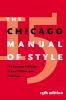
The Chicago Manual of Style, 15th edition (Call #Z253 .U69 2003), one of the leading reference books on style, grammar and publication in the US, is available in print at the reference desk. BLS Library also has a subscription to the online version available to BLS students and faculty.


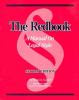
The Redbook: A Manual of Legal Style by Bryan A. Garner (Call #KF250 .G375 2006) is on reserve at the Circulation Desk along with Just Writing: Grammar, Punctuation, and Style for the Legal Writer by Anne Enquist (Call #KF250 .E57 2009. Both of these style guides provide grammar and style advice specific to legal publications.

For an online overview, CALI has two punctuation and grammar lessons. Punctuation and Grammar Basics for Law Students covers fragments and run-on sentences, commas, semi-colons, verb agreement and misplaced modifiers. Punctuation and Grammar: Advanced covers colons, hyphens and dashes, passive voice, parallelism, and misplaced modifiers. See also Introduction to Basic Legal Citation (online ed. 2010) by Peter W. Martin which reflects changes appearing in the third edition of the ALWD Citation Manual, published in 2006 and the edition of The Bluebook published in 2005.

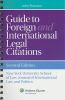
Those writing in international law can consult the LibGuide Developing a Paper Topic: International & Comparative which Reference Librarian Jean Davis created. It has a “Source-checking Guides” a tab that cites the Guide to Foreign and International Legal Citation, 2d ed., produced by N.Y.U. Journal of International Law and Politics (Call #K 89 .G85 2009) and the International Citation Manual published by the Washington University Global Studies Law Review with a link to guide sections for specific countries.

New York practicitioners will want to consult the Official New York Law Reports Style Manual (2007), once popularly known as the “Tanbook”, prepared by the Law Reporting Bureau of the State of New York. The editors of St. John’s Law Review publish New York Rules of Citation (5th ed. 2005) which applies the Bluebook rules to New York examples.

This post has no comments.
Field is required.