

A summons for jury duty from my local county New Jersey Superior Court evoked thoughts like those of many others: serving will be time-consuming, inconvenient, and tiresome. What excuses work to get out of jury service? That instinct is understandable. With pay for jurors set at $5 for each day of service, no one wants to miss work and wait all day to sit on an actual jury. The law (N.J.S.A. 2B:20-14) imposes fines up to $500. Those who are barred from serving as jurors are non-citizens, ex-felons, illiterates, minors, and those whose disabilities would prevent them from serving. The New Jersey Orientation Video is in two parts here:
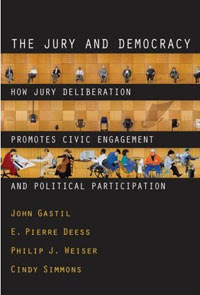 The privileges and benefits of performing jury duty are explained in The Jury and Democracy: How Jury Deliberation Promotes Civic Engagement and Political Participation by John Gastil et als. (Call JK1764 .J87 2010) available in the Brooklyn Law School Library main collection. Through a combination of narrative, quantitative analysis, and anecdotal illustrations, the authors argue that performing jury duty is not only necessary to the health of American democracy but also is civically and psychologically rejuvenating for citizens.
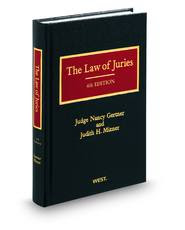 To help the legal professional better understand the process of jury selection, the BLS Library has two recent additions to its collection. The Law of Juries, 4th edition, by Nancy Gertner and Judith Mizner (Call # KF8972 .G47 2010) has chapters on Right to a jury trial — Compositional challenges — Law of voir dire — Peremptory challenges — Venue — Jury nullification — Dealing with jury conduct/misconduct — Structure of the jury — Issues arising from jury deliberations — Jury and the media.
 Jury Selection: The Law, Art and Science of Selecting a Jury, 3rd editon, by James Gobert and Walter Jordan (Call # KF8979 .J67 2009) has chapters titled Right to jury trial — Characteristics and features of the jury — Mock and shadow juries — Investigation of the venire — Challenges to the array — Challenges for cause — Peremptory challenges — Juror questionnaires — Voir dire in civil cases — Voir dire in criminal cases — Voir dire in capital cases — Choosing the jury.



 As a lawyer, Lincoln knew how to craft successful closing arguments. In the Gettysburg Address, perhaps the greatest closing argument in history, Lincoln showed that he knew how to persuade a bitterly divided country into ultimately doing what was right for all. The short 200 page book,
  The Brooklyn Law School Library has in its collection
The BLS Library recently completed its successful series of Spring 2011 Lunch and Learn Workshops. The fourth and final session on February 23, 2011 covered New York State Legislative History research. This presentation followed one on February 16th on Federal Legislative History research. While federal legislative histories are sometimes easier to compile because there are many documents produced by Congress and Congressional committees, such as debates in the Congressional Record, hearings and reports in print, online and in microfiche, New York State legislative history research can be more difficult to track down because of the paucity of some documents produced by the New York State Legislature.
However, things have begun to improve in the last decade. The New York State Assembly and Senate now provide live coverage on the Internet and on cable television of floor proceedings; the New York State Archives makes bill jackets available online since 1996 and Westlaw has a New York legislative history database, for example.
The BLS Library gets requests for assistance with legislative history research from students, alumni and even from inmates. We recently had a request from an inmate who was doing research for his parole hearing. He needed a sponsor’s memorandum from 1975 dealing with the necessity of the parole board to provide reports to inmates on why they were denied parole. Of course, we were happy to help and provided a copy of the memorandum from the 1975 New York Legislative Annual.
To learn more about New York Legislative History, view the PowerPoint presentation by clicking here.
Commenting on blog posts requires an account.
Login is required to interact with this comment. Please and try again.
If you do not have an account, Register Now.