The Brooklyn Law School logo

BLS Library Blog

Showing 10 of 12 Results

02/28/2012
profile-icon BLS Reference Desk

Today, the Consumer Financial Protection Bureau (CFPB) issued a Notice and request for information into the impact of banks’ overdraft practices on consumers. The inquiry will look into whether banks are reordering customers’ debit-card charges to maximize overdraft fees. Reordering transactions can double or triple penalties. The practice has been the target of several class-action lawsuits against the nation’s biggest banks. In Gutierrez v. Wells Fargo Bank, NA, 730 F. Supp. 2d 1080 (2010), US District Court Judge William Alsup for the Northern District of California ordered Wells Fargo to return $203 million in overdraft fees to customers whose transactions were reordered. Earlier this month, JP Morgan Chase agreed to pay $110 million to settle litigation on overdraft fees for checking accounts. Last November, Bank of America agreed to pay $410 million without admitting liability to settle an overdraft lawsuit brought by its customers. See In re Checking Account Overdraft Litigation Order of Final Approval of Settlement. The CFPB’s inquiry also will focus on bank overdraft policies, how they market the plans, and their impact on low-income and young consumers. The agency will solicit feedback from the public. Consumers complain that withdrawals of as small as $3 result in penalties as high as $37.

The CFPB said it is seeking information on how prevalent the practice remains and how it affects consumers. It is also concerned about a 2008 FDIC report that found that 9 percent of checking account customers made up about 84 percent of overdraft charges, suggesting that the fees were concentrated among low-income customers. CFPB Director Richard Cordray said in remarks earlier this week that the agency hopes to educate consumers about the overdraft rules with a campaign called “What’s your overdraft status?” and that that the CFPB has developed a “penalty fee box” that would appear on checking account statements to help consumers understand any overdraft charges.

Researchers at Brooklyn Law School can use CCH’s Intelliconnect platform to access the Consumer Financial Protection Bureau Reporter, a comprehensive resource covering the federal laws and regulations governing consumer financial protection and the Consumer Financial Protection Bureau, with practice commentary and analysis by Ralph C. Ferrara. The reporter provides the full text of the Consumer Financial Protection Act and the consumer laws over which the Bureau has regulatory authority, as well as the regulations of the Bureau. It has explanations that discuss the enumerated consumer laws, with case annotations included. In addition, the reporter provides the full text of consumer financial protection court opinions, pertinent agency issuances and related materials, Bureau rulemaking proposals and adoptions, and a list of articles.

On Friday, March 2, 2012, the Brooklyn Journal of Corporate, Financial and Commercial Law is hosting a Symposium: The CFPB After a Year.

This post has no comments.
02/27/2012
profile-icon BLS Reference Desk

Listen to this episode on BrooklynWorks.

In this podcast, Brooklyn Law School Professor Marsha Garrison discusses the forthcoming book, Marriage at a Crossroads (2012) which she co-edited with Prof. Elizabeth S. Scott of Columbia Law School. The book has articles by legal scholars and social scientists examining marriage at a time when advocates for same-sex marriage are clamoring for the right to marry while heterosexual couples are marrying less than in the past. Marriage at a Crossroads, due for publication later this year by Cambridge University Press, examines contemporary marriage in historical and social context and explores alternative policy paths at this critical juncture. It captures the complexity of the current political and ideological debate about marriage through contributions by authors of widely varying perspectives. The introduction to the book states: “A generation from now, marriage may be quite different than it is today. Will marriage be less or more important as a family form? Will access to marriage be extended to couples who cannot marry today? Will lawmakers increase or reduce support for marriage?” This book provides tools to resolve these questions.
This post has no comments.
02/23/2012
profile-icon BLS Reference Desk

To follow up on a post here earlier this month, see this video of an interview of Brooklyn Law School Professor Roberta Karmel with Bloomberg Law’s Lee Pacchia discussing the Dodd-Frank reform of the financial industry. Viewing Dodd-Frank as weak, Prof. Karmel discusses alternate proposals such as breaking up large American banks and combining the Securities Exchange Commission with the Commodity Futures Trading Commission. 


In the interview, Prof. Karmel comments that the Dodd-Frank financial reform is not strong enough to stop another financial crisis. “This is not a recipe for strong regulation.” Karmel said that the Dodd-Frank Act “has improved some financial regulation, but it did not work any real structural change either in the regulatory system or in the financial system.” She added “What we’ve moved away from is holding people responsible for business failure.”

Bloomberglaw’s interview with Rodge Cohen, of Sullivan & Cromwell LLP takes a difference perspective on “too big to fail”.

For more videos, see Bloomberglaw’s Channel on YouTube.

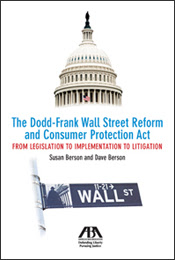
The BLS Library recently added to its collection The Dodd-Frank Wall Street Reform and Consumer Protection Act: From Legislation to Implementation to Litigation by David Berson and Susan A. Berson, two noted banking and tax lawyers. The book is a practical guide to help attorneys who represent clients in the financial services industry untangle the complexities of the provisions of Dodd-Frank and regulations issued in response to it. Divided into eight parts, each section represents a financial services sector where the book addresses the factual and regulatory background behind the pertinent Dodd-Frank provisions. It also features practical advice on steps that should be taken by financial services companies to prepare for the statutory and regulatory changes.

This post has no comments.
02/22/2012
profile-icon BLS Reference Desk

The Brooklyn Law School Library’s subscription to CQ Press Political Reference Suite of Online Editions combines a number of CQ’s government and political reference materials. Among the titles in the suite are:

  • CQ Almanac (with analysis on politics and policy in Congress since 1945)
  • The Supreme Court Yearbook (coverage of the Court updated yearly since 1989)
  • Vital Statistics on American Politics 2010–2011 (complete, authoritative, data-rich resource on the full-spectrum of U.S. politics)
  • Political Handbook of the World (the most authoritative resource for political information on more than 200 countries)
  • Historic Documents Series (key documents and analysis-updated yearly since 1972)
  • Washington Information Directory (essential guide to key contacts at government and nongovernmental organizations).

Users can search the whole Reference Suite or work with selected titles. The opening screen provides a single search box, Search Your Online Editions, as well as an advanced search link. Further down the page is the option to Browse Your Online Editions followed by a column of all the titles to which the library subscribes. Users can link to the Your Profile link to Log in/Create Your Account, Document History, Favorite Documents, and Saved Searches

A search for “Fiorello La Guardia” yielded 16 results ranging from Unions and Labor-Management Relations Legislation, Background, 1900-1945 in Congress and the Nation Online Edition to CQ Almanac and from Guide to U.S. Elections Online Edition to Encyclopedia of the First Amendment. The first document refers to the Norris–La Guardia Anti-Injunction Act of March 23, 1932; another is a state-by-state account of the 1914 House of Representatives elections, with candidate names, party affiliations, and the votes each received.

The Advanced Search permits searches of the entire database or of specific titles only, as well as queries that include only certain topics—Congress, The Courts, Elections, Executive and Federal Government. Users can limit by document type, such as case summary or election (an icon labels the type, and an explanation of each is available under User Resources), and by event date. An advanced search for “Fiorello La Guardia,” limiting results to biography,  returned one result: an entry for Lloyd N. Cutler from the Encyclopedia of the First Amendment (Cutler’s father was one of the mayor’s law partners).

A review in the October 15, 2011 edition of the Library Journal used the search term “immunization refusal” and found the results were “right on target, ranging from information on public health programs to a mention of immunization programs in a state of the union address.” Users can change the display ranking by date, number of hits, type, or alphabetically by title or source. The type and quality of information includes legislative analyses, primary-source materials, encyclopedias, in-depth current issues and archival reports, biographies, maps, chronologies, images, case summaries, bibliographies, and more.

This post has no comments.
02/21/2012
profile-icon BLS Reference Desk

The most recent New Book List from the Brooklyn Law School Library includes the 2d edition of Judith D. Fischer’s Pleasing the Court: Writing Ethical and Effective Briefs, a reader-friendly book for both law students and practitioners. It examines ethical and effective legal writing with more than two hundred examples of judges’ reactions to errors in lawyers’ writing. This new edition covers errors ranging from serious ethical breaches, like misrepresenting facts, to grammatical and citation errors. Lawyers committing such mistakes suffered consequences that ranged from disbarment to strong verbal rebukes. Contents of the book include: State the law accurately — State the facts accurately — Provide cogent analysis — Write clearly — Avoid wordiness and legalese — Avoid grammar, spelling, punctuation, and typographical errors — Cite correctly — Follow court rules — Do not plagiarize — Be civil.

The author is associate professor of law at the University of Louisville’s Brandeis School of Law and practiced law as a partner in a large California law firm. She has written numerous articles on the subject of legal writing. The book is recommended for law school courses as well as for continuing legal education courses, law firms, and individuals interested in effective writing and the soundness of the legal system. Practical exercises are included to help readers improve their writing techniques.

This post has no comments.
02/17/2012
profile-icon BLS Reference Desk

Almost every year since 1975, it has become customary for the President to issue a message recognizing the important contribution made to our nation’s life and culture by its African American citizens. This year, the President issued a Proclamation designating February as National African American History Month 2012. The Law Library of Congress has compiled guides to commemorative observations, including a comprehensive inventory of the Public Laws, Presidential Proclamations and congressional resolutions related to African American History Month.

Every year, the theme changes and this year, it is “Black Women in America: Culture and History” to honor African American women and the roles they played in the shaping of our nation. The theme, chosen by the Association for the Study of African American Life and History (ASALH), urges all Americans to study and reflect on the value of their contribution to the nation. This theme combines February’s celebration of Black History Month with March’s celebration of Women’s History Month. The theme is announced annually by ASALH in Washington DC, which also offers “theme kits” for every African American History year. A list of past and future themes for Black History Month is available at this page of the ALALH website.

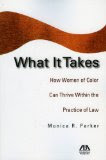
The Brooklyn Law School Library has in its collection a book by Monica Parker, an African American lawyer, Harvard graduate and renowned career coach titled What It Takes: How Women of Color Can Thrive Within the Practice of Law (Call #KF299.A35 P37 2010). The book is in three parts with 11 chapters: Part One: How Did We Get Here? Chapter 1 Our Glorious History, Chapter 2 Our Not-So-Glorious Present: The Intersection of Race and Gender, Part Two: The Potential Minefields and Time-Tested Strategies for Getting Around Them, Chapter 3 It’s All About the Work, Chapter 4 Relationships at Work, Chapter 5 Relationships with Clients, Chapter 6 I Can’t Be Being Discriminated Against, Can I? Chapter 7 Assimilate or Not? Part Three: Should I Stay or Should I Go? Chapter 8 The Imposter Complex, Chapter 9 Is It Our Responsibility to Uphold the Race? Chapter 10 On Becoming a Golden Child Chapter 11 Counting the Hours, Minutes, and Seconds.

This post has no comments.
02/16/2012
profile-icon BLS Reference Desk

An article in the Feb. 14th edition of the Wall Street Journal, Stop-and-Frisks Hit Record in 2011 (full text available in print at the Brooklyn Law School reference desk and online in Lexis and the BLS online subscription to the WSJ), reports that the use of the stop and frisk tactic in New York City effected 684,330 people in 2011, a 14% increase over 2010. Of the total, about 12% were arrested or received summonses; males made up 92% of the stops, 87% of the total were either black or Hispanic and whites were 9%. An analysis by the New York Civil Liberties Union estimates that the use of stop and frisk has increased 603% since the first year of the Bloomberg administration, when there were only 97,296 stops. It says that under the Bloomberg administration, the NYPD has conducted more than 4.3 million street stops with about 88% of those stops – nearly 3.8 million – resulting in no arrest or summons.

In defense of the practice, a spokesperson from the NYPD said that 8,263 weapons, including 819 guns, were recovered as a result of stops and that tactic has reduced crime. NYCLU Executive Director Donna Lieberman counters that “crime rates were going down before the skyrocketing stop-and-frisk campaign.” Critics say that stop and frisk targets minority men in NYC where blacks make up 25% of the city’s population, Hispanics 29% and whites 33%, according to the 2010 census. In response, the NYPD spokesperson said that the stop numbers “comport by race with victim-crime reports.” In 2011, 66% of violent-crime suspects were black, 34% were Hispanics and 9% white. The NYC website maintains a Stop, Question and Frisk Report Database for the years 2003 through 2010.

Students at Brooklyn Law School can review the law related to stop and frisk on the CALI website where there are two relevant lessons: Stop and Frisk (CRMPRO12) and Stop and Frisk Exception (CRMPRO06). SARA, the BLS Library catalog, lists an internet resource Analysis of Racial Disparities in the New York Police Department’s Stop, Question, and Frisk Practices by Greg Ridgeway published by RAND Safety and Justice and sponsored by the New York City Police Foundation.

This post has no comments.
02/14/2012
profile-icon BLS Reference Desk

Last month, the Second Circuit Court of Appeals in Capital Management Select Fund Ltd. v. Bennett ruled that plaintiff investors failed to allege deceptive conduct by the principals because the investors knew what they were getting into when they signed a standard agreement allowing Refco Capital Markets to “re-hypothecate” or otherwise use securities and other property held in customer brokerage accounts to secure margin trading. Re-hypothecation, which was at the heart of the MF Global collapse (see MF Global and the Great Wall St Re-Hypothecation Scandal), is the pledging to banks by securities brokers of the amount in customers’ margin account as collateral for broker loans, which are used to cover margin loans to customers for margin purchases and selling short. Re-hypothecation occurs when a broker, to whom his customers have hypothecated — or pledged — securities as collateral for a margin loan, pledges those same securities to a bank or other lender to secure a loan to cover the firm’s exposure to potential margin account losses. This video explains the process simply.

Judge Ralph Winter in the 2nd Circuit case decision upheld the dismissal of the consolidated lawsuits for lack of standing, as well as failure to show how Refco officers had deceived them, saying “We hold that appellants have no remedy under the securities laws because, even assuming they have standing, they fail to make sufficient allegations that their agreements with RCM misled them or that RCM did not intend to comply with those agreements at the time of contracting.” He went on to say “On review of the customer agreement, we conclude that it unambiguously warned the RCM Customers that RCM intended to exercise full rehypothecation rights as to the customers’ excess margin securities.” The judge also found that because Refco had stated that it was not a US regulated entity, rehypothecation rights in the agreement were not subject to either SEC rules or New York state law. “In short, RCM’s alleged violation of federal law does not in and of itself constitute deceptive conduct,” Judge Winter found, adding that the customers’ monthly account statements were not deceptive “about what securities may or may not be rehypothecated.” For more, see the article in the NY Law Journal.

A 2010 IMF working paper, The Sizable Role of Rehypothecation in the Shadow Banking System, provides estimates from the hedge fund industry for the “churning” factor or re-use of collateral and examines the policy implications of the practice. The paper states that “In the aftermath of Lehman, larger hedge funds are increasingly seeking to ensure that assets that have not been pledged as collateral are kept in segregated client accounts, so that prime brokers have absolutely no claim over those assets.” See chart below.

A Financial Times article, Lehman Collapse Puts Prime Broker Model In Question (available to member of Brooklyn Law School via the BLS Library ProQuest subscription) suggest blocking rehypothecation altogether. “Even if there is no dramatic change to the business model, prime brokers face a less profitable future and hedge funds will have to pay more for less generous leverage. If investors get their way, that cost will be even higher – but at least there will be less chance of funds being destroyed by a catastrophic bank collapse.”

This post has no comments.
02/09/2012
profile-icon BLS Reference Desk

The Brooklyn Law School Library has added to its collection BLS Professor Bradley T. Borden’s new book, Taxation and Business Planning for Real Estate Transactions (Call #KF6760 .B67 2011). A new addition to the LexisNexis Graduate Tax Series, a series of course materials designed for use in tax LL.M. programs, the book is designed for graduate tax faculty and students in and emphasizes complex, practice-oriented problems to develop the skills of careful analysis of the Internal Revenue Code and regulations. It is divided into 18 chapters, the first five of which are background chapters. Chapter 1 introduces the fact pattern and encourages students to spend time thinking about it and the work that a successful tax plan will require. Chapters 2 and 3 provide overviews of state-law entities (general partnerships, limited partnerships, limited liability companies, and corporations) and tax entities to consideer when planning for real estate transaction. Chapters 6 through 18 focus on tax planning in earnest (e.g., depreciation deductions, and rules governing gain and loss computation). They focus on ownership and transactional structures that best serve the interest of real estate investors. The book has four main objectives: (1) teaching tax planning skills; (2) helping students understand responsible tax planning that complies with standards of tax practice and professional ethics, (3) showing students who enter into government service be better prepared to draft rules that accomplish the government’s objectives, and (4) studying rules in a practice setting to reinforce how they apply in a broader context.

The abstract for the book reads in part:

This book focuses on tax planning in the real estate context. To adequately provide tax-planning advice, attorneys must be familiar with the transactional tax attorney’s analytical process. Transactional tax attorneys must recognize opportunities for tax planning and address issues that such planning may raise. Recognizing opportunities and addressing issues generally require a thorough understanding of the transaction and the relevant law. Such knowledge often derives from legal research and an in-depth study of primary-source legal resources, such as statutes, cases, regulations, and rulings. Legal research generally begins with treatises or articles that address the questions relevant to the tax-planning opportunity. That initial research leads the attorney to primary-source legal resources. The attorney then must interpret the law and apply it to a set of facts and provide advice.

To replicate the research process, each chapter of the book provides commentary that could be similar to . . . material typically found in a treatise, article, or other secondary source of legal authority. The commentary introduces ideas and legal concepts that apply to the questions and directs the reader to relevant primary legal authority. Ultimately, the students must carefully study, interpret, and apply relevant law to the issues raised by the questions. The commentary cites legal sources in the footnotes. The chapters reproduce relevant case law and rulings, but students will have to access the cited tax statutes and regulations in sources outside this book. The knowledge students will need to properly approach the material is largely contained in the law. In fact, students generally will not be able to fully understand and answer the questions until they have carefully studied the relevant law.

This post has no comments.
02/08/2012
profile-icon BLS Reference Desk

I don’t Tweet and I’m not on Facebook, although I probably should re-join LinkedIn and I can’t image that anyone is actually interested in the minutiae of my daily life.  I, on the other hand, am very much interested in hearing what you have to say about the Library.

If you have a question, comment or suggestion about Library resources, please let me know via an e-mail letter.  Your query can be about print or electronic resources, services or facilities.  For example, if there are research topics that you would like to see covered in our Fall or Spring Lunch & Learn Sessions (you come to learn; we provide lunch), let me know.

Please e-mail me at:  linda.holmes@brooklaw.edu and I will reply back to you within 48 hours (except weekends).  If I think your query/comment/suggestion would be of general interest to the entire student body, I will use a forthcoming blog to post your e-mail and my response.

I look forward to hearing from you, so send those Letters to Linda.  (Linda Holmes, Associate Law Librarian)

This post has no comments.
Field is required.