The Brooklyn Law School logo

BLS Library Blog

Showing 10 of 18 Results

05/31/2012
profile-icon BLS Reference Desk

Although the Library of Congress does not make Congressional Research Service (CRS) Reports public and the Federal Depository Library Program does not distribute them to libraries, users of the Brooklyn Law School Library can access many of the latest CRS reports by searching the SARA catalog. Use the keywords “Congressional Research Service” and display the Publication/Copyright Date as Newest to oldest. See the search results in this link. Another way for researchers to find the latest CRS Reports is to set up an alert for “CRS report” OR “Congressional Research Service” to find research about current of issues or subjects. Go to http://www.google.com/alerts to set up alerts, or search Google news and scroll to the bottom of the page to create an alert for your search.

Some recent CRS reports in the news are:

The Domestic Terrorist Threat: Background and Issues for Congress. CRS Report R41780. Posted on the FAS Secrecy News site.

Canadian Oil Sands: Life-Cycle Assessments of Greenhouse Gas Emissions. CRS Report R42537. Posted on the FAS Secrecy News site.

Rare Earth Elements: The Global Supply Chain. The CRS Report R41347 says that China currently produces 97 percent of the world’s rare earth oxides. Posted on the FAS Secrecy News site.

The U.S. Income Distribution and Mobility: Trends and International Comparisons. The CRS Report R42400 notes that “although the rank of the United States differs somewhat from one study to the next, as discussed below, the United States typically is found to be among the least mobile of the advanced economies.” Posted on the FAS Secrecy News site.

This post has no comments.
05/31/2012
profile-icon BLS Reference Desk

Brooklyn Law School Professor Mark Noferi recently posted on SSRN Cascading Constitutional Deprivation: The Right to Appointed Counsel for Mandatorily Detained Immigrants Pending Removal Proceedings. The article will be published in 18 Mich. J. of Race & L. (2012). Here is the abstract of the article which provides extensive discussion of the Joseph hearing where a detained immigrant must show that the government (Department of Homeland Security) is “substantially unlikely to prevail” on the charges on which the immigrant is being held for mandatory detention. The Joseph hearing is named after the decision in Matter of Joseph, 22 I&N Dec. 799 (BIA 1999).

When a Department of Homeland Security officer mandatorily detains a green card holder without bail pending his removal proceedings, for a minor crime committed perhaps long ago, the immigrant’s life takes a drastic turn. If he contests his case, he likely will remain incarcerated in substandard conditions for months or years, often longer than for his original crime, and be unable to acquire a lawyer, access family whom might assist, or access key evidence or witnesses. In these circumstances, it is all but certain he will lose his deportation case, sometimes wrongfully, and be banished abroad from work, family, and friends. The immigrant’s one chance to escape these cascading events is the off-the-record “Joseph” hearing challenging detention. If he wins, is released, and can secure counsel, he likely will win his case to stay in America. Yet pro se and detained, he may not even be told the “Joseph” hearing exists, let alone win the hearing involving complex statutory analysis on facts, witnesses, and evidence relating to the conviction, now all outside his reach.

It is rare in modern American law that a non-lawyer’s decision causes so much to hang in the balance in such complex yet informal proceedings without a lawyer to challenge it. Indeed, the modern immigration detention system is uniquely rare, in peacetime or war, in providing for preventive pretrial detention without counsel pursuant to underlying proceedings without counsel. It creates a cascading risk of wrongful detention and deportation – one cognizable under modern procedural due process theories, even notwithstanding traditional plenary power over immigration laws. In a post-Padilla v. Kentucky world with an increasingly functionalist Constitutional view of deportation, and where criminal defenders now must advise on the same issues litigated at the Joseph hearing, a right to appointed counsel for mandatorily detained immigrants pending removal proceedings is constitutionally viable, practically feasible, and morally necessary.

Prof. Noferi has been an Instructor of Legal Writing at BLS since 2010 and is faculty advisor to the BLS Immigration Court Observation Project. Prior to coming to BLS, he was a Public Interest Fellow at the Seton Hall Center for Social Justice, where he supervised clinical law students on immigrants’ rights, civil rights, and national security-related litigation.

This post has no comments.
05/23/2012
profile-icon BLS Reference Desk

The US Code (36 USC §116) designates Memorial Day as the last Monday in May which this year falls on May 28. The first national celebration of Memorial Day took place May 30, 1868 at Arlington National Cemetery. The holiday originated in 1868 as General John A. Logan of the Union Army issued General Order Number 11, designating May 30 as a memorial day. He declared it to be “for the purpose of strewing with flowers or otherwise decorating the graves of comrades who died in defense of their country during the late rebellion, and whose bodies now lie in almost every city, village, and hamlet churchyard in the land.” In 1888, 25 Stat. 516 designated May 30 as Decoration Day. In the 20th Century, it became Memorial Day and was extended to honor all those who died in American wars. On June 28, 1968, President Johnson signed Public Law 90-363, the Uniform Monday Holiday Act, to ensure three-day weekends for Federal employees by celebrating national holidays including Memorial Day on Mondays. The law took effect on January 1, 1971 changing the observance of the holiday to the last Monday in May.

In every session of Congress since 1989, Sen. Daniel Inouye (D-Hawaii), a World War II Medal of Honor winner, has introduced legislation to restore Memorial Day to May 30. This year, in introducing S.70, he said “In our effort to accommodate many Americans by making Memorial Day the last Monday in May, we have lost sight of the significance of this day to our nation. My bill would restore Memorial Day to May 30 and authorize our flag to fly at half-mast on that day. . . . This legislation would help restore the recognition our veterans deserve for the sacrifices they have made on behalf of our Nation.” (2011 Congressional Record S181) Memorial Day observance has diminished over the years and most Americans have forgotten its meaning. The graves of the fallen are too often ignored and neglected. Most people no longer remember proper flag etiquette for the day. NYC has three parades: the Little Neck–Douglaston parade in Queens, the largest of its kind; Brooklyn’s 145th annual Memorial Day Parade (one of the oldest in the US dating back to 1867) at Third Avenue and 87th Street; and Manhattan’s smaller parade in Inwood at Broadway and Dyckman Street.

This post has no comments.
05/23/2012
profile-icon BLS Reference Desk

Perhaps you are looking for a good book to read on vacation, but don’t know where to begin looking. Dozens of new books are added to the Brooklyn Law School Library collection every month. They cover a variety of practice areas and topics, ranging from practical guides on legal mediation to the psychology of eyewitness identification. The full list of new titles is available to browse through the library catalog here.

Some particularly interesting new titles include:

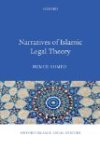
Narratives of Islamic Legal Theory by Rumee Ahmed

From Amazon.com: “Ahmed takes the reader into the logic of Islamic legal theory to uncover diverse conceptions of law and legal application in the Islamic tradition, clarifying and making accessible the sometimes obscure legal theories of central figures in the history of Islamic law. The book offers important insights about the ways in which legal philosophy and theology mutually influenced premodern jurists as they formulated their respective visions of law, ethics, and theology.”

An Outline of the History of Economic Thought by E. Screpanti & S. Zamagni

From Amazon.com: “This book provides a comprehensive overview of the development of economics from its beginnings, at the end of the Middle Ages, up to contemporary developments. It is strong on contemporary theory, providing extensive coverage of the twentieth century, particularly since the Second World War.”

International Approaches to Rape edited by G. Gangoli and N. Westmarland

From Amazon.com: “Many governments have begun to take rape more seriously than in the past and have started to implement wide-ranging reforms; this book describes those reforms and assesses the degree to which they have been successful. Introducing readers to various national perspectives on rape, the contributors outline a comparative approach that highlights the similarities and differences between countries, contexts, laws, issues, policies, and interventions.”

This post has no comments.
05/22/2012
profile-icon BLS Reference Desk
The Brooklyn Law School Library New Books List for May includes works on labor history in America, climate change, lawyering skills, European Union law, mediation and negotiation, Islamic legal theory, electronic discovery, human trafficking, the law of class actions, the law of armed conflict, eyewitness identification, the North American Free Trade Agreement and other trade agreements. Members of the BLS Faculty can request a book by clicking on the “Faculty Book Request” tab in the SARA Catalog above the search box to submit a request. Students can go to the open shelves to locate books and bring them to the circulation desk for checkout.
 

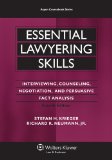
Some titles for graduating law students are: Essential Lawyering Skills: Interviewing, Counseling, Negotiation, and Persuasive Fact Analysis by Stefan H. Krieger and Richard K .Neumann (Call #KF300 .E84 2011). Chapters are: Becoming a lawyer — What this book is about — Professionalism — Lawyering for and with the client — Lawyering as problem-solving — Communications skills — Multicultural lawyering — Interviewing — Observation, memory, facts, and evidence — Interviewing the client — Interviewing witnesses — Persuasive fact analysis — How we organize and think about facts — The legal elements model of organizing facts — The chronology model of organizing facts — The story model of organizing facts — Selecting a model for presentation of the case — Strengthening the persuasiveness of your facts — Investigating the facts — Responding to your adversary’s facts — Counseling — What happens when a lawyer counsels a client — An example of counseling : the plant closing — Preparing for counseling : structuring the options — The counseling meeting with the client — Overcoming special problems in counseling — Negotiating — How negotiation works — Negotiation preparation : assessing the parties — Developing a negotiation strategy — Styles and rituals — Following through on your plan — Negotiation tactics.

The Lawyer’s Guide to Professional Coaching: Leadership, Mentoring, and Effectiveness by Andrew Elowitt (Call #KF276.5 .E56 2012). Chapters are: When and why to call a coach — The business case for coaching — Coaching expressly for lawyers and their firms — Coaching compared to other helping professions — An inside look at coaching — More than a fad — Finding and selecting a coach — Law firm mentors as coaches — Law firms leaders as coaches — Lawyers as coaches — Becoming a coach — Looking forward.

This post has no comments.
05/18/2012
profile-icon BLS Reference Desk

This week, the Brooklyn Law Incubator & Policy (“BLIP”) Clinic announced the winners of  the hacking competitions as part of last month’s successful Legal Hackathon held at Brooklyn Law School. There were two competitions. In the #HackTheAct competition, First Prize went to the proposal DMCA for Trademarks which BLS Class of 2012 students Warren Allen, Sean Comerford, and Elliott Siebers submitted with Sarah Feingold, in-house counsel for Etsy. The Runner-Up was David Collado, student at Cardozo School of Law, for his proposal Kill the Trolls. The Docracy Contract Hacking Competition winner was Boyan Toshkoff, BLS Class of 2014, for his proposal Indemnification Agreement – Standard Corporate.

To learn more about the First Annual BLIP Legal Hackathon, read the BLS Advocate article by Alexander Goldman and Boyan Toshkoff. Also see last month’s post on this blog. In addition, get a sense of the Legal Hackathon by viewing the video below which has a selection of clips from the morning session and an interview with #HackTheAct competition winners. 

This post has no comments.
05/17/2012
profile-icon BLS Reference Desk

Whether you are studying for the July 24-25, 2012 New York State bar exam, enrolled in summer school, doing research for a professor or working on an independent research project of your own, the library will have extended hours most of the summer and reference librarians will be available to assist you.  See the schedule below:

Early Summer Hours, May 14-31, 2012:  9:00am-10:00pm, 7 days a week.

Summer Hours, June 1-July 23, 2012:  9:00am-12:00am, 7 days a week.

Late Summer Hours, July 24-August 12, 2012: 9:00am-10:00pm, 7 days a week.

Reference Librarians’ schedule:  Monday-Friday, 9:00am-9:00pm; Saturday & Sunday, 9:00am-5:00pm.

This post has no comments.
05/16/2012
profile-icon BLS Reference Desk

Students taking the International Information Sources course at Pratt Institute, School of Information and Library Science  created  the following three tutorials for learning how to use the these United Nations materials:

This post has no comments.
05/16/2012
profile-icon BLS Reference Desk

Listen to this episode on BrooklynWorks.

In this podcast, James Renken, Brooklyn Law School Class of 2007, talks about a program which he co-presented in April with Charles-Eric Gordon, BLS Class of 1979. See a condensed version of his materials Resources for Professional Internet Investigations. For more on that program, see here. James talks about changes in skip tracing with online social media tools and discusses some of the databases that help attorneys and investigators locate people, assets and records. In addition to his duties as a Systems Engineer with the IT Department at BLS, James works with the Civil Legal Advice and Resource Office Student Action Group (CLARO/SAG), a student organization dedicated to educating the BLS community about legal issues surrounding consumer debt. CLARO/SAG offers the opportunity to learn about consumer debt issues and New York civil practice while helping unrepresented litigants and interacting with practicing attorneys and fellow students.

This post has no comments.
05/11/2012
profile-icon BLS Reference Desk

Congratulations to Brooklyn Law School Adjunct Instructor of Legal Writing Margo Brodie on her swearing in today as a District Court Judge in the Eastern District of New York! Since 2009, Brodie has been teaching first year students course in Fundamentals of Law Practice: Writing, Analysis, Research and Skills. Born in Antigua, she came to the US and obtained a BA from St. Francis College in Brooklyn and a JD from the University of Pennsylvania Law School. She practiced law for 20 years including working as a Federal prosecutor in Brooklyn for 12 years. She rose from the ranks of Assistant US Attorney to Deputy Chief of General Crimes to Chief of the Criminal Division and successfully prosecuted numerous cases on matters ranging from violent crimes and drug offenses to white collar crimes. She has also led public corruption cases, successfully prosecuting criminals who embezzled funds and tried to bribe government agencies in New York. The President nominated her to the bench in June 2011. In February 2012 the Senate voted 86–2 to confirm the nomination.

This post has no comments.
Field is required.