The Brooklyn Law School logo

BLS Library Blog

Showing 10 of 10 Results

11/30/2012
profile-icon BLS Reference Desk

On the eve of World AIDS Day 2012, more than 40 top business leaders have called for the repeal of travel bans that restrict the freedom of movement of people living with HIV. For nearly 23 years beginning in 1987, HIV-positive immigrants and travelers were banned from entering the United States. But that changed on January 4, 2010, when the U.S. Government officially lifted its HIV travel and immigration ban. President Obama announted the repeal of the HIV travel and immigration ban on Oct. 30, 2009 when he signed the Ryan White HIV/AIDS Treatment Extension Act of 2009, Public Law 111–87. See Medical Examination of Aliens—Removal of Human Immunodeficiency Virus (HIV) Infection from Definition of Communicable Disease of Public Health Significance, 75 Fed. Reg. 56547 (Nov. 2, 2009) (to be codified at 42 CFR Part 34). The ban went into effect after a 60-day waiting period. Other countries like Armenia, China, Fiji, Moldova, Namibia, South Korea and Ukraine have also removed such restrictions in recent years. However, countries including Australia, Russia, Singapore and the United Arab Emirates still maintain HIV travel bans as law.

Many countries enacted travel restrictions “to protect the public health” in the 1980s when ignorance, fear and prejudice surrounded HIV. Since then, effective HIV prevention has revolutionized the lives of people living with HIV so that they are fully productive workers living long and healthy lives. Newer treatments reduce the amount of HIV in one’s body to an undetectable level, lowering the possibility of transmitting HIV to someone else by some 96%. There is no evidence that HIV travel restrictions protect public health. The travel ban leads some professionals to leave their HIV medicines at home during business trips for fear that their pills will be discovered by airport agents. Skipping one’s HIV medication can lead to drug resistance, a troubling and expensive public health concern.

For these reasons, CEOs of more than 40 companies, including Levi Strauss & Co. and Kenneth Cole Production, issued a press release and pledge calling on the 45 remaining governments to lift their travel restrictions. These CEOs lead some of the world’s largest companies from Johnson & Johnson to The Coca-Cola Company from the National Basketball Association to Heineken, Pfizer and Aetna. They represent industries from travel to technology from banking to mining and almost 2 million employees around the world.

For information on the topic of HIV-Related Restrictions on Entry, Stay and Residence, see the Brooklyn Law School Library’s online resource Discrimination, Denial, and Deportation: Human Rights Abuses Affecting Migrants Living with HIV published by Human Rights Watch. 

This post has no comments.

The Brooklyn Law School Library’s most recent New Books List has 69 items on a wide range of legal topics. From Sword to Shield: The Transformation of the Corporate Income Tax, 1861 to Present by Law UCLA Law Professor Steven A. Bank (Call #KF6464 .B36 2010). An absorbing read for those with an interest in tax and those interested in the legislative process or in economic history, the book is the first historical account of the evolution of the corporate income tax in America. The author explains the origins of corporate income tax and the political, economic, and social forces that transformed it from a sword against evasion of the individual income tax to a shield against government and shareholder interference with the management of corporate funds. The 304 page volume has chapters titled The Roots of a Corporate Tax; From Industry Taxes to Corporate Taxes; Corporate Tax at the Turn-of-the-Century; The Rise of the Separate Corporate Tax; Non-recognition and the Corporate Tax Shield; The Origins of Double Taxation; The Lost Moment in Corporate Tax Reform; and The Present and Future of Corporate Income Taxation.

The U.S. corporate income has long been one of the most criticized and stubbornly persistent aspects of the federal revenue system. Unlike other industrialized countries, corporate income in the U.S. is taxed twice, first at the entity level and again at the shareholder level when distributed as a dividend. The conventional wisdom has been that this double taxation was part of the system’s original design over a century ago and has survived despite withering opposition from business interests. In both cases, history tells another tale. Double taxation as we know it today did not appear until several decades after the corporate income tax was first adopted. Moreover, it was embraced by corporate representatives at the outset and in subsequent years businesses have been far more ambivalent about its existence than is popularly assumed.
This post has no comments.
11/27/2012
profile-icon BLS Reference Desk

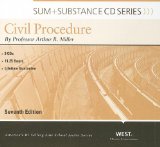
Brooklyn Law School students preparing for final exams during the reading period may want to consider listening to some study aids rather than reading them. Sum & Substance is a popular series of study aids  available on CD-ROM from the BLS Library. See for example, Sum & Substance Audio on Civil Procedure, 7th Edition by Arthur R. Miller (Call #KF8841 .M56 2010) in the library’s AV Collection. It provides the essentials of civil procedure in a clear, succinct, timesaving format and has a quick-reference indexing to easily locate all topics in the recording, and informed exam tips to help maximize your performance. Sections discuss clusters of procedure, citizenship, traditional basis of jurisdiction, constitutional principles, illustrative application, federal court jurisdiction, service of process, venue principles, pleading, sanctions, joinder, counterclaims, class actions, discovery, summary judgment, trial, jury trial, post-trial motions, new trial motions, motion for judgment notwithstanding the verdict, collateral estoppel, and appeals. 

The BLS Library has other Sum & Substance CD-ROMs on constitutional law, federal income tax, and legal research. They are all located in the AV room 111 on the ground floor level next to the reference desk. Students can check them out for a 48 hour period, with renewals. It is possible that the one you want may be checked out. If so, stop by the reference or the circulation desk and request a staff person place a hold on the item. Then you will be notified when the item has been returned, and you will be next in line for it.

Law student who are iPhone users can purchase some titles from the Sum & Substance series from the App Store. Currently, the following titles are available: contracts, criminal law, constitutional law, criminal procedure, and real property. Prices range from $49.99 to $59.99. See details at this link

This post has no comments.
11/27/2012
profile-icon BLS Reference Desk

Online study room reservations will begin on Thursday, November 29, 2012.  On Wednesday, November 28th students may begin making study room reservations online.   The link to the study room reservations website will be posted on the Library home page under “Related Links.”  The system is set up so that students may make reservations for the current day and two days ahead, but on Wednesday, November 28th please  do not make any reservations for that day, as they will not be honored; make reservations only for Thursday, November 29th and Friday, November 30th.  Thereafter students may make reservations for the current day and two days ahead.  The instructions for making reservations are posted on the reservations website.

Please remember that study rooms are for the use of groups of two or more people and they cannot be reserved for an individual.  Students are permitted four hours of study room space per day per student.  Study rooms will be kept locked and students must pick up the key to the room from the circulation desk at the time of their reservation.

The Library will have extended hours, 8:00am – 2:00am, 7 days a week, Thursday, December 6th through Thursday, December 20th.

Good luck on your exams!
Linda Holmes, Associate Law Librarian

This post has no comments.
11/24/2012
profile-icon BLS Reference Desk

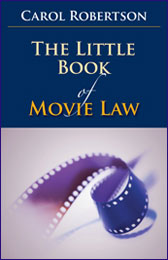
Movie lovers may want to take a look at Carol Robertson’s The Little Book of Movie Law (KF4298 .R63 201) in the Brooklyn Law School Library collection.  The book, not so little with over 400 pages, looks at the legal world of cinema from Edison and the dawn of motion pictures to the Transformers and the big-business movie industry today. As with other books in the ABA Little Book series, the author selects cases to illustrate the law on the topic. This one  includes a selection of the best cases involving the movies with 30 “reels” in all, each featuring a separate case that made headlines and changed movies forever. Robertson examines the relationship of cinema and the areas of patent, trademark, copyright, obscenity, and cyberlaw, and explains the legal ramifications of each case as well as the relevance to movie history.  Cases examined in the book include:


De Havilland v. Warner Bros. Pictures, 67 Cal. App. 2d 225 (1944) (The “Studio System”)
Joseph Burstyn, Inc. v. Wilson, 343 U.S. 495 (1952) (The Catholic Church and Censorship)

Lugosi v. Universal Pictures, 25 Cal. 3d 813 (Cal. 1979) (Publicity)

Rogers v. Grimaldi, 875 F. 2d 994 (2d Cir. 1989) (Protection of a Celebrity’s Name)

Stewart v. Abend, 495 U.S. 207 (1990) (Copyright – Derivative Works)

This post has no comments.
11/21/2012
profile-icon BLS Reference Desk
The annual Presidential Thanksgiving pardon of a turkey is a relatively new tradition that began in 1989 when George H.W. Bush granted the first official pardon. This year, President Obama will pardon one of two turkeys, either Cobbler or Gobbler, to become the 24th turkey to receive the honor of the presidential pardon. Rumors of turkey pardons stretch back to President Abraham Lincoln who spared a turkey meant for Christmas dinner when his son Tad argued the turkey had as much a right to live as anyone. President John F. Kennedy spared a turkey not as an official pardon on November 19, 1963, shortly before his assassination, saying “Let’s just keep him.” In 1987, President Ronald Reagan deflected questions about pardoning Oliver North in the Iran-contra case by joking about pardoning the turkey that was already heading to a petting zoo.
 

The Brooklyn Law School Library collection includes a 75 page pamphlet The Thanksgiving Turkey Pardon, The Death of Teddy’s Bear, and the Sovereign Exception of Guantánamo. In it, the author sees the annual presidential reprieve as more than a lark but as “a symbolic pardoning act which, through public performance, establishes and manifests the sovereign’s position at the helm of the state by highlighting . . . his power to control matters of life and death.” These rituals raise troubling thoughts on the exercise of US sovereignty, from Teddy Roosevelt’s big-stick era to the holding of prisoners at Guantanamo.

The Encyclopedia Smithsonian says that the first Thanksgiving service known to be held by Europeans in North America occurred on May 27, 1578 in Newfoundland, although earlier Church-type services were probably held by Spaniards in La Florida. In 1941, the US Senate amended H.J. Res. 41, making the Fourth Thursday in November a national legal holiday for Thanksgiving.

This post has no comments.
11/14/2012
profile-icon BLS Reference Desk

Congratulations to Brooklyn Law School Professor of Law Claire Kelly on her nomination to the U.S. Court of International Trade. In a White House Press Release, President Obama said  that he is “honored to put forward this highly qualified candidate for the federal bench. Ms. Kelly will be a distinguished public servant and valuable addition to the Court of International Trade.”

Prof. Kelly has a long history with Brooklyn Law School where she received her J.D. magna cum laude in 1993. She began teaching at BLS as an Instructor of Law in 1997 and moved on to become Acting Assistant Professor of Law in 2000, Assistant Professor of Law and Associate Director for the Center of the Study of International Business Law in 2003 and Associate Professor of Law and Associate Director for the Center of the Study of International Business Law in 2005. She has been a BLS Professor of Law since 2008.

This post has no comments.
11/13/2012
profile-icon BLS Reference Desk

Brooklyn Law School Professor Bradley Borden has posted on the SSRN website his latest paper, Tax-Free Exchanges of Art and Other Collectibles. The full text of the article appears at 29 Journal of Taxation of Investments 3 (Spring 2012) which is available in LexisNexis Academic through the BLS Library’s subscription or by password in Lexis. The abstract for the articles reads: 

In a thriving art market, investors making changes to their collections understandably might want to save tax dollars by structuring like-kind exchanges. But the lack of specific guidance regarding the definition of like-kind art and other collectibles — and the unusual nature of collectibles transactions — clouds the applicability of Section 1031 to such arrangements. This article suggests that tax advisors can create structures that will help such transactions come within the qualified intermediary safe harbor, while keeping in mind that many positions an owner might take with respect to like-kind art or other collectibles are subject to challenge.
The BLS Library has in it collection The Antique and Art Collector’s Legal Guide: Your Handbook to Being a Savvy Buyer by Leonard DuBoff (Call #KF4288 .D825 2003), a guide to the legal aspects of art collecting and the antiques business cover such topics as purchasing collectibles, authenticating works, insurance, security systems, investments, and conservation and restoration. Chapters include: Acquisition and protection — Getting started — Purchasing and reselling your collectibles — Due diligence on purchase and/or sale — Authenticating the work — Inventory and insurance — A guide to protecting your home and collection from theft — Investments — Conservation and restoration — Specific legal issues — Copyright — When rights collide — Tax considerations — Import and export restrictions for the collector — When your artwork is held by others.

This post has no comments.
11/12/2012
profile-icon BLS Reference Desk

Practising Law Institute (PLI) treatises and course handbooks are no longer available through either WestlawNext or Westlaw Clasic.  As I noted in a prior post, however, many PLI treatises, deskbooks and answer books from 2008 to present are available through Bloomberg Law.  In Bloomberg Law’s home page, there is a “Resources” box.  Click: “Books & Treatises.”  Under heading “PRACTISING LAW INSTITUTE” click: “All PLI Books & Treatises” to view available sources.  These include: DIrectors’ & Officers’ Liability (Oct. 2012) by James A. Fanto; Soderquist on the Securities Laws (March 2012) by Gary M. Brown; and Trade Secrets: A Practitioner’s Guide (June 2012) by Henry H. Perritt, Jr.  A BLS student, faculty member or administrator can register to obtain a law school account from Bloomberg Law.

Selected PLI print sources also are available in BLS Library.  To identify BLS Library’s print holdings, search SARA catalog by keywords, such as:

  • practising law institute corporate 
  • practising law institute computer

Additional helpful resources:

  1. Many practice-oriented publications of the American Bar Association are also available through BLS Library.  These titles range from Ipad Apps in One Hour for Lawyers (2012) by Tom Mighell to How To Build and Manage a Personal Injury Practice (2012) by K. WIlliam Gibson.  To view recently published ABA sources available through BLS Library, search SARA catalog by keywords: american bar association.  Then, in the pull-down menu on the right, view search results by: Publication/Copyright date: Newest to Oldest.
  2. Practical Law Company also allows BLS students, faculty and admistrators to register for law school accounts. PLC’s available materials include model documents, checklists, practice-area overviews and updates about legal developments.  PLC focuses on these practice areas: commercial; corporate and securities; employee benefits and executive compensation; finance; intellectual property and technology; international arbitration (new); labor and employment; and litigation (federal).  PLC also provides some materials for: antitrust; real estate; and tax.
  3. Librarians at the BLS reference desk (refdesk@brooklaw.edu or 718 780 7567) could assist in identifying potentially useful sources for your research.

Jean Davis, Associate Librarian for International Law

This post has no comments.
11/10/2012
profile-icon BLS Reference Desk

A NY Times article dated November 3, 2012, Wrongly Turning Away Ex-Offenders, addresses state laws dating back to Reconstruction that deny the vote to people who have committed felonies barring about 5.85 million people from voting in the 2012 election. Policies on restoration of the voting franchise to convicted felons among the 50 states are so inconsistent that they create confusion among for both former offenders who wish to regain the right to vote as well as the officials charged with implementing the laws. See  the State by State Chart of Felon Voting Laws on the Pro.Con.org website. This past October, the Minnesota Supreme in Council on Crime and Justice and Enjoli Rosas v. Mark Ritchie issued an Order in a case where a probation office incorrectly told a voter who pleaded guilty to felony possession of marijuana, was placed on 5 years of probation, and received a stay of adjudication that she could not vote and doing so would be a new felony offense. After the State admitted its mistake regarding the petitioner’s ability to vote, the Supreme Court dismissed the case as moot. However, the case illustrates that kind of misinformation that discourages legally eligible voters from registering to vote and may cause confusion for former offenders who, unaware of their state’s restrictions, then register and vote, unwittingly committing a new crime.

Other countries address felony re-enfranchisement much differently. The Australian Senate recently voted to amend the Electoral and Referendum Act to give the right to vote to persons who are serving sentences of three years or less. The amendment came after the High Court of Australia 2006 ruling in Roach v Electoral Commissioner on the validity of Commonwealth legislation that prevented prisoners from voting. In 2002, the Canadian Supreme Court ruled in Sauvé v. Canada that any ban on prison voting violates Canada’s Constitution and is counterproductive to the governments’ professed goal of promoting civil responsibility and respect for the rule of law.

Last year, Brooklyn Law School Professor Susan N. Herman stated in a NY Times article, Restore the Right to Vote, that she does not view voting as a “privilege” and that “the idea that our democracy is only open to a chosen few flies in the face of decades of struggle to democratize the fundamental right to vote.” The Brooklyn Law School Library has a number of items in its collection on the subject of the loss of political rights including suffrage for ex-convicts in the United States including The Disenfranchisement of Ex-Felons by Elizabeth Hull (Call # KF9747.Z95 H84 2006) and My First Vote, a compilation of stories by the Brennan Center for Justice from people across the country who voted for the first time in November 2008 after having lost, and then regained, their right to vote following a criminal conviction.

This post has no comments.
Field is required.