

On Monday, March 24, there will be an upgrade to the European Union’s legal website, New EUR-Lex, and the URL will switch to: eur-lex.europa.eu. The site’s administrators have noted that New EUR-Lex might be temporarily unavailable on Monday. EUR-Lex provides free access, in multiple official EU languages, to 1) the Official Journal of the European Union, 2) EU treaties and secondary legislation (including consolidated versions), 3) legislative proposals, 4) working papers and 5) EU case law.
Commenting on blog posts requires an account.
Login is required to interact with this comment. Please and try again.
If you do not have an account, Register Now.

Brooklyn Law School Library’s March New Books List has 61 titles covering a wide range of subjects including Supreme Court Justice Elena Kagan; felon disenfranchisement; trade secrets; appellate procedure; law and war; and taxation.

Thrill-seekers and those who like their adventure from an easy chair may be drawn to one title, Adventure and the Law by Cecil C. Kuhne III (Call #KF1290.S66 K84 2014). The author, a member of Fulbright & Jaworski LLP’s litigation section since 1993 in Dallas, TX examines adventures on land, water, and everywhere in between. It tells how all sorts of exciting ventures can change from thrilling to threatening and what happens when these instances go to the courtroom. In the book which the American Bar Association’s Tort Trial and Insurance Practice Section sponsored, the author tells of 16 riveting cases surrounding extreme activities such as mountain biking, water skiing, snowboarding, bungee jumping, car racing, skydiving from recreational to extreme, and reveals how real-life adventures can take a turn for the unexpected.
Commenting on blog posts requires an account.
Login is required to interact with this comment. Please and try again.
If you do not have an account, Register Now.

The Pew Research Center, the nonpartisan fact tank that informs the public about the issues, attitudes and trends shaping America and the world, recently released the report, The Web at 25 in the U.S.
What were the report’s findings? “The internet has been a plus for society and an especially good thing for individual users” proclaims its subtitle. But we all knew that.
Here are some highlights from the report:
- 87% of American adults use the internet
- 90% of internet users say the internet has been a good thing for them personally
- 6% say it has been a bad thing, while 3% volunteer that it has been some of both
- 76% say the internet has been a good thing for society
- 15% say it has been a bad thing and 8% say it has been equally good and bad
- 53% say the internet would be, at minimum, “very hard” to give up
- 49% of cell phone owners say the same thing about their cell phone
- 35% of all adults say their television would be very hard to give up (44% in 2006)
- 28% of landline telephone owners say their phone would be very hard to give up (48% in 2006)
- 70% report positive treatment by others online
- 24% report negative treatment
Social media did not command as great an appreciation. Only 10% reported that they would find it very hard to give up social media.
Commenting on blog posts requires an account.
Login is required to interact with this comment. Please and try again.
If you do not have an account, Register Now.
Listen to this episode on BrooklynWorks.
This podcast features an interview with Brooklyn Law School Visiting Professor of Law Andrew Napolitano who teaches courses on Constitutional Interpretation and Individual Rights and First Amendment Law. Professor Napolitano discusses his role in the upcoming Evening with United States Supreme Court Justice Antonin Scalia scheduled for Friday, March 21, 2014 from 5:30 pm to 7:00 pm at the Brooklyn Academy of Music’s Howard Gilman Opera House.
In the conversation, Judge Napolitano discusses the format of the upcoming event where he will question Justice Scalia on issues of human freedom and the U.S. Constitution. Following that will be questions from the audience on a range of topics that Justice Scalia has covered both in his judicial opinions and dissents as well as the books that he has authored. Books in the collection of the BLS Library include:
- Reading Law: The Interpretation of Legal Texts by Antonin Scalia and Bryan A. Garner (Call #K290 .S28 2012)
- Making Your Case: The Art of Persuading Judges by Antonin Scalia and Bryan A. Garner (Call # KF8870 .S28 2008)
- The Opinions of Justice Antonin Scalia: The Caustic Conservative by Antonin Scalia and Paul I. Weizer (Call # KF4549 .S33 2004)
- Scalia Dissents: Writings of the Supreme Court’s Wittiest, Most Outspoken Justice by Antonin Scalia and Kevin A. Ring (Call # KF4549 .S33 2004)
- A Matter of Interpretation: Federal Courts and the Law by Antonin Scalia and Amy Gutmann (Call # KF4552 .S28 1997)
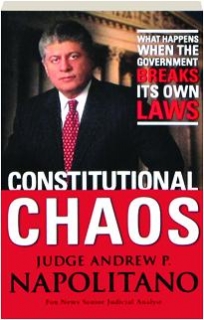 Judge Napolitano talks about two of his books that are in the BLS Library collection. The earliest is Constitutional Chaos: What Happens When the Government Breaks Its Own Laws (Call # HV9950 .N34 2004) written after he left the New Jersey Superior Court where he served as a trial judge from 1987 to 1995. The book speaks from his experiences and investigation about how government agencies will often arrest without warrant, spy without legal authority, imprison without charge, and kill without cause.
 The other title is The Constitution in Exile: How the Federal Government Has Seized Power by Rewriting the Supreme Law of the Land (Call # KF5050 .N37 2006). The book explains how the federal government has manipulated the Constitution to take power from the states and the people. He closes the interview by discussing The Second Constitutional Convention: How the American People Can Take Back Their Government by Richard E. Labunski (Call #KF4555.L33 2000) which looks at Article V of the U.S. Constitution that authorizes the American people to call for a new constitutional convention.
Commenting on blog posts requires an account.
Login is required to interact with this comment. Please and try again.
If you do not have an account, Register Now.
A recent NY Times op-ed Renting Judges for Secret Rulings by Prof. Judith Resnick of Yale Law School raises the question whether wealthy litigants should be able to rent state judges and courthouses to decide cases in private and keep the results secret. While the use of alternate dispute resolution in the form of arbitration and mediation is nothing new dating back to the Federal Arbitration Act of 1925, it is the attempt by the Delaware courts to legitimize in-court secrecy that makes the article and the case that it follows one of interest to the legal community.
The article follows the case of Delaware Coalition for Open Government, Inc. v. Strine, 733 F.3d 510 (3d Cir. 2013) that the US Supreme Court may decide. In 2009, Delaware amended its code to grant the Court of Chancery “the power to arbitrate business disputes” permitting companies to resolve disputes through closed-door arbitration presided over by a sitting judge. The Third Circuit found the amendment unconstitutional, even though such proceedings are not identical to civil trials, and even though arbitration has historically been private, since Delaware’s government-sponsored arbitration differs fundamentally from other arbitration, in that they are in front of judges in courthouses, result in binding orders of Chancery Court, and allow only limited right of appeal. Finding that court proceedings have historically been open to the public and the judiciary as part of a democratic society, the District Court and the Third Circuit sought to ensure accountability and allow the public to maintain faith in Delaware judicial system. The ruling stated that the drawbacks of openness are slight as court rules provide for confidential filing of documents, and there are remedies to protect trade secrets or other proprietary information. Confidentiality is not the sole advantage of Delaware’s arbitration proceeding over regular Chancery Court proceedings.
The case is pending before the US Supreme Court as Strine v. Delaware Coalition For Open Government, Inc., Docket No. 13-869. Briefs are available at SCOTUSblog which states the issue before the Court as: Whether Press-Enterprise Corp. v. Superior Court of California‘s “experience and logic” test requires invalidation on First Amendment grounds of a Delaware statute authorizing state judges to act as arbitrators in business disputes — when the parties voluntarily select arbitration — because the arbitration proceedings are not open to the public.
The issue is not a new one and was the subject of a 2006 law review article. See Laurie Kratsky Dore, Public Courts Versus Private Justice: It’s Time To Let Some Sun Shine in on Alternative Dispute Resolution, 81 Chicago-Kent Law Review 463 (Spring 2006) available to the Brooklyn Law School community through the BLS Library subscription to HeinOnline.
Have a particular legal issue you are keen on? Interested in writing about it? If so, then submit your paper to be considered for the annual Brown Award given by the Judge John R. Brown Scholarship Foundation.
The Award is in recognition of Excellence in Legal Writing in American Law Schools. There is no limitation as to topic; only that the writing must be on a legal subject.
Any student wishing to submit a paper must have a letter of recommendation from a faculty member. Specific details regarding the competition may be found here.
Some topics from last year’s winners.
First Place: Information Traps
Second Place: Beneath the Surface of the Clean Water Act: Exploring the Depth of the Act’s Jurisdictional Scope of Groundwater Pollution
Third Place: Lien on Me: The Survival of Security Interests in Revenues from the Sale of an FCC License
Commenting on blog posts requires an account.
Login is required to interact with this comment. Please and try again.
If you do not have an account, Register Now.