

The Library will be open the following hours during the Labor Day Weekend:
Friday, September 4: 9:00am – 10:00pm
Saturday, September 5: 9:00am – 10:00pm
Sunday, September 6: 10:00am – 10:00pm
Monday, September 7, Labor Day: 9:00am – 10:00pm

The Library will be open the following hours during the Labor Day Weekend:
Friday, September 4: 9:00am – 10:00pm
Saturday, September 5: 9:00am – 10:00pm
Sunday, September 6: 10:00am – 10:00pm
Monday, September 7, Labor Day: 9:00am – 10:00pm
Amendment XIX of the United States Constitution, which reads “The right of citizens of the United States to vote shall not be denied or abridged by the United States or by any State on account of sex,” was proposed to the legislatures of the several States by the Sixty-sixth Congress, on June 4, 1919. It was declared, in a proclamation of the Secretary of State, dated August 26, 1920, to have been ratified by the legislatures of 36 of the 48 States. The front page story in the New York Times noted the lack of fanfare for the historic event as none of the leaders of the woman suffrage movement were present when the proclamation was signed, and no photographers or film cameras recorded the event. Secretary Colby, wanting to avoid any public scene at the signing stemming from the rivalry between suffragists Alice Paul and Carrie Chapman Catt, told reporters that “effectuating suffrage through proclamation of its ratification by the necessary thirty-six States was more important than feeding the movie cameras.”
It was the State of Tennessee’s vote that provided the three-fourths of the states needed to ratify the amendment when Harry T. Burn, a 24-year-old legislator, switched his vote on the Tennessee state house floor at the urging of his mother. But the State of New York played a prominent role in the women’s suffrage movement: it was in Seneca Fall, NY where the first Women’s Rights Convention was held July 19 to 20, 1848. On November 6, 1917, the men of New York approved a constitutional amendment allowing women the right to vote, after a defeat of such a measure two years earlier in 1915, and three years before the final ratification of the 19th Amendment.
In 1971, New York Representative Bella Abzug supported a Joint Resolution in the U.S. Congress designating August 26 as “Women’s Equality Day” stating that “the President is authorized and requested to issue a proclamation annually in commemoration of that day in 1920, on which the women of America were first given the right to vote.” On August 24, the President issued this year’s Proclamation.
 For historical reading on the subject of women’s suffrage, see the Brooklyn Law School Library e-book called The Trial of Susan B. Anthony: An Illegal Vote, a Courtroom Conviction and a Step toward Women’s Suffrage by Martin Naparsteck. It tells how, following a public argument with her friend Frederick Douglass, Susan B. Anthony altered her strategy of seeking a broad range of rights for women and blacks and focused exclusively on winning the vote for women. Defying state and federal law, she voted in the presidential election of 1872, and was arrested and tried in a case presided over by U.S. Supreme Court Justice Ward Hunt, who directed the jury to deliver a guilty verdict. Fined $100, Anthony defiantly told the judge she would never pay–and never did. This is the story of the landmark trial that attracted worldwide attention and made Anthony into the iconic leader of the women’s rights movement.

The BLS Library staff sends a warm welcome to both old and new students to the 2015 fall semester at Brooklyn Law School. Here at the Library we hope to help you make it a successful and productive one.
Attention all New Students – Check out the Library Research Guide – 1L Resources, Tips and Tools. This guide covers first year law school basics and will familiarize you with the Library and its many resources.
Chat – Have a question and you are not near the Library? Contact a reference librarian (when he or she is on duty) at the reference desk. Library Chat may be accessed via the Library’s webpage or the Library page at BLS Connect.
Library Hours for September

Fridays 8:00 am – 10:00 pm
Saturdays 9:00 am – 10:00 pm
Sundays 10:00 am – Midnight
Labor Day Monday Sept 7 9:00 am – 10:00 pm
Rosh Hashanah Mon. Sept 14 9:00 am – 10:00 pm
Yom Kippur Wed. Sept 23 9:00 am – 10:00 pm
Today marks the 80th anniversary of the signing into law of the Social Security Act by President Franklin Delano Roosevelt. In his Statement Upon Signing the Social Security Bill on August 14, 1935, FDR said: “Today, a hope of many years standing is in large part fulfilled…We have tried to frame a law which will give some measure of protection to the average citizen and to his family against the loss of a job and against poverty-ridden old age.”
The act survived a series of constitutional challenges to become a linchpin of retirement planning. Three Social Security cases made their way to the Supreme Court during its October 1936 term. One case, Helvering vs. Davis, 301 U.S. 619 (1937), challenged the old-age insurance program. The two others, Steward Machine Company vs. Davis, 301 U.S. 548 (1937) and Carmichael vs. Southern Coal & Coke Co., 301 U.S. 495 (1937), challenged the unemployment compensation program of the Social Security Act. The Court issued rulings on all three on the same day, May 24, 1937.
In 1965, thirty years after passage of the Social Security Act, President Lyndon Johnson signed the Social Security Act Amendments, popularly known as Medicare, a national health insurance program for the elderly. Companion legislation created Medicaid, providing health care for people on welfare. Later, Medicaid was broadened into a more comprehensive program financing health care for low-income persons. Today, Social Security retirement benefits currently average $1,335 per month. The average disabled worker and aged widow or widower receives slightly less. For 65 percent of elderly beneficiaries, these benefits provide the majority of their cash income. For 36 percent of them, the benefits provide 90 percent or more of their income. For 24 percent of them, it is the sole source of income. This leaves little room for cuts for beneficiaries.
The Brooklyn Law School Library has a wide range of practice materials related to the Social Security Act including The Social Security Act Sourcebook by ABA Publishing (Call # KF3644.581935 .A2 2013) in the Main Collection and the 6th edition of Social Security Claims and Procedures by Harvey L. McCormick (Call # KF3649 .M272 2009) on Reserve at the Circulation Desk.
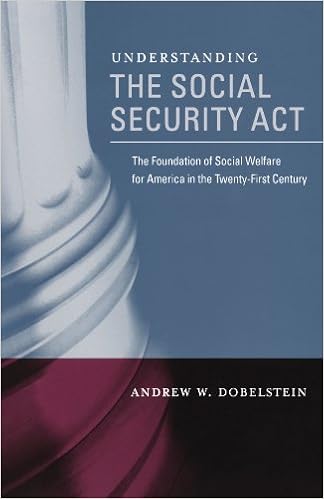 Additionally, the BLS Library has in its collection Understanding the Social Security Act: The Foundation of Social Welfare for America in the Twenty-First Century by Andrew Dobelstein (Call # KF3649 .D63 2009). With so many social welfare policy experts failing to grasp the sheer size and intricacy of the Social Security Act, this book takes readers step by step to provide the kind of comprehensive view of the U.S. social welfare system that is essential for any would-be reformers to master. Since being signed into law in 1935, the Social Security Act has institutionalized the country’s social welfare undertakings into a massive package administered by a sprawling federal agency and state-level organizations that must implement its programs. This is the first complete guide to every entitlement authorized by the Social Security Act, drawing on the author’s 38 years of research, teaching, and community service to explain in accessible, straightforward writing the origins, development, and ins and outs of their practical administration. By showing how the United States’ unique social welfare philosophy is reflected by the Social Security Act, this book provides a foundation for examining how its social welfare programs are bonded into a major social welfare enterprise. Students and scholars of policy and government, as well as public servants, whose work involves the real-life implications of the Social Security Act, will find this sweeping yet detailed overview an indispensable aid.

Judge Trager was born in Mount Vernon, New York and graduated from Columbia University in 1959 and Harvard Law School in 1962. After four years in private practice, he dedicated his life to public service, fulfilling many roles, including law clerk, federal prosecutor, teacher, state investigation commissioner, administrator, and jurist. From 1974 – 1978, he served as United States Attorney for the Eastern District of New York. Afterward, he began a fifteen-year tenure at Brooklyn Law School, first serving as Professor of Law (1978 – 1983) and then as its Dean (1983 – 1993). In 1993, President Bill Clinton appointed him to the United States District Court for the Eastern District of New York. He attained senior status on March 1, 2006. Judge Trager passed away on January 5, 2011 at the age of 73.
Today is the fiftieth anniversary of the enactment of the Voting Rights Act of 1965 guaranteeing voting rights for black citizens. It was a huge step toward protecting the right to vote for all Americans. President Lyndon Johnson’s signing of the Voting Rights Act began to address America’s long history of denying black Americans the right to vote. For 100 years, the 15th Amendment, which guarantees the right to vote regardless of “race, color, or previous conditional of servitude” was made useless by tactics like secret ballots, poll taxes, literacy tests and other practices that made it impossible for most blacks to vote. When these laws were in place, black voting plummeted throughout the south. According to the Constitutional Rights Foundation, in Mississippi alone the percentage of black voting-age men who were registered to vote fell from 90% during the Reconstruction period after the 15th Amendment’s passage to about 6% in 1892. By 1940, only about 3% of eligible blacks in the south were registered to vote.
After decades of state and local officials acting to disenfranchise African Americans through the use of both legal and illegal tactics, there was little action from Congress. But the passage of the Civil Rights Act of 1964, along with the reaction to the violence inflicted on voting-rights protesters marching from Selma to Montgomery, Alabama, in March 1965, prompted federal legislators to respond. Together with other laws, the Voting Rights Act outlawed literacy tests and gave the U.S. Department of Justice authority to challenge the use of poll taxes in state and local elections. Passage of the 24th Amendment in 1964 already barred the use of poll taxes in national elections. Section 2 of the Voting Rights Act essentially restated the 15th Amendment, prohibiting any voting rules or procedures that discriminate on the basis of race or color. Amendments to the law in 1975 extended its protections to members of a language minority group, such as speakers of Spanish or Native American languages. Additional amendments in 1982 permitted citizens challenging voting regulations under Section 2 to prove only that, in the “totality of the circumstance of the local electoral process,” the rules abridge voting rights.
The original Voting Rights Act provided for special intervention in jurisdictions where racial discrimination is believed to be greatest. Under Section 5, those parts of the country identified by a formula established in Section 4 must obtain “pre-clearance” from the DOJ or the U.S. District Court of the District of Columbia before making any changes to its voting laws. However, the Supreme Court in Shelby County v. Holder, 570 U.S. 2 (2013), struck down the Section 4 formula, leaving Section 5 intact but requiring legislators to redraw its coverage before further enforcement. Since then, several amendments have been proposed but Congress has not yet acted.
Now, fifty years later, the nation still faces restrictions on voting rights. Voting rights cases are taking place in North Carolina, and in Ohio and Wisconsin, where two other voting lawsuits ended only recently. And one day before the Voting Rights Act turned 50 years old, U.S. 5th Circuit Court of Appeals ruled in Veasey v. Abbott that the Texas voter ID law had a “discriminatory effect” that violates the federal law that prohibits racial discrimination. In the months and years ahead, the fate of the Voting Rights Act will be decided in Congress and in the courts. But its legacy as the singular triumph of the civil rights movement will remain strong.
 The Brooklyn Law School Library has many titles in its collection on the subject of the Voting Rights Act. The latest is Latinos and the Voting Rights Act: The Search for Racial Purpose by Henry Flores (Call # KFT1620.85.A6 F56 2015). It explores the role race and racism played in the Texas redistricting process and the creation and passage of the state’s Voter Identification Law in 2011. In addition to reviewing the redistricting history of the state, the book provides an analysis of court decisions concerning the Tenth Amendment to the Constitution, the Voting Rights Act, and a thorough discussion of the Shelby County decision. Flores brings together scholarly research and the analysis of significant Supreme Court decisions focusing on race to discuss Texas’ election policy process. This is the first book that speaks specifically to the effects of electoral politics and Latinos. Flores concludes that the tense race relations between Anglos and Latinos in Texas affected both the redistricting process and the creation of the Voter ID Bill.

With the beginning of the Fall 2015 semester, the Library has adopted a new food policy. Students may now have “light snacks” in the Library. Light snacks, such as food generally dispensed in vending machines: candy, cookies, chips, pretzels, donuts, bagels, etc., are now permitted. In other words, packaged foods which can be easily eaten dry and with the hands.
No plates or bowls of food which require utensils; no fast food such as pizza, burgers, hot dogs, chicken, etc. No greasy, aromatic, noisy food which may disturb others.
The Library reserves the right to determine which food items are acceptable and which are not appropriate for Library consumption.
Your cooperation is appreciated!
Commenting on blog posts requires an account.
Login is required to interact with this comment. Please and try again.
If you do not have an account, Register Now.