The Brooklyn Law School logo

BLS Library Blog

Showing 6 of 6 Results

A US District Court judge in Los Angeles has issued a 41 page ruling that will hopefully end copyright claims to “Happy Birthday to You” perhaps the most recognized song in the English language. Chief U.S. District Judge George King ruled that the publishers Warner/Chappell Music’s claim to own the copyright to “Happy Birthday” is “implausible and unreasonable.” After an announcement of a documentary about the Happy Birthday song. Warner/Chappell demanded a $1,500 licensing fee, which the company making the film agreed to pay. When Warner/Chappell sent a second letter, warning it could claim a $150,000 statutory penalty for copyright infringement, Good Morning to You Productions, the company making the documentary, filed suit in the US District Court for the Central District of California against Warner/Chappell which has collected millions of dollars in licensing fees for “Happy Birthday to You” although the song has been in the public domain for decades.

The opinion provides a history of the tune from before 1893, when sisters Mildred and Patty Hill wrote words and music for 73 songs, composed or arranged by Mildred, with words by Patty. They sold or assigned their rights to Clayton F. Summy on Feb. 1, 1893, for 10 percent of retail sales. The songs included “Good Morning to All.” It had the same tune but different words from Happy Birthday. Summy published a songbook that year under the title “Song Stories for the Kindergarten,” and filed a copyright application on Oct. 16, 1893, in which he claimed to own the copyright, but not to be the author. His copyright expired in the 1920s and he did not immediately renew it. A reconstituted company, the Hill Foundation, applied for a new copyright on it in 1934, and a number of lawsuits followed. By then, a number of other companies claimed to own the copyright, including the Board of Sunday Schools of the Methodist Episcopal Church (1912), and the Gospel Trumpet Co. (1928). The opinion states:

The Hill sisters gave Summy Co. the rights to the melody, and the rights to piano arrangements based on the melody, but never any rights to the lyrics. Defendants’ speculation that the pleadings in the Hill-Summy lawsuit somehow show that the Second Agreement involved a transfer of rights in the lyrics is implausible and unreasonable.

The summary judgment record shows that there are triable issues of fact as to whether Patty wrote the Happy Birthday lyrics in the late Nineteenth Century and whether Mildred may have shared an interest in them as a co-author. Even assuming this is so, neither Patty nor Mildred nor Jessica ever did anything with their common law rights in the lyrics. For decades, with the possible exception of the publication of The Everyday Song Book in 1922, the Hill sisters did not authorize any publication of the lyrics. They did not try to obtain federal copyright protection. They did not take legal action to prevent the use of the lyrics by others, even as Happy Birthday became very popular and commercially valuable. In 1934, four decades after Patty supposedly wrote the song, they finally asserted their rights to the Happy Birthday/Good Morning melody – but still made no claim to the lyrics.

Defendants ask us to find that the Hill sisters eventually gave Summy Co. the rights in the lyrics to exploit and protect, but this assertion has no support in the record. The Hill sisters gave Summy Co. the rights to the melody, and the rights to piano arrangements based on the melody, but never any rights to the lyrics. Defendants’ speculation that the pleadings in the Hill-Summy lawsuit somehow show that the Second Agreement involved a transfer of rights in the lyrics is implausible and unreasonable. Defendants’ suggestion that the Third Agreement effected such a transfer is circular and fares no better. As far as the record is concerned, even if the Hill sisters still held common law rights by the time of the Second or Third Agreement, they did not give those rights to Summy Co.

In light of the foregoing, Defendants’ Motion is DENIED and Plaintiffs’ Motion is GRANTED as set forth above. Because Summy Co. never acquired the rights to the Happy Birthday lyrics, Defendants, as Summy Co.’s purported successors-in-interest, do not own a valid copyright in the Happy Birthday lyrics.

CopyrightsThe Brooklyn Law School Library has a wealth of material on the subject of copyright often called a “limited monopoly.” When copyrights grow old and die, the works they protect fall into the public domain. Subject to certain exceptions, public domain works may be freely copied or used in the creation of derivative works without permission, or authorization, of the former copyright owners. One book in the BLS Library collection on copyright and the public domain is  Without Copyrights: Piracy, Publishing, and the Public Domain by Robert Spoo (Call #KF2994 .S656 2013). The book tells the story of  Samuel Roth who made a name–and a profit–for himself by publishing selections from foreign writings–especially the risqué parts–without permission. When he reprinted segments of James Joyce’s novel Ulysses, the author took him to court. The story shows that clashes between authors, publishers, and literary “pirates” influenced both American copyright law and literature itself. From its inception in 1790, American copyright law offered no or less-than-perfect protection for works published abroad–to the fury of Charles Dickens, among others, who sometimes received no money from vast sales in the United States. American publishers avoided ruinous competition with each other through “courtesy of the trade,” a code of etiquette that gave informal, exclusive rights to the first house to announce plans to issue an uncopyrighted foreign work. The climate of trade courtesy, lawful piracy, and the burdensome rules of American copyright law profoundly affected transatlantic writers in the twentieth century. Drawing on previously unknown legal archives, Robert Spoo recounts efforts by James Joyce, Ezra Pound, Bennett Cerf–the founder of Random House–and others to crush piracy, reform U.S. copyright law, and define the public domain.

This post has no comments.

A computer monitor and books

AI-generated content may be incorrect.

The Fourth Annual Library Databases Research Fair will be held on Tuesday, September 29, 2015.  The Fair will be held in the Student Lounge from 3:00pm to 6:00pm.  Representatives from the following legal research companies will be here to demonstrate their databases:


  • Bloomberg Law
  • Ebscto
  • Fastcase
  • Gale
  • Hein Online
  • Lexis
  • ProQuest
  • Westlaw
  • Wolters Kluwer

Come and learn how these databases will help you with your legal research.  There will be handouts, light refreshments, and a raffle drawing for prizes including gift cards and gift bags.

Save the date:  Tuesday, September 29th, 3:00pm – 6:00pm, Student Lounge.

This post has no comments.
09/20/2015
profile-icon BLS Reference Desk

On June 29, 2015, the final day of its 2014 term, the US Supreme Court ruled in Glossip v. Gross. The Court, in a 5-4 opinion by Justice Alito, ruled that death-row inmates had failed to establish a likelihood of success on the merits of their claim that the use of midazolam, a sedative in Oklahoma’s lethal injection protocol, violates the Eighth Amendment because it fails to render a person insensate to pain. Today, Glossip is scheduled to die by the controversial method that the Court greenlighted this summer unless there is a stay of execution. The case is likely not the final word on the death penalty. Justice Scalia this week Scalia told students at a Memphis college that he “wouldn’t be surprised” if the Supreme Court ruled the death penalty unconstitutional citing Justice Breyer’s dissent that it is time to consider whether the Eighth Amendment bars capital punishment in all cases.

Breyer is not the first Supreme Court justice to invite constitutional debate about the death penalty. Several justices in Gregg v. Georgia, 428 US 153 (1976) bringing back the death penalty later came to reject it. Justice Powell told his biographer that the death penalty should be abolished. Justice Blackmun, wrote in 1994 that he would no longer “tinker with the machinery of death.” In 2008, Justice Stevens wrote that his review of hundreds of cases had persuaded him that the penalty is both profoundly unworkable and unconstitutional. Justice Breyer in his dissent in Glossip argued that the death penalty is unreliable and arbitrary in application citing the long delays that undermine its purpose, convinced that we have executed the innocent. In Rudolph v. Alabama, 375 U.S. 889, (1963), Justice Goldberg’s dissent also suggested that capital punishment might violate the Eighth Amendment. That dissent prompted statewide moratoriums and encouraged cases to be brought to the Court challenging the constitutionality of capital statutes. A decade later, the Court struck them all down in Furman v. Georgia, 408 U.S. 238 (1972). Perhaps, in the wake of Glossip, we are about to travel down that path once again.

BarbellaOn the subject of capital punishment, Brooklyn Law School Library has The Trials of Maria Barbella: The True Story of a 19th Century Crime of Passion by Idanna Pucci (Call #HV6053 .P83 1996). This book illustrates the debate over the death penalty in the late 19th Century in the story of the trial of Maria Barbella for the murder of Domenico Cataldo in New York City on April 26, 1895. Maria and her family immigrated to New York in 1892. She met and became friendly with Cataldo, also from the same region of Italy. One day Cataldo took her to a boarding house, drugged her with the drink he bought her, and took advantage of her. With strong morals about intimacy and marriage, Maria said that they would have to get married. He promised they would marry in several months, even though he was already married to a woman in Italy, with whom he had children. Later Cataldo told Maria that he was going back to Italy and would not marry her. When Maria and her mother confronted him and insisted he marry Maria he said the only way he would do that was if they paid him $200. As the mother stormed away, Maria asked, one last time, whether she would be his wife. When he replied that “Only a pig would marry you“, she drew out her razor and killed him by cutting his throat.
Thus began the saga of Maria Barbella, who shortly became the first woman sentenced to die in the electric chair. She was arrested and put in the New York Halls of Justice and House of Detention (otherwise known as “The Tombs”) for more than two months. Her trial began on July 11. Maria was unable to speak or understand English. She admitted everything: how she slit his throat and how he ran after her, unable to reach her and dropped dead. The jury showed sympathy for her case; but trial Judge John W. Goff asked the jury not to have mercy on Maria. He said, “Your verdict must be an example of justice. A jury must not concern itself with mercy. The law does not distinguish between the sexes. The fragility of the female sex is sometimes involved to excuse savage crimes. We cannot publicly proclaim a woman not guilty of killing a man solely because this man has proposed marriage and then changed his mind!” The jury declared her guilty. On July 18, 1895, Judge Goff sentenced her to “execution by electricity” and sent her to Sing Sing Prison, the first female convict held there in 18 years and the first one on death row.

The case stirred up controversy in the Italian community which felt that the verdict was unjust with no Italians on the jury. Many complained to the Governor about how the trial was handled. On April 21, 1896, the Court of Appeals of New York in People v Barberi, 149 N.Y. 256 (also available on Westlaw Next at this link) ruled that the judgment of conviction should be reversed and a new trial granted. In the second trial at the criminal branch of the New York Supreme Court, she was said to be epileptic and mentally ill because of everything that had happened. She was found not guilty.

This post has no comments.
09/16/2015
profile-icon BLS Reference Desk

This year, on Constitution Day, Brooklyn Law School will host a special symposium discussing the impact of the Magna Carta on the development of the Constitution. The U.S Constitution, in turn, has become perhaps the most influential legal document. Since its adoption on September 17, 1787, more than one hundred countries have used it as a model for their own constitutions. It is one of the world’s oldest surviving constitutions. The Constitution’s basic tenets have remained virtually unchanged since its inception. People quarrel over its interpretation, but they never question the wisdom of its underlying principles.

The Constitutional Convention proposed a new Constitution establishing a much stronger national government. Although this controversial new constitution provided a great deal of resistance, it was eventually ratified by the necessary number of states, replacing the Articles of Confederation as the framework of the United States government. Some fascinating facts about the U.S. Constitution

  • The U.S. Constitution has 4,400 words. It is the oldest and shortest written Constitution of any major government in the world.
  • James Madison, “the father of the Constitution,” was the first to arrive in Philadelphia for the Constitutional Convention. He arrived in February, three months before the convention began, bearing the blueprint for the new Constitution.
  • Patrick Henry was elected as a delegate to the Constitutional Convention, but declined, because he “smelt a rat.”
  • Because of his poor health, Benjamin Franklin needed help to sign the Constitution. As he did so, tears streamed down his face.
  • The oldest person to sign the Constitution was Benjamin Franklin (81). The youngest was Jonathan Dayton of New Jersey (26).

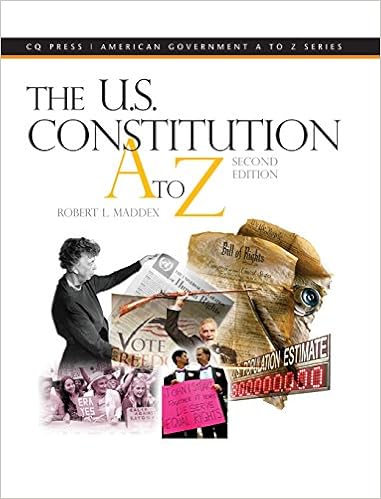
For mConstitutionore on the U.S. Constitution, see the BLS Library copy of The U.S. Constitution A to Z, 2nd Edition by Robert L. Maddex (Call # KF4548 .M33 2008). The book clearly and concisely explains every key aspect of the U.S. Constitution. This classic, easy-to-use reference is thoroughly updated with new entries covering the events of recent years including court cases with impact on Constitutional rights. Each of the more than 250 entries, arranged in encyclopedic A-to-Z format, provides accessible insight into the key questions readers have about the U.S. Constitution.

This post has no comments.

This week Prof. Fajans and Librarian Kathy Darvil will hold their semi-annual workshop on how to research and write a seminar paper. Topics covered included sources for selecting your topic, sources for researching your topic, and how to effectively organize and write your paper. The workshop will be held in Room 401 on Wednesday, September 16th from 4:00-5:30 PM.
If you are unable to attend the workshop, you can access an online research guide which contains a recording of the workshop, links to and descriptions of all the research sources discussed, and the writing and research presentations. The online guide is available at guides.brooklaw.edu/seminarpaper. From the guide’s landing page, you will be able to access a recording of this year’s presentation, Professor Fajans’ slideshow on how to write your seminar paper, and Kathy Darvil’s online presentation on how to research your seminar paper. If you should need further help selecting or researching your topic, please stop by the reference desk for assistance.

This post has no comments.
09/08/2015
profile-icon BLS Reference Desk

Brooklyn Law School will host a traveling exhibit commemorating the 800th anniversary of Magna Carta September 14th to 28th. The exhibit will be open to the public on the first floor of Brooklyn Law School, 250 Joralemon Street from September 14th to 19th. Public viewing hours are 9 a.m. to 6 p.m. Monday-Friday, and 10 a.m. to 4 p.m. on Saturday. The exhibit will then move to Brooklyn Borough Hall, where it will be open to the public from September 21st to 28th. Sponsored by the ABA Standing Committee on the Law Library of Congress, the exhibit, Magna Carta: Enduring Legacy 1215-2015, features 16 banners, 13 of which reflect spectacular images of Magna Carta and precious manuscripts, books and other documents from the Library of Congress’s rare book collections. The exhibit features a video by the Library of Congress, showing the Law Librarian and the exhibit curator handling the materials and explaining their significance.

In conjunction with the exhibit, the Law School will hold a special day-long symposium From Runnymede to Philadelphia to Cyberspace: The Enduring Legacy of Magna Carta on September 17. The symposium is a global gathering of renowned legal scholars, authors, artists, historians, public officials, librarians, and archivists from around the world who will explore the continuing impact of this seminal document on U.S. law, civil rights and liberties, art, the role of libraries and archives in the Digital Age, and law and order in Cyberspace. BLS Library Director and Associate Professor Janet Sinder will serve as moderator of a morning panel called Secrets of the Archives: Why We Preserve Documents in the Digital Age. Professor Sinder is one of a several BLS faculty members taking part in the event. For the full program of events, click here.

In advance of the exhibit, BLS Library Associate Librarian Linda Holmes has put together a presentation in the book display case on the first floor of the library with items from the library collection. The titles in the display are:

foundation

  • Magna Carta: The Foundation of Freedom 1215-2015 by Nicholas Vincent and others (Call # KD3946 .V56 2015). Contents are: Magna Carta in Context: a general survey from 1215 to the present day; Law Before Magna Carta: the Anglo-Saxon law codes and their successors before 1215; Plantagenet Tyranny and Lawmaking; The Tyranny of King John; Magna Carta: Defeat into Victory; Magna Carta in the Later Middle Ages; Magna Carta against the King; Magna Carta and the American Age of Reason; Magna Carta in the 19th Century; From World War to World Heritage: Magna Carta in the 20th Century; and 21st-Century Magna Carta
  • Magna Carta: Law, Liberty, Legacy edited by Claire Breay and Julian Harrison (Call # KD3946 .M345 2015). Contents are: Kingship and crisis; Runnymede and the granting of Magna Carta; Revival and survival; English liberties; Colonies and revolutions; Radicalism and reform; Empire and after; Magna Carta in the modern age; the text of Magna Carta 1215.
  • Magna Carta and the Rule of Law edited by Daniel Barstow Magraw and others (Call # KD3946 .M33 2014). The book is a comprehensive and insightful new book from the American Bar Association that takes a fresh look at Magna Carta and its impacts on various issues and the rule of law in light of contemporary legal concerns. It includes an examination of the following aspects of Magna Carta; historical background, importance to constitutionalism and the rule of law, impact on the United States Constitution, executive power, role as a foundation for women’s rights and individual rights (such as habeas corpus), relevance to international law, and much more.
  • Magna Carta Uncovered by Anthony Arlidge and Igor Judge (Call # KD3946 .A75 2014). The authors (Aldridge, a Queen’s Counsel for more than 30 years who in 1990 argued a case on the meaning of clause 40 of Magna Carta, and Judge, a retired Lord Chief Justice of England and Wales) of this 238 page history provide a detailed explanation of the Magna Carta and its place in English (and subsequently American) law.

This post has no comments.
Field is required.