The Brooklyn Law School logo

BLS Library Blog

Showing 4 of 4 Results

The Brooklyn Law School Library New Books List for November 11, 2015 has 88 items with 65 print volumes and 23 e-books. The entries cover a wide range of subjects from Lotteries (American Sweepstakes: How One Small State Bucked the Church, the Feds, and the Mob to Usher in the Lottery Age) to Discrimination in Criminal Justice (Crime, Inequality and Power) to Prostitution (Getting Screwed: Sex Workers and the Law) to Freedom of Expression (Lessons in Censorship: How Schools and Courts Subvert Students’ First Amendment Rights) to Race Relations (Liberalizing Lynching: Building a New Racialized State).

Hidden WealthAlso included is The Hidden Wealth of Nations: The Scourge of Tax Havens (Call # HJ2336 .Z8313 2015) by Gabriel Zucman (translated by Teresa Lavender Fagan from the French original Richesse Cachée des Nations and with a foreword by noted economist Thomas Piketty, author of Capital in the Twenty-First Century). This slim 129 page book claims to be the “the first serious economic research” into tax haven activity and an important work that anyone interested in tax havens, social justice, defeating inequality and delivering tax reform should read. The author is a French economist based at the University of California, Berkeley, and part of a network of doing valuable work on inequality, wealth, tax and the difficulties caused by the uneven distribution of capital resources in society. Although the book fails to define what a tax haven is, it does set out a campaign on tax havens in the second half of this book which makes a lot of sense. The book recommends the creation of a global register of financial asset wealth holding. This suggestion could be a practical and necessary step in the assembly of the data needed for the global wealth tax proposed in his book.

Whether country-by-country reporting can be an effective foundation for a taxation of multinational corporations is an open question. Country-by-country reporting may well permit tax authorities to determine what proportion of the sales, employees and assets of a multinational corporation are located in its jurisdiction. Similarly, if a global register of wealth could be established, the data needed to tax global wealth would have been created. The book is worth reading of its vision of an activist committed to promoting a new and radical solution that he has identified. Not many academics take on the role of the public intellectual who demands action to address a problem that they have identified. This one does.

Price We PayReaders interested on this topic may want to view The Price We Pay, a documentary inspired by another French book La Crise Fiscale qui Vient. Director Harold Crooks looks at the dirty world of corporate malfeasance and the dark history and dire present-day reality of big-business tax avoidance, which has seen multinationals depriving governments of trillions of dollars in tax revenues by harboring profits in offshore havens. Tax havens, originally created by London bankers in the 50s, today put over half the world’s stock of money beyond reach of public treasuries. Nation states are being reshaped by this offshoring of the world’s wealth. Tax avoidance by big corporations and the wealthy is paving the way to historic levels of inequality and placing the tax burden on the middle class and the poor. Crusading journalists, tax justice campaigners and former finance and technology industry insiders speak frankly about the  trends carrying the Western world to an unsustainable future.

This post has no comments.
11/12/2015
profile-icon BLS Reference Desk

TRDThanksgiving

The Library will be open the following hours during the Thanksgiving break:

Wednesday, November 25th:  9:00am – 10:00pm

Thanksgiving Day, Thursday, November 26th:  CLOSED

Friday & Saturday, November 27th-28th;  9:00am – 10:00pm

Sunday, November 29th:  10:00am – 12:00am

Enjoy your Thanksgiving Holiday!
This post has no comments.

The Brooklyn Law School Library has long provided access to Bloomberg Law to the law school community. BLS users now have access to a new legal intelligence platform: the Privacy & Data Security through the Practice Centers tab where users can click on Intellectual Property. At the top left corner of the page is a purple banner that reads “Looking for Bloomberg Law: Privacy & Data Security >> Access Now.” There, users will find analysis and news in an increasingly critical area for legal professionals.

Announced late last month, this newest Bloomberg Law tool was launched to address the need many legal practitioners have to quickly educate themselves on privacy and data security trends shaping legal practice, compliance and business operations. Data security runs the gamut from maintaining the integrity of simple personal information such as names, social security numbers and other private information to more complex business issues like those last month in the European Court of Justices’ invalidation of the long standing U.S. “safe harbor” agreement in the case of Schrems v. Data Protection Commissioner. Privacy and data security laws can change overnight and the Privacy & Security Data Resource Center helps explain them.

In addition to aggregating news and information in this area of law, the platform features tools to help users develop perspective on the items most likely to impact specific industries or business units. For example, the platform’s “chart builder” allows practitioners to compare laws on breach notification, privacy and data security laws across regional jurisdictions. It also has “heat maps” that highlight areas of developing case law and legislation, and provide direction to applicable documentation for easy review.

Bloomberg Law: Privacy & Data Security has a collection of portfolios offering insight and guidance from leading privacy and data security authorities. Written by expert practitioners, titles include Cybersecurity and Privacy in Business Transactions: Managing Data Risk in Deals and Cross-Border Data Transfers. There are also treatises with expert practitioner insights and guidance to help make sound decisions and plan with confidence. Titles include Practical Guide to the Red Flag Rules: Identifying and Addressing Identity Theft Risks and Cyber Liability in the Age of the New Data Security Laws.

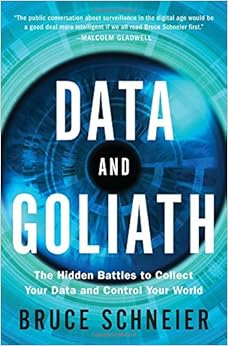
GoliathThe BLS Library has many titles in its collection on the subject of data security. One of the latest is Data and Goliath: The Hidden Battles to Collect Your Data and Control Your World by Bruce Schneier (Call # HM846 .S362 2015). The publisher of the 383 page NY Times bestseller says “Your cell phone provider tracks your location and knows who’s with you. Your online and in-store purchasing patterns are recorded, and reveal if you’re unemployed, sick, or pregnant. Your e-mails and texts expose your intimate and casual friends. Google knows what you’re thinking because it saves your private searches. Facebook can determine your sexual orientation without you ever mentioning it.

“The powers that surveil us do more than simply store this information. Corporations use surveillance to manipulate not only the news articles and advertisements we each see, but also the prices we’re offered. Governments use surveillance to discriminate, censor, chill free speech, and put people in danger worldwide. And both sides share this information with each other or, even worse, lose it to cybercriminals in huge data breaches.

“Much of this is voluntary: we cooperate with corporate surveillance because it promises us convenience, and we submit to government surveillance because it promises us protection. The result is a mass surveillance society of our own making. But have we given up more than we’ve gained? In Data and Goliath, security expert Bruce Schneier offers another path, one that values both security and privacy. He shows us exactly what we can do to reform our government surveillance programs and shake up surveillance-based business models, while also providing tips for you to protect your privacy every day. You’ll never look at your phone, your computer, your credit cards, or even your car in the same way again.”

This post has no comments.

A screenshot of a website

AI-generated content may be incorrect. 

The Law Library of Congress produces many excellent legal research tools – including the Guide to Law Online.  The Guide to Law Online provides links for web-based sources of federal law http://www.loc.gov/law/help/guide/federal.php, state law http://www.loc.gov/law/help/guide/states.php, and for the laws of hundreds of foreign countries http://www.loc.gov/law/help/guide/nations.php.

Another great Law Library of Congress research tool is the Global Legal Monitor http://www.loc.gov/law/foreign-news/?loclr=bloglaw.  The Global Legal Monitor offers coverage of legal news and developments worldwide.  Global Legal Monitor is produced by a team of Law Library of Congress editors, it is updated frequently, and its content is drawn from news stories found in official national legal publications and reliable press sources. Browse news stories from the Global Legal Monitor homepage or search for older news stories by text, topic, jurisdiction, author, or date.

This post has no comments.
Field is required.