The Brooklyn Law School logo

BLS Library Blog

Showing 5 of 5 Results

12/22/2015
profile-icon Kathleen Darvil

Attention all students! Remember to return your library books on or before Tuesday, December 22, 2015. It is the due date for all semester loans. If you do not turn in your books on or before December 22, you will incur fines. If you are unsure whether or not you have items checked out to you or if you have incurred any fines, you can log into your library account from the SARA catalog. You log into your account with your BLS credentials (first name.last name and your BLS password). Once logged in, you can see the items currently checked out to you, along with the items’ due dates. If you would like, you can renew any overdue item. You can also view your complete fine history, including outstanding fines and fines paid. Finally, you can review and update your personal information the library has on file, including your mailing address, phone numbers, and email address.

This post has no comments.

Listen to this episode on BrooklynWorks. 

In this podcast, Brooklyn Law School Professor Anita Bernstein and Loren Pani, BLS Class of 2015, her research assistant, discuss her series of articles on legal malpractice written for the Outside Counsel column of the New York Law Journal. Professor Bernstein reports on a data set of legal malpractice decisions issued during the last five years by the appellate courts of New York. To date four columns have been published:  Nine Easy Ways to Breach Your Duty to a Real Estate Client, which appeared in the August 11, 2015 edition of the NYLJ; Avoidable and Actionable Errors by New York Personal Injury Lawyers, September 17, 2015; Matrimonial Malpractice Before, During and After a Client’s Divorce, October 30, 2015; and  Judiciary Law §487 Claims For Attorney Misconduct, November 24, 2015. The fifth entry in the series, “Legal Malpractice Liability for Criminal Defense: Rare, Yet Possible”, is slated for publication on December 30. Prof. Bernstein and Loren credit BLS Reference Librarian Kathleen Darvil for her assistance in compiling the data set.

This post has no comments.
12/16/2015
profile-icon BLS Reference Desk

achri6

The Library will be closed Thursday, December 24, 2015 through January 1, 2016 for Winter Break,

Saturday, January 2, 2016:  9am – 5pm

Sunday, January 3, 2016:  10am – 6pm


Winter Session, Monday, January 4 – Sunday, January 17:

Monday – Friday:  9am -10pm

Saturday:  9am – 10pm

Sunday:   10am – 10pm

Monday, January 18 (Martin Luther King, Jr. Day):  9am – 10pm

This post has no comments.
12/11/2015
profile-icon BLS Reference Desk

Brooklyn Law School Library’s subscription to HeinOnline has many libraries including the U.S. Presidential Library with nearly 500,000 pages. Its titles include Messages and Papers of the Presidents, Public Papers of the Presidents, the Weekly Compilation of the Presidential Documents, and other documents relating to U.S. presidents. The Public Papers of the Presidents begins with Herbert Hoover and concludes with George W. Bush. Compiled and published by the Office of the Federal Register, National Archives and Records Administration since 1957 in response to a recommendation by the National Historical Publications Commission, they are a rich collection for researchers.

The Daily Compilation of the Presidential Documents is issued through the Office of the Federal Register and contains statements, messages and other Presidential material released by the White House. It also includes: speeches, press conferences, press releases, proclamations, executive orders, acts approved by the President, and many more documents. The predecessor title, the Weekly Compilation of the Presidential Documents, is also included. The collection contains a number of other titles, including the Economic Report of the President, Hearings before the President’s Commission on the Assassination of President Kennedy, and the Public Papers and Address of Franklin Delano Roosevelt.

Infamy

The last collection of FDR material can now be used with the New Digital Speech Collections, recently released by the FDR Library with support from AT&T, Marist College and the Roosevelt Institute. Surprisingly it shows the famous FDR quotation in a speech just after the attack on Pearl Harbor as “a date which will live in infamy” was edited from the original “a date which will live in world history.” The collection links to FDR’s Master Speech File, one of the FDR library’s most in-demand archival collections. With over 46,000 pages of drafts, reading copies, and transcripts created throughout FDR’s career, it is the most extensive collection of primary source documents related to FDR’s lifetime of public addresses.

This post has no comments.
12/05/2015
profile-icon BLS Reference Desk

Eighty-two years ago, on December 5, 1933, Amendment XXI to the US Constitution was ratified, repealing Amendment XVIII which had mandated nationwide Prohibition on alcohol on January 17, 1920. The Twenty-First Amendment is the only one of the 27 amendments of the U.S. Constitution to repeal a prior amendment. It is also unique as having been ratified by state ratifying conventions rather than by state legislatures.

The story of National Prohibition of alcohol and its ultimate repeal seems an historical oddity with little meaning for 21st Century life. Yet only recently in November 2012, voters in Colorado and Washington voted to legalize the production and sale of cannabis for social use, a first not only in the United States but also the world. Medical cannabis is now legal in twenty states and Washington, D.C., and many Americans use it in place of conventional pharmaceuticals. Nevertheless the federal government continues to raid and arrest people: 49.5 percent of all drug-related arrests involve the sale, manufacture, or possession of cannabis.

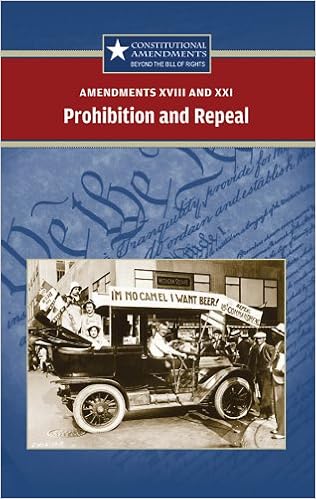
AmendmentsThe story of alcohol prohibition under the Volstead Act is worth reviewing. Much of it is told in the Brooklyn Law Library’s copy of Amendments XVIII and XXI: Prohibition and Repeal by Sylvia Engdahl (Call # KF3919.A844 2009). Its 160 pages discuss the social and cultural forces that lead to Prohibition, the unintended consequences of the Eighteenth Amendment, the passage of the Twenty-first Amendment, and connections to the War on Drugs. National Prohibition was viewed by millions of Americans as the solution to the nation’s poverty, crime, violence, and other ills and they eagerly embraced it. After its adoption in 1920, Evangelist Billy Sunday staged a mock funeral for alcoholic beverages and then extolled on the benefits of prohibition. “The rein of tears is over,” he asserted. “The slums will soon be only a memory. We will turn our prisons into factories and our jails into storehouses and corncribs.” With the ban on alcohol which was seen as the cause of most, if not all, crime, some communities sold their jails.

It soon became clear that Prohibition not only failed in its promises but actually created other serious and disturbing social problems leading to an increasing disillusionment by millions of Americans. Journalist H. L. Mencken wrote in 1925 that “Five years of prohibition have had, at least, this one benign effect: they have completely disposed of all the favorite arguments of the Prohibitionists. None of the great boons and usufructs that were to follow the passage of the Eighteenth Amendment has come to pass. There is not less drunkenness in the Republic but more. There is not less crime, but more. There is not less insanity, but more. The cost of government is not smaller, but vastly greater. Respect for law has not increased, but diminished.”

It was nine prominent New York lawyers, organized as the Voluntary Committee of Lawyers and chaired by eminent Park Avenue lawyer and Harvard Law School graduate Joseph H. Choate, Jr., who helped bring about Prohibition’s repeal. In 1927, the lawyers formed the VCL declaring as their purpose “to preserve the spirit of the Constitution of the United States [by] bringing about the repeal of the so-called Volstead Act and the Eighteenth Amendment.” With this modest platform they undertook first to draft and promote repeal resolutions for local and state bar associations. Their success culminated with the American Bar Association calling for repeal in 1928, after scores of city and state bar associations in all regions of the country had spoken unambiguously, in words and ideas cultivated, shaped, and sharpened by the VCL. For more on this remarkable story, see The VCL: Architects of Repeal by Richard M. Evans.

This post has no comments.
Field is required.