The Brooklyn Law School logo

BLS Library Blog

Showing 7 of 7 Results

03/29/2018
profile-icon BLS Reference Desk

A logo of a congress

Description automatically generated

All non-confidential reports of the Congressional Research Service must be made publicly available online through a Government Publishing Office website within 90 to 270 days under the 2018 omnibus appropriations act that was passed by Congress and signed by the President last week. Buried in the 2,232-page fiscal 2018 omnibus spending bill is a much-debated provision to require the Library of Congress to post all the lawmaker-requested reports on a central website.

AVAILABILITY OF CRS REPORTS THROUGH LIBRARY OF CONGRESS WEBSITE.
(1) WEBSITE.— (A) ESTABLISHMENT AND MAINTENANCE.—The Librarian of Congress, in consultation with the CRS Director, shall establish and maintain a public website containing CRS Reports and an index of all CRS Reports contained on the website, in accordance with this subsection.
(B) FORMAT.—On the Website, CRS Reports shall be searchable, sortable, and downloadable, including downloadable in bulk.
(C) FREE ACCESS.—Notwithstanding any other provision of law, the Librarian of Congress may not charge a fee for access to the Website.
(2) UPDATES; DISCLAIMER.—The Librarian of Congress, in consultation with the CRS Director, shall ensure that the Website—(A) is updated contemporaneously, automatically, and electronically to include each new or updated CRS Report released on or after the effective date of this section; (B) shows the status of each CRS Report as new, updated, or archived; … Any CRS Report may be reproduced and distributed in its entirety without permission from CRS. However, as a CRS Report may include copyrighted images or material from a third party, you may need to obtain the permission of the copyright holder if you wish to copy or otherwise use copyrighted material.’’

The move is the culmination of more than two decades of efforts to encourage, cajole or coerce Congress into making the reports broadly available to the public. Finally, Congress will make the non-confidential reports available to every American for free. See Long-Proprietary Congressional Research Reports Will Now Be Made Public by Charles S. Clark, March 23, 2018.

This post has no comments.
03/21/2018
profile-icon Eric Yap
A cover of a book

Description automatically generated

In “Riot Days”, her short memoir of the events leading to her incarceration and subsequent release 18 months later, Maria Alyokhina gives us a glimpse of the Russian justice and penal systems. But it is a glimpse, and nothing more.

Alyokhina is a member of the band Pussy Riot, perhaps still best known for their “punk prayer” protest in 2012, at the Cathedral of Christ the Savior in Moscow. After eluding authorities for a while, Alyokhina and two fellow Pussy Rioters were arrested.  Most of “Riot Days” is about what ensued: detention, trial, conviction, and imprisonment in prisons in Berezniki near the Ural Mountains, and in Nizhny Novgorod.

Upon arrest, the author and her bandmates were charged with “hooliganism motivated by religious hatred”, with prosecutors seeking a 3 year prison term for each of the accused. In the chapter titled “Russian Trial”, Alyokhina describes a trial which is by turns tedious and absurd: a long line of accusers claiming shock and moral injury, confused witnesses, an accuser who wasn’t present at the church and only “saw the video”, a vomiting dog.  Not to mention a sometimes distracted judge:

“The secretary stops recording the proceedings. The judge bows her head and starts doodling.

‘Your Honour, please stop doodling!’ the lawyer shouts.

‘Don’t look at my desk!’ the judge shouts back.”

A person pointing at camera

Description automatically generated

After she was convicted and sentenced to 2 years in prison, Alyokhina would continue to fight the system from within.  Often her protests would fall flat, and she spent months in solitary confinement. Yet a surprising number of times, and in part due to her celebrity, her efforts bore fruit. Notably, on occasions when she was able to tell the authorities what specific law they were violating, she managed to get the guards to rein in their abuses such as stealing from the salaries owed to the prisoners.  

Included in “Riot Days” are some evocative vignettes, as Alyokhina navigates the Russian justice and penal systems.  The guards who get upset when the prisoner who gives manicures to everyone in prison, guards and prisoners alike, is about to be released (“Who will do our nails?”) Having nothing to read in prison other than a box full of romance novels.  Igor, the chief of criminal investigations, who boasts about dieting and riding 10 miles on his bicycle. The author making sushi rolls for her fellow prisoners, none of whom has tasted sushi before.  

With widespread disenfranchisement of those who have been convicted in this country, one of the author’s stories involving voting was quite striking.  Alyokhina was a detained prisoner accused of political crimes, and on hunger strike, when this happened:

“In the middle of all this, the clatter of an iron key in the lock of the iron door, and someone roars “You want to vote?”

Despite being weakened by her hunger strike, the author jumped out of her cell. In an elegantly decorated room adorned with a large portrait of Putin, she got to vote in the Russian presidential elections.

“Riot Days” is fragmented, a bit messy, and may not be everyone’s cup of tea. If you are looking for a more comprehensive account of events surrounding the Pussy Riot case, there are other sources you can turn to.  Still, the book does an excellent job capturing the mood of those turbulent events. Despite the hardships she suffered, the author manages to ring a note of optimism: even if the system is stacked against you, knowing your rights and fighting for them can take you a long way.  As Alyokhina tells herself, in the midst of one of her many battles with prison authorities, “I have to understand the law.” 

Riot Days, by Maria Alyokhina (Call No. ML420.A57 A3 2017)

This post has no comments.

A newspaper with a picture of a person

Description automatically generated

Brooklyn Law School recently digitized and made accessible its collection of Brooklyn Law School’s student run newspaper, The Justinian.  The digitized collection is available on Brooklyn Law School’s digital repository, BrooklynWorks. The BLS student-run periodical program began in 1918 as The Barrister. It was published monthly until 1922. Almost a decade later, in 1931, the periodical’s title changed to The Justinian. Publication continued until 1998. The Justinian was not produced from May 1945 to September 1954. After 1998, it was referred to as Brooklyn Law School News, which ran from 2002 to 2006.

The Brooklyn Law School Library Archives provides digitized versions of this printed collection from April 1932 to October 2006. The content has complete OCR text recognition for all 238 issues. The periodicals were published monthly. For most April issues, there is a special for April Fool’s Day. For 88 years, these news-sources have been accurate portrayals of political, social, economic, and local topics that have interested Brooklyn Law School students and engaged them in active involvement and debate.

This post has no comments.

The US Congress, by Public Law 100-9, designated the month of March 1987, as “Women’s History Month”. This law requested the President to issue a proclamation calling on the American people to observe this month with appropriate activities. President Reagan then issued Presidential Proclamation 5619 proclaiming March 1987 as “Women’s History Month”. Since then, Presidential Proclamations have declared March as Women’s History Month.

Brooklyn Law School celebrates Women’s History Month by recognizing Amelia Dietrich Lewis, Class of 1924, as “one of the most tenacious lawyers the state of Arizona has ever seen.” She was a graduate of St. Lawrence University School of Law (now Brooklyn Law School). She exhibited her moxie early in her career, even before she was sworn in as an attorney. Although Lewis was scheduled to take the bar exam on June 24, 1924, she learned that the New York Bar prohibited candidates under the age of 21. In Lewis’s case, she was to turn 21 the very next day, on June 25. Facing this technicality, she filed suit against the Bar, arguing she would be 21 on the 24th because her birthday was actually the first day of her 22nd year.” She was successful in her suit and took the exam as planned on the 24th and passed. After practicing law in New York for 33 years, in 1957 following the death of her husband, she moved to Arizona. She took the bar examination in that state with just one other woman, Sandra Day O’Conner. There, she worked as a prosecutor for six years and then maintained a thriving solo practice, concentrating in elder law in Sun City. She was well into her eighties when she retired.

Lewis is best known for her involvement in the landmark 1967 Supreme Court case, In re Gault, 387 U.S. 1 (1967), which brought due process to juvenile courts across the nation. Her client, Gerald Gault, had been sentenced without legal counsel to an Arizona reformatory. He allegedly made an obscene phone call to a neighbor, was arrested by local police, and tried in a proceeding that did not require his accuser’s testimony. He was sentenced to six years in a juvenile “boot camp” for an offense that would have cost an adult only two months. Lewis assumed the role of co-counsel after Gault’s appeals at the lower level were exhausted. She was drawn to the case because she had raised three healthy sons and “wanted to give something back.” Ultimately, the defense of the boy prevailed, with the Court holding that he was entitled to the same constitutional safeguards as adults: a trial by jury, the right to legal counsel, the right to cross-examine witnesses, and the right to remain silent. Justice Fortas in his 8-1 majority opinion wrote: “Neither the 14th Amendment nor the Bill of Rights is for adults only. Under the Constitution, the condition of being a boy does not justify a kangaroo court.”

Lewis was recognized by the Arizona Republic as one of the legal greats of that state. In 1988, she received the first Amicus Award of the Association of Trial Lawyers of America, which honored her for pioneering the vital role of women in the legal profession. Upon her death in 1994, the Chief Justice of the Arizona Supreme Court commented: “She made history for the law in many ways. Her life and career epitomized the practice of law as it should be.”

A person in handcuffs with his hands on his face

Description automatically generatedThe Brooklyn Law School Library has in its collection The Constitutional Rights of Children: In re Gault and Juvenile Justice by David S. Tanenhaus (Call No. KF228.G377 T36 2017). This new edition includes expanded coverage of the Roberts Court’s juvenile justice decisions including Miller v. Alabama (in which the Court held that mandatory sentences of life without the possibility of parole are unconstitutional for juvenile offenders) and explains how disregard for children’s constitutional rights led to the “Kids for Cash” scandal in Pennsylvania. Widely celebrated as the most important children’s rights case of the twentieth century, Gault affirmed that children have the same rights as adults and formally incorporated the Fourteenth Amendment’s due process protections into the administration of the nation’s juvenile courts.

This post has no comments.
03/05/2018
profile-icon BLS Reference Desk

Courts have cited the Administrative Procedure Act, Pub. L. 79–404 enacted on June 11, 1946, in blocking the Trump administration’s attempts to end policies from the Obama era. These include actions to undermine the Deferred Action for Childhood Arrivals program (New York v. Trump), a delay in a regulation requiring oil and gas companies to reduce methane leaks (Sierra Club v. Zinke), and postponement of a rule that would give low-income families more access to housing in wealthier neighborhoods (Open Communities Alliance v. Carson). In each instance, Trump policy changes have hit the same stumbling block: Courts say the administration has not followed the proper steps in enacting them, citing a 1940s-era law that’s become a key weapon in the legal battle over the president’s agenda. Under that law, the Administrative Procedure Act, federal agencies are required to provide a reasoned justification for their policy decisions and offer the public an opportunity to weigh in when they are creating new regulations, making notable changes to existing rules, or scrapping them altogether. In other words, rescission of the former policies require that the government provide notice and comment, otherwise there would be a violation of Section 553 of the APA.

Congress passed the Administrative Procedure Act in 1946 amid the rise of communism and fascism in Europe, hoping to place checks on the vast bureaucracy created by the New Deal and “avoid dictatorship and central planning,” as one legal expert explained. Under the law, federal agencies must provide a reasoned analysis for making policy changes to avoid “arbitrary and capricious” rule-making. The Administrative Procedure Act requires that agencies go through a process known as “notice and comment” before issuing, amending or repealing “substantive rules.” As part of that process, the agency must publish proposed actions in the Federal Register and then give the public at least 30 days to submit feedback. When it finalizes its proposal, the agency must respond to issues raised by the public comments and must explain why it settled upon the course of action that it chose. The explanation must show why the agency’s action is reasonable and not “arbitrary” or “capricious.”

Brooklyn LawA black and white sign with white text

Description automatically generated School students may want to review Informal Rulemaking, a CALI lesson (password required), which examines the procedural steps that an administrative agency must follow in order to create a valid “informal” rule. This lesson is intended for students who have studied these issues in class and wish to further refine their knowledge.

This post has no comments.
03/02/2018
profile-icon BLS Reference Desk

A white cover with black text

Description automatically generated

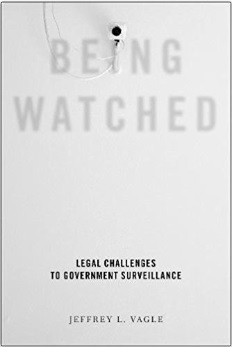
The Brooklyn Law School Library New Books List for March 1, 2018 is out with 40 print titles and 17 e-book titles. One of the titles is the 151-page volume Being Watched: Legal Challenges to Government Surveillance by Jeffrey L. Vagle, Lecturer in Law at the University of Pennsylvania Law School. The nine chapters (You Are Being Watched; A History of Government Surveillance; Getting through the Courthouse Door; The Doctrine of Article III Standing; Before the Supreme Court; Government Surveillance and the Law; The Legacy of Laird v. Tatum; Technology, National Security, and Surveillance; and The Future of Citizen Challenges to Government Surveillance) tell a riveting history of the Supreme Court decision that set the legal precedent for citizen challenges to government surveillance, particularly the case of Laird v. Tatum, 408 U.S. 1 (1972). There the Supreme Court considered the question of who could sue the government over a surveillance program, holding in a 5-4 decision that chilling effects arising “merely from the individual’s knowledge” of likely government surveillance did not constitute adequate injury to meet Article III standing requirements. The book also discusses a more recent case where the ACLU challenged the constitutionality of the FISA Amendments Act over surveillance of American citizens and residents. That Supreme Court case, Clapper v. Amnesty International USA (2013), was one where the Court held that the District Court for the Southern District of New York was correct ruling that the plaintiffs had no standing to bring their case before any federal court.

The book is a fascinating and disturbing story of jurisprudence related to the issue of standing in citizen challenges to government surveillance in the United States. It examines the facts of surveillance cases and the reasoning of the courts who heard them, and considers whether the obstacle of standing to surveillance challenges in U.S. courts can ever be overcome. The author examines the history of military domestic surveillance, tensions between the three branches of government, the powers of the presidency in times of war, and the power of individual citizens in the ongoing quest for the elusive freedom-organization balance. It is essential reading for every American citizen. It explains all the legalities and the methods government uses to surveil citizens.

This post has no comments.
03/02/2018
profile-icon BLS Reference Desk

The Library was recently the recipient of a gift in honor of Joan Wexler, Dean and President Emerita of Brooklyn Law School.  The funds received from the gift were used to purchase books in an area of particular interest to President Wexler.  She chose the area “academic freedom,” and Library Director Janet Sinder selected the books that have been cataloged and added to our collection, and are now available on the shelves in the cellar’s main collection area for loan.  While Professor Sinder ordered over twenty books on this topic, a few of these new books are briefly described below.

A logo of a graduation cap

Description automatically generated

Academic Freedom in an Age of Conformity: Confronting the Fear of Knowledge.

A book cover with pencils falling down

Description automatically generated

This book, written by Joanna Williams, gives the history and analysis of the rise and recent fall of academic freedom, including a discussion of the restrictions that some governments are imposing on academic freedom.

While academic freedom might seem to be a “largely academic proposition disconnected from the pursuit of knowledge,” Ms. Williams enumerates academic freedom in the areas of science, social science, sociology, literature, etc.  She also discusses how the fight for academic freedom has    become a campaign for “academic justice” in recent years.

Academic Freedom in Conflict: The Struggle over Free Speech in the University

A person with a tape over his mouth

Description automatically generated
This work is a collection of essays edited by James L. Turk.  The many contributors to this book document the areas in which academic freedom is in jeopardy, including in religious institutions, in academic-corporate settings, etc.  Also discussed are the “managed university” and demonstrations on campuses.

A practical area for discussion regarding academic freedom is given an entire chapter entitled “Giving and taking offence: civility, respect, ad academic freedom.”  While this book was published in Canada, the information conveyed has implications for those interested in academic freedom in the U.S.

Freedom to Learn: The Threat to Student Academic Freedom and Why It Needs to be Reclaimed

A blue background with white text

Description automatically generated

The author, Bruce Macfarlane, argues for student choice, or real academic freedom, in the areas of attendance requirements, class participation, assessments, etc., in other words, student-centered learning.  He advocates certain rights for students, such as the right to non-discrimination, the right to reticence in the classroom, the right to choose how to learn, etc.


Why Academic Freedom Matters:  A Response to Current Challenges

A stack of books with an open book on top

Description automatically generated

This book, edited by Cheryl Hudson and Joanna Williams, is written by several contributors from the British perspective, and gives a history of academic freedom, defines it as it is currently viewed, discusses the university in the 21st century, and explores the current threats to academic freedom.

This post has no comments.
Field is required.