The Brooklyn Law School logo

BLS Library Blog

Showing 10 of 13 Results

06/07/2014
profile-icon BLS Reference Desk

Brooklyn Law School students interested in competing for cash prizes in connection with Securities Arbitration and Securities Law can enter the James E. Beckley Securities Arbitration and Law Writing Competition being sponsored by the PIABA Foundation. The mission of the PIABA Foundation is to promote investor education and to provide the public with information about abuses in the financial services industry and the securities dispute resolution process. The Beckley competition is open to all law students. Eligible topics include any aspect of securities law, securities arbitration, the Federal Arbitration Act, or the FINRA Code of Arbitration. Winners get their submissions published in the PIABA Bar Journal and receive cash prizes for first place ($1,000), second place ($750), and third place ($500). The deadline for entries is September 19, 2014.

This post has no comments.
01/28/2013
profile-icon BLS Reference Desk

Brooklyn law School Professor James Park has posted his latest scholarly article Securities Class Actions and Bankrupt Companies on SSRN. The article is scheduled for publication in the February 2013 edition of the Michigan Law Review. The abstract reads:

This is the first extensive empirical study of securities class actions involving bankrupt companies. It examines 1466 securities class actions filed from 1996 to 2004, of which 234 (16%) involved companies that were in bankruptcy proceedings while the securities class action was pending. The study tests the hypothesis that securities class actions involving bankrupt companies (“bankruptcy cases”) are more likely to have merit than securities class actions involving companies that are not in bankruptcy (“non-bankruptcy cases”). It finds that bankruptcy cases were more likely to involve restatements than non-bankruptcy cases, but not more likely to have other indicia of merit. Bankruptcy cases were more likely to be successful in terms of dismissal rates, significant settlements, and third party settlements than non-bankruptcy cases. This bankruptcy effect fades with respect to settlements of $20 million or more, likely reflecting the influence of D&O insurance policy limits. The bankruptcy effect is evidence that courts and parties assess the merits of securities class actions differently based on the context of the suit.
This post has no comments.

Insider trading by members of Congress and their staff is back in the headlines after a CBS report on 60 minutes. See video below: 


The 60 Minutes report has renewed attention in H.R 1148, the Stop Trading on Congressional Knowledge Act which would prevent members of Congress and their staffs from using information not available to the public to guide them in making or selling investments. This proposal goes back to 2006 when Rep. Louise Slaughter (D-NY) first proposed the bill in response to a story about day trading by the chief of staff of then-House Majority Leader Tom DeLay(R-TX). The Chairman of the House Financial Services Committee, Rep. Spencer Bachus (R- AL), has announced that he will schedule the first-ever House hearing on legislation to prevent lawmakers from trading on nonpublic information. Sen. Kirsten Gillibrand (D-NY) announced that she and other Senators will introduce a Senate version of the STOCK Act to prohibit members of Congress from engaging in insider trading.

Insider trading in Congress is nothing new. See Abnormal Returns from the Common Stock Investments of Members of the United States Senate, 39 J. Fin. & Quantitative Analysis 661 (2004) which studied congressional insider deals dating to the mid-1990s. The SEC has not taken any action against insider trading by senators and other congressional officers, leaving Congress to police itself so far without success. Such “insider trading” is illegal for most Americans, but the question whether it applies to members of Congress and their staff is the subject of some debate. Insider trading is not explicitly prohibited by law. The SEC website says “the term actually includes both legal and illegal conduct.” The offense is prosecuted as a violation of Rule 10b-5 of the Securities Exchange Act of 1934, a general anti-fraud rule that prohibits deception “in connection with the purchase or sale of any security.”

Commentators claim that Congressional officials are immune from federal insider trading law. But Prof. Donna M. Nagy argues that the “conventional wisdom that there is some type of legal loophole for Congressional insider trading is simply wrong. Any Member of Congress or legislative staffer who trades securities on the basis of material nonpublic information obtained through Congressional service is already doing so in violation of existing federal securities law.” See her article Insider Trading, Congressional Officials, and Duties of Entrustment, 91 B.U. Law Rev. 1105 (2011). 

On the other hand, Prof. Stephen Bainbridge argues the opposite in Insider Trading Inside the Beltway saying “As to members of Congress, however, current law provides a strong argument that their trading cannot be punished under either the classic disclose or abstain or the misappropriation theory.” He concludes: “Insider trading by corporate insiders has been banned for over four decades. Throughout that period, we have known that insider trading by members of Congress was a potential problem that arguably presented even more serious policy concerns than trading by classic insiders. Congressional insider trading creates perverse legislative incentives and opens the door to serious corruption. Yet, both Congress and the SEC have turned a blind eye.”

60 Minutes reported that Chairman Bachus made bets that financial markets would collapse at the same time he met with officials from the Fed and Treasury Department in 2008 by buying options when the Dow opened at 8,604 and selling them a few days later after the market fell doubling his investment. If the STOCK Act becomes law, the true test of equal enforcement will be if the SEC will pursue civil actions and the DOJ pursue criminal actions against a powerful chairman of Congress with oversight of their funding.

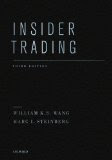
For more on insider trading, see the Brooklyn Law School Library copy of the 3d edition of Insider Trading by William Wang and Marc Steinberg, an 1178 page comprehensive and up-to-date resource by two experts who provide clear and concise information on insider trading liability. Chapters include: Impact on society, the issuer, and the insider trader’s employer — The harm to individual investors from a specific insider trade — Some basic elements of insider trading liability under Section 10(b) and Rule 10b-5 — Those who violate Section 10(b) and Rule 10b-5 by insider trading or tipping — The Rule 10b-5 private plaintiffs who can sue a stock market insider trader for damages — Government enforcement.

This post has no comments.

The Securities and Exchange Commission announced that it filed a record 735 enforcement actions and collected some $2.8 billion in sanctions in the fiscal year that ended September 30 with 146 of these actions being taken against investment advisors, a 30% increase over 2010. The previous year, it brought 677 cases collecting slightly more in penalties — $2.85 billion. The record number of enforcement actions is a result of the enforcement division undergoing its most “significant” reorganization in 2009 and 2010 since being established in the early 1970s. The number of enforcement actions against advisors and broker-dealers also increased, going from 112 in 2010 to 146 at the end of September. The chart below from the SEC website shows Year-by-Year SEC Enforcement Actions 2002 to 2011. 

SEC Chairman Mary Schapiro boasts of increased enforcement in a statement announcing the enforcement results: “We continue to build an unmatched record of holding wrongdoers accountable and returning money to harmed investors. I am proud of our Enforcement Division’s many talented professionals and their efforts that resulted in a broad array of significant enforcement actions, including those related to the financial crisis and its aftermath.”

Increased fines are not the only measure of the effectiveness of an agency’s enforcement efforts. A recent article reports that in the case of U.S. Securities and Exchange Commission v. Citigroup Global Markets Inc. pending in the U.S. District Court for the Southern District of New York, US District Judge Jed S. Rakoff is considering whether to approve Citigroup’s proposed settlement of $285 million ($95 million plus $190 million in disgorgement and interest) with the SEC. Expressing doubts about whether the agreement is sufficient for alleged misdeeds over mortgage-related securities in a deal where Citibank made a $160 million profit and caused its customers to lose $700 million, Judge stopped short of saying he would reject the settlement withholding his approval of the settlement which allows Citibank to avoid prosecution without any admission of wrongdoing. He ridiculed the SEC’s decision to describe the crime as “negligence” instead of intentional fraud, questioning whether a bank making a profit of $160 million by causing losses of $700 million to its customers can conceivably be described as an accident. See Judge Rakoff’s his questions about the proposed settlement in his Order dated October 27 and Citbank’s memorandum in response.

For in depth research on this topic, see the Brooklyn Law School Library resource from its subscription to BNA, the Corporate Practice Series Portfolio No. 77-4th, The SEC Enforcement Process: Practice and Procedure in Handling an SEC Investigation which discusses practice and procedure in handling both informal and formal investigations by the SEC’s Division of Enforcement, including responding to subpoenas, producing documents, and testimony; when and whether companies should conduct internal investigations; the Wells process and settlement discussions; remedies; and consent decrees. The portfolio also examines related issues, including disclosure of an SEC investigation and issues arising out of parallel civil and criminal inquiries.

This post has no comments.
09/23/2011
profile-icon BLS Reference Desk

After six years of litigation in the securities class action case of In re Smith Barney Transfer Agent Litigation, Judge William H. Pauley III of the Southern District of New York in the an Order dismissed the Lead Plaintiff based on the fact that it had never purchased any of the Smith Barney funds at issue. Stating that one of the foundational grounds for a motion testing the pleadings is lack of standing, the judge cited “epic failures” by the lawyers on both sides of the case, and called the effect of the error “seismic” causing the litigation to take on “Sisyphean dimensions.” 

“After six years of litigation, including extensive motion practice, an appeal to the Second Circuit, remand, more motion practice, and discovery, lead counsel learned that the lead plaintiff never purchased any of the securities at issue in this action,” Pauley wrote in today’s decision. “Lead counsel’s failure to confirm the most basic fact — that its client purchased the securities at issue in this action — has resulted in a considerable waste of time and resources,” Pauley said. Criticizing the lawyers for all of the parties in the case for failing to exercise due diligence, Pauley wrote “In retrospect, it was something so obvious that every lawyer in the case should have recognized the problem and reacted immediately. But no one did.”

The Brooklyn Law School Library has in its collection A Practitioner’s Guide to Class Actions by Marcy Hogan Greer (Call #KF8896 .P735 2010), an ABA publication that is a comprehensive guide providing practitioners with an understanding of the intricacies of a class action lawsuit. It also has a state-by-state analysis of the ways in which the class action rules differ from the Federal Rule of Civil Procedure 23.

This post has no comments.
06/25/2010
profile-icon BLS Reference Desk

The US Supreme Court decision Morrison v. National Australia Bank is worth reading for the differing views of the role of the courts expressed by Justice Scalia in the majority opinion and Justice Stevens in his concurrence. Justice Scalia forcefully ruled that §10(b) of the Securities Exchange Act of 1934 (and associated Rule 10b-5) have no international reach and found a presumption against extraterritoriality. Justice Stevens called the presumption against extraterritoriality a nice catchphrase that overstates the point saying: “The presumption against extraterritoriality can be useful as a theory of congressional purpose, a tool for managing international conflict, a background norm, a tiebreaker. It does not relieve courts of their duty to give statutes the most faithful reading possible.”

The case involved a private civil suit alleging securities fraud in a transaction that took place mostly in Australia with some minor US conduct. Eight Justices affirmed the Southern District of New York dismissal of the claim which the Second Circuit subsequently affirmed. But Justice Scalia’s opinion went on to criticize a general approach that has been the law in the Second Circuit, and most of the rest of the country, for nearly four decades. Justices Breyer, Stephens and Ginsberg joined in concurring opinions. Justice Sotomayor did not participate.

Justice Scalia’s 24 page opinion on the extraterritorial reach of the §10b noted that it is a “longstanding principle of American law ‘that legislation of Congress, unless a contrary intent appears, is meant to apply only within the territorial jurisdiction of the United States.'” It also said “When a statute gives no clear indication of an extraterritorial application, it has none.” The ruling strongly criticized the New York-based Second Circuit for relying on a 1968 opinion Schoenbaum v. Firstbrook, 405 F. 2d 200 to use a conduct-and-effects test which asked “(1) whether the wrongful conduct occurred in the Unites States, and (2) whether the wrongful conduct had a substantial effect in the United States or upon United States citizens.” The conduct-and-effects test sought to ascertain what Congress would have done if it had addressed the eventual internationalization of the securities markets. Instead, Justice Scalia formulated a “transactional test” under §10(b), saying that it forbids not all deceptive conduct, but only deceptive conduct “in connection with the purchase or sale of any security registered on a national securities exchange or on any security not so registered.” Finding the statutory focus to be the “purchase and sale transactions,” he concluded that §10(b) applied to “transactions in securities listed on domestic exchanges, and domestic transactions in other securities.” 

Today’s securities market is international in scope with few cases that are either wholly foreign or wholly domestic. The “transactional test” may leave unprotected US citizens who purchase or sell securities outside the United States as well as foreign citizens trading abroad who are victims of domestic conduct perpetrated by Americans over whom foreign courts may lack personal jurisdiction. Interestingly, the issue of the extraterritorial reach of US securities law is part of the Wall Street Reform and Consumer Protection Act of 2009, the financial reform bill pending in Congress. §7216 of H.R. 4173 provides courts with extraterritorial jurisdiction for “1) conduct within the United States that constitutes significant steps in furtherance of the violation, even if the violation is committed by a foreign adviser and involves only foreign investors; or 2) conduct occurring outside the United States that has a foreseeable substantial effect within the United States.” 

For more on the Morrison case, see the post at the Securities Law Prof Blog

This post has no comments.

The dramatic drop in the stock market that occurred on May 6 causing the Dow Jones Average to plummet 1,000 points, 10% of its total value, in a half hour has prompted the Securities and Exchange Commission to propose a rule that would pause trading of individual stocks if the trading price falls 10 percent or more in a five-minute period. A Wall Street Journal article ‘Flash Crash’ Plan: a Circuit Breaker for Every Stock reports the SEC proposed rule change announced this week. The SEC is working with the Financial Industry Regulatory Authority (FINRA) on this issue. 

SEC Chairman Mary Schapiro said she believed that disparate trading rules and conventions across the exchanges exacerbated the “flash crash”. The proposed rule comes as the SEC and the Commodity Futures Trading Commission (CFTC) released Preliminary Findings Regarding the Market Events of May 6, 2010. On page 75, the staff report states “the SEC is taking a number of steps to identify the cause or causes of the May 6 market disruption as well as factors that may have exacerbated that event, and to develop regulatory initiatives to help prevent a recurrence.” 

While the cause of the “flash crash” remains unclear, the report focused on orders placed by high-frequency traders, or HFTs, firms that barely existed a few years ago but now account for two-thirds of all US stock trading. It makes these observations about high frequency traders which it defines as “professional traders that use computer systems to engage in strategies that generate a large number of trades on a daily basis.”:
 

Both the CFTC and the SEC have had extensive conversations with a wide variety of market participants (investors, hedge funds, exchange traded funds, dealers, high frequency traders, etc.) to better understand their trading activities throughout May 6, and to gather anecdotal evidence from which common themes and/or trends can be identified to inform further areas of investigation.

The SEC needs to develop the tools necessary to readily identify large traders and be able to evaluate their trading activity is heightened by the fact that large traders, including certain high-frequency traders, are playing an increasingly prominent role in the securities markets.

See the NY Times DealBook article Speedy New Traders Make Waves Far From Wall Street for more on the growing impact of high-frequency traders.

In a press release issued by the SEC this week, Schapiro said “I believe it is important that all the exchanges quickly reached consensus on a set of uniform circuit breakers that would be triggered when needed. Today’s filings reflect that consensus. I am pleased by the constructive cooperation of the exchanges and FINRA, as evidenced by their rapid response.” The proposed rule is laid out in the SEC Release No.34-62131.

A CNN.Money report Schapiro: Robo-trading eyed in ‘flash crash’ says that Schapiro told a Senate panel that computerized trading could be responsible for the historic market plunge on May 6 and that the 1,000-point stock plunge was “possibly exacerbated by the withdrawal of liquidity by electronic market makers and the use of market orders, including automated stop-loss market orders.” This video featuring Fortune’s Managing Editor Andy Server explains the more proactive regulatory stance that the SEC is now taking:

This post has no comments.
04/29/2010
profile-icon BLS Reference Desk

In a victory for the plaintiff shareholders, the US Supreme Court unanimously ruled in Merck & Co., Inc. v. Reynolds that the statute of limitations actions brought under §10(b) of the Securities Exchange Act of 1934 begins to run upon “discovery of the facts constituting the violation.” The Court held “facts showing scienter are among those that ‘constitut[e] the violation.’” Justice Breyer, writing for the Court ruled that, due to delayed discovery of the claim, the two-year statute of limitations did not bar the investors from bringing a securities fraud action. The decision stated:

We conclude that the limitations period in §1658(b)(1) begins to run once the plaintiff did discover or a reasonably diligent plaintiff would have “discover[ed] the facts constituting the violation”—whichever comes first. In determining the time at which “discovery” of those “facts” occurred, terms such as “inquiry notice” and “storm warnings” may be useful to the extent that they identify a time when the facts would have prompted a reasonably diligent plaintiff to begin investigating. But the limitations period does not begin to run until the plaintiff thereafter discovers or a reasonably diligent plaintiff would have discovered “the facts constituting the violation,” including scienter—irrespective of whether the actual plaintiff undertook a reasonably diligent investigation.

Now the shareholders may pursue their claims that Merck & Co. Inc. violated federal securities law by misrepresenting the safety and commercial viability of Vioxx, a pain reliever ultimately withdrawn from the market. The Court affirmed the Third Circuit Court of Appeal’s decision In re Merck & Co. Securities, Derivative & ERISA Litigation, 543 F.3d 150 (3d Cir. 2008), which held that the statute of limitations does not begin to run until the plaintiff has information suggesting defendant’s scienter. The Third Circuit decision reversed the judgment of dismissal entered by the US District Court for the District of New Jersey, which ruled that the claims were barred by the statute of limitations because the plaintiffs “were put on inquiry notice of the alleged fraud more than two years before they filed suit.” See In re Merck & Co., Inc. Securities, Derivative & “”Erisa” Litigation, 483 F.Supp.2d 407 (D.N.J. 2007).

Justice Scalia, joined by Justice Thomas, concurred in part and concurred in the judgment. Justice Scalia argued for an even more plaintiff-friendly result, stating that the statute of limitations should begin to run when a plaintiff actually discovers facts constituting the violation, rather than when a reasonably diligent plaintiff should have known such facts.

In its decision the Court rejected Merck’s proposed “inquiry notice” standard as inconsistent with the statute, which provides that “discovery” is the event that triggers the 2-year limitations period—for all plaintiffs. It noted that courts applying the traditional discovery rule have long had to ask what a reasonably diligent plaintiff would have known and that courts in at least five Circuits already ask this kind of question in securities fraud cases. Whether the interpretation of “knowledge” to include constructive knowledge will make a meaningful difference in a significant number of cases is unclear. District courts may yet find complaints untimely based on what a “reasonably diligent” investor would do.

This post has no comments.

The Second Circuit Court of Appeals recently ruled that the federal securities laws preclude Sherman Act antitust claims. The decision, Electronic Trading Group v. Banc of America Securities, held that the plaintiff investors were precluded from asserting an antitrust claim against brokers accused of conspiring to charge excessive fees to short sellers where the federal securities regime provided for a remedy. The class-action alleged that the banks conspired to charge inflated borrowing fees through daily conversations, e-mails, and faxes, and jointly determined which securities they should classify as “hard-to-borrow.” The Second Circuit ruled that securities laws take priority over antitrust laws noting that “antitrust liability would inhibit conduct that the SEC permits and that assists the efficient function of the short-selling market.”

In his ruling affirming the dismissal of the antitrust allegations of the complaint by the New York Southern District Court, Judge Dennis Jacobs applied the preclusion analysis stated in Credit Suisse Securities (USA) LLC v. Billing, 551 U.S. 264 (2007). There, the US Supreme Court stated the four considerations of the preclusion analysis: (a) whether the “area of conduct [is] squarely within the heartland of securities regulations”; (b) whether the Securities and Exchange Commission (“SEC”) has “clear and adequate authority to regulate”; (c) whether there is “active and ongoing agency regulation”; and (d) whether “a serious conflict” arises between antitrust law and securities regulations.

The Billing case involved antitrust claims brought by investors in an initial public offering alleging that the underwriters engaged in questionable “tying” practices that required purchasing less desirable securities and “laddering” practices that required buyers to take additional shares at escalating prices, forcing them to pay high commissions on subsequent buys. In Billing, the District Court dismissed the complaint on the grounds that federal securities law impliedly precludes application of antitrust laws. The Second Circuit reversed and reinstated the complaints. The US Supreme Court, addressing the question whether there is a “‘plain repugnancy’” between antitrust claims and federal securities law, concluded that there is, interpreting the securities laws as implicitly precluding the application of the antitrust laws to the conduct alleged in that case.


For more on the Electronic Trading Group decision, see Mark Hamblett’s NY Law Journal article Antitrust Claim Found Precluded by Securities Regime (password required).

The BLS Library subscribes to the Annual Review of Antitrust Law Developments (Call #KF1649 .A763) published by the Section of Antitrust Law of the American Bar Association, which summarizes developments each year in the courts, at the agencies, and in Congress. The annual supplements are recognized as an authoritative and comprehensive set of research tools for antitrust research.

This post has no comments.
08/26/2009
profile-icon BLS Reference Desk

Today’s Wall Street Journal has an article Fight Brews as Proxy-Access Nears. It is worth reading to contrast the reactions of companies, on the one hand, and shareholder activists, on the other, to a proposed SEC plan for greater accountability in corporate governance. Whether shareholders should be allowed to nominate and elect their own candidates as company directors is not a new topic. For some time, proponents of “shareholder democracy” have advocated more shareholder input in the nomination of directors. Typically, in large companies, the company management, not the shareholders, controls the nominating process, so that directors become loyal to the company and often lose sight of shareholder interests. If shareholders want to nominate their own candidate for the board of directors, they have to send separate ballots to all other shareholders at their own expense. Although obligated by law to provide shareholder lists, often company management makes that process as difficult as possible. As a result, when shareholders do nominate their own candidates as company directors, they often spend tens of thousands of dollars in a proxy battle to inform shareholders that there is a contested election.

In an effort to make companies more accountable and responsible to shareholders, the SEC voted earlier this year to enact a proposed rule change to the federal proxy rules that would permit shareholders to nominate directors as part of a corporation’s annual proxy solicitation process. In explaining the need for the reform, the SEC cited the current economic crisis suggesting that the crisis has led many to raise serious concerns about the accountability and responsiveness of some companies and boards of directors to the interests of shareholders, and has resulted in a loss of investor confidence. Under the new rules, shareholders could also modify a company’s nomination procedures or disclosure about elections, subject to applicable state law requirements.

There are certain complexities in the proposed rule change. For example, 14a-11 would allow large shareholders to include nominations in the company’s proxy statement. The proposed change sets thresholds that would allow shareholders to organize and put together groups for submitting nominations to the board (1% for companies above $750 million; 3% for companies above $75 million; 5% for companies below $75 million) without triggering most of the requirements of the proxy rules. 

For greater detail on the topic of the SEC’s access proposal, see several excellent postings in The Race to the Bottom that provides an analysis of laws and regulatory measures that govern today’s corporations. One of those posts, Access and Its Opponents: An Overview, includes contrasting views by legal practitioners and the legal academy in submissions made during the recently ended comment period regarding the proposed rule change. The two comment of special interest are the one letter from seven large law firms that took the unusual step of submitting a joint letter opposing the idea; the other letter from 80 law professors, including BLS Law Professors James A. Fanto and Arthur r. Pinto, supported the SEC’s proposal.

This post has no comments.
Field is required.