The Brooklyn Law School logo

BLS Library Blog

Showing 8 of 8 Results

decorative-image

What began as a local celebration of Women’s History Week in Santa Rosa, California in 1978, has since evolved into a nationally observed Women’s History Month. The theme for 2025, chosen by the National Women’s History Alliance, is “Moving Forward Together! Women Educating & Inspiring Generations.”  

We would like to highlight the following events and resources at BLS Library in celebration of Women’s History Month:

Alcove Academy - Reading and Research with Jean: Wednesday, March 5, 12:45 pm at the 1st Floor Library Alcove. Join Librarian Jean Davis to explore library resources on gender and the law, that can help with your seminar papers or your submissions to writing competitions. More information about this event below: 

Book Display:  We invite you to explore the array of books on women and the law in our collection, that are on display on the library’s first floor.

Digital Display: Please look through our library’s digital display for Women's History Month at https://guides.brooklaw.edu/digital_book_displays/women_history_month. The display include books by and about members of the BLS community; titles about women judges, law professors and practitioners; and books covering key topics on women and the law. 


Finally, if you are attending the IBL Lecture: Women's Property Rights Under CEDAW on Monday, March 3, at 5:30 PM (Subotnick, 10th Floor), BLS Library has multiple digital copies of the book co-authored by speaker Professor José E. Alvarez. You can access the book at https://sara.brooklaw.edu/cgi-bin/koha/opac-detail.pl?biblionumber=492581 or use the QR code below.


This post has no comments.
05/29/2018
profile-icon BLS Reference Desk

A book cover with a person wearing a crown
    Description automatically generated

Her fans refer to her as the “Notorious R.B.G.” a reference to the legendary rapper “The Notorious B.I.G.” Ruth Bader Ginsburg jokes in an interview that they have a lot in common. They both come from Brooklyn. Through Ginsburg’s history you can track the women’s movement in the United States:  her fight for legal equality (for women and men), her position on an increasingly conservative court. It gives access to Ginsburg, who is interviewed, along with her children, her granddaughter, and her friends.

Starting with various right-wing figures calling Ginsburg “witch,” “very wicked,” “zombie,” the documentary takes us on a tour through Ginsburg’s life: her 1993 confirmation hearing for the Senate Judiciary Committee, recent interviews at Harvard Law School or the Virginia Military Institute, all of which help fill in the blanks of her lengthy career, as a lawyer working on women’s rights issues to her eventual nomination to the highest court in the land. There is information of personal details: her love of opera, her friendship with Antonin Scalia, the diverse collars she wears to court, her lengthy marriage to Martin D. Ginsburg. Once we reach the present day, the memes take over, showing how Ginsburg has captured the hearts of a younger generation. Seeing a class full of high school students as they listen to Ginsburg’s during a visit to their class is especially endearing.

Her husband, “Marty,” was by all accounts a well-liked and gregarious man, and not threatened by his wife’s ambitions. Gloria Steinem refers to her as a “superhero,” but Ginsburg did not spend the 1970s walking in protest marches. Instead, she went about trying to establish legal precedent for gender equality. She did so in a couple of groundbreaking cases, like Frontiero v. Richardson, her first case before the Supreme Court. “RBG” profiles those early cases, where Ginsburg took the opportunity in her arguments not only to plead for her client, but also to teach the existing Supreme Court justices that inequality is real, and why it was wrong to treat women as second-class citizens. In one of her arguments, she quoted 19th century abolitionist and attorney Sarah Grimké,: “I ask no favors for my sex. I surrender not our claim to equality. All I ask of our brethren is, that they will take their feet from off our necks.” The Supreme Court listened. Ginsburg won 5 out of 6 of her cases.

We get to hear a brief sequence dealing with her controversial 2016 comments about then-Presidential candidate Donald Trump, a serious break with the tradition of Supreme Court Justices maintaining poker faces, regardless of who is in power. One of the regular interview subjects is Senator Orrin Hatch, who may disagree with her politics but also admires her, expressing no doubt that she belongs on the Supreme Court. In the film, his is a measured presence, exuding an acceptance of disagreement and the need for compromise. His comments come from an earlier, more civilized world. Ginsburg is now queen of the dissenting opinion, but unfortunately the filmmakers stay far, far away from any “dissenting opinions” themselves.


This post has no comments.

The US Congress, by Public Law 100-9, designated the month of March 1987, as “Women’s History Month”. This law requested the President to issue a proclamation calling on the American people to observe this month with appropriate activities. President Reagan then issued Presidential Proclamation 5619 proclaiming March 1987 as “Women’s History Month”. Since then, Presidential Proclamations have declared March as Women’s History Month.

Brooklyn Law School celebrates Women’s History Month by recognizing Amelia Dietrich Lewis, Class of 1924, as “one of the most tenacious lawyers the state of Arizona has ever seen.” She was a graduate of St. Lawrence University School of Law (now Brooklyn Law School). She exhibited her moxie early in her career, even before she was sworn in as an attorney. Although Lewis was scheduled to take the bar exam on June 24, 1924, she learned that the New York Bar prohibited candidates under the age of 21. In Lewis’s case, she was to turn 21 the very next day, on June 25. Facing this technicality, she filed suit against the Bar, arguing she would be 21 on the 24th because her birthday was actually the first day of her 22nd year.” She was successful in her suit and took the exam as planned on the 24th and passed. After practicing law in New York for 33 years, in 1957 following the death of her husband, she moved to Arizona. She took the bar examination in that state with just one other woman, Sandra Day O’Conner. There, she worked as a prosecutor for six years and then maintained a thriving solo practice, concentrating in elder law in Sun City. She was well into her eighties when she retired.

Lewis is best known for her involvement in the landmark 1967 Supreme Court case, In re Gault, 387 U.S. 1 (1967), which brought due process to juvenile courts across the nation. Her client, Gerald Gault, had been sentenced without legal counsel to an Arizona reformatory. He allegedly made an obscene phone call to a neighbor, was arrested by local police, and tried in a proceeding that did not require his accuser’s testimony. He was sentenced to six years in a juvenile “boot camp” for an offense that would have cost an adult only two months. Lewis assumed the role of co-counsel after Gault’s appeals at the lower level were exhausted. She was drawn to the case because she had raised three healthy sons and “wanted to give something back.” Ultimately, the defense of the boy prevailed, with the Court holding that he was entitled to the same constitutional safeguards as adults: a trial by jury, the right to legal counsel, the right to cross-examine witnesses, and the right to remain silent. Justice Fortas in his 8-1 majority opinion wrote: “Neither the 14th Amendment nor the Bill of Rights is for adults only. Under the Constitution, the condition of being a boy does not justify a kangaroo court.”

Lewis was recognized by the Arizona Republic as one of the legal greats of that state. In 1988, she received the first Amicus Award of the Association of Trial Lawyers of America, which honored her for pioneering the vital role of women in the legal profession. Upon her death in 1994, the Chief Justice of the Arizona Supreme Court commented: “She made history for the law in many ways. Her life and career epitomized the practice of law as it should be.”

A person in handcuffs with his hands on his face

Description automatically generatedThe Brooklyn Law School Library has in its collection The Constitutional Rights of Children: In re Gault and Juvenile Justice by David S. Tanenhaus (Call No. KF228.G377 T36 2017). This new edition includes expanded coverage of the Roberts Court’s juvenile justice decisions including Miller v. Alabama (in which the Court held that mandatory sentences of life without the possibility of parole are unconstitutional for juvenile offenders) and explains how disregard for children’s constitutional rights led to the “Kids for Cash” scandal in Pennsylvania. Widely celebrated as the most important children’s rights case of the twentieth century, Gault affirmed that children have the same rights as adults and formally incorporated the Fourteenth Amendment’s due process protections into the administration of the nation’s juvenile courts.

This post has no comments.

A group of men sitting at a table

Description automatically generated


Thirty years ago, before a sparse audience scattered throughout a cavernous auditorium at Cornell University, a petite woman argued passionately about the meaning of the U.S. Constitution. As her fellow symposium panelists — Cornell professors of law, government, and history — debated the technicalities of the document, she pushed for broader questions to be asked on issues that the Constitution is silent on, including “affirmative rights” and “cultural and social guarantees.”  ‘’ ‘Our Constitution is defective in that respect’ she said. ‘Why should the U.S. Constitution be a model for the world? Who needs freedom of speech when you have an empty belly?’ ” (Yaukey, Ithaca Journal, September 19, 1987, p. 4A)  


A person sitting at a table with gavel

Description automatically generated

Much has changed in the intervening years. That appellate judge and pioneering women’s rights advocate who couldn’t draw a decent-sized crowd at her own alma mater, is now a pop culture icon.  Journalists breathlessly report on her fashion sensibilities (fishnet gloves anyone?) or when she is spotted carrying a tote bag with her own face on it.  Kids dress up as her for Halloween and adore her coloring book.
 

One thing hasn’t changed though: Ruth Bader Ginsburg still has plenty to say about the Constitution.


A lot has also been said and written about Justice Ginsburg, who holds an honorary degree from BLS.  The following are some relevant titles in the BLS Library collection to consider putting on your summer reading list:

A book cover with a person wearing a crown

Description automatically generated

Notorious RBG: The Life and Times of Ruth Bader Ginsburg by Irin Carmon & Shana Knizhnik (2015). [Call number: KF8745.G56 C37 2015]  The elevation of RBG to her current status as a cultural icon can be traced to the Notorious R.B.G. Tumblr created by Shana Knizhnik, one of the book’s co-authors, in 2013. This title is a colorful and entertaining look at Ginsburg’s life and career.  We get plenty of juicy nuggets about her Brooklyn childhood and nickname (Kiki), her favorite bathroom at Cornell where she could get schoolwork done (in the architecture school), the time she couldn’t check a citation as a Harvard Law Review member (the volume was located in a men-only library reading room), and how her mentor Prof. Gerald Gunther had to “blackmail” federal judge Edmund Palmieri so she could secure a clerkship (Justice Frankfurter flatly said no; Judge Learned Hand refused to hire women as he was “potty-mouthed” and did not want to watch his language around women.)   Notorious RBG remains accessible even when it starts covering the denser legal material from Ginsburg’s time as a law professor, at the ACLU Women’s Rights Project, and her judicial tenure.  Excerpts from the brief she authored in Reed v. Reed (1971), her majority opinion in the VMI gender discrimination case, United States v. Virginia (1996), and the dissent she read from the bench in the equal pay case Ledbetter v. Goodyear Tire & Rubber Co. (2007) (that helped spur passage of the Lilly Ledbetter Fair Pay Act of 2009) are all meticulously annotated so as to be readily understood by the layperson. RBG’s loving marriage to Marty Ginsburg shines through: the last note he wrote to her before he died from cancer, reproduced in the original, is especially touching.  Even if you don’t want to read all the material, skimming through the many photographs and illustrations in the volume can be a joy.

A book cover of a person

Description automatically generated

My Own Words by Ruth Bader Ginsburg, with Mary Hartnett and Wendy W. Williams (2016)  [Call number: KF373.G565 G56 2016]  My Own Words is a collection of Ginsburg’s writings and speeches which are given context by short introductory essays by her co-authors.  Especially interesting are the early documents: a school newspaper editorial from June 1946 that champions the new United Nations Charter; “One People”, a 1946 article for the East Midwood Jewish Center Bulletin (religious school graduation issue) discussing post-war unity; and a 1953 letter to the editor published in the Cornell Daily Sun titled “Wiretapping: Cure worse than Disease?” We get some insight into Ginsburg’s love for opera, friendship with Justice Antonin Scalia, and why her given name Joan never stuck.  Her family and marriage get some attention: husband Marty was a true partner, did all the cooking, and was the biggest champion of his wife — decades after the fact, he remained annoyed at Harvard Law School for not allowing RBG to be awarded a Harvard degree after completing her third year at Columbia.  Yet My Own Words feels incomplete: despite the many speeches, law review articles, briefs, and judicial opinions contained in the volume, Ginsburg’s personality and character remain elusive.  This is a function of the limited scope of the project: RBG’s co-authors Mary Hartnett and Wendy Williams are her official biographers, and one gets the sense that more personally revealing anecdotes and materials are being held back for the main publication that will follow.

A close-up of a document

Description automatically generated
Brief for Appellant, Reed v. Reed

The Legacy of Ruth Bader Ginsburg by Scott Dodson (ed.) (2015)  [Call number: KF8745.G56 L4499 2015]  This volume is a collection of 16 essays from legal luminaries that include Herma Hill Kay, Nina Totenberg, Lani Guinier, Tom Goldstein, and many more.  Linda Kerber’s essay “Before Frontiero there was Reed” vividly traces the history of Reed v. Reed, the first case in which the Supreme Court held that arbitrary discrimination based on gender violated the Equal Protection clause. As Kerber writes, Ginsburg added the names of Pauli Murray and Dorothy Kenyon to her Reed brief; even though neither had written a word, RBG “understood more clearly than anyone of her time the debt that the women of her generation [ ] owed to those of preceding generations.” Many of the essays focus on doctrine — criminal procedure, jurisdiction, federalism — but the closing essays speak to her temperament and approach to life and the law. The closing essay “Fire and Ice: Ruth Bader Ginsburg, the Least Likely Firebrand” by Dahlia Lithwick is especially revealing. Lithwick describes how Ginsburg’s judicial voice grew exponentially after Justice O’Connor retired and RBG was left the only woman on the court.  Faced with the male Justices’ insensitivities during oral argument in Safford Unified School District v. Redding (2009), a case in which school officials strip searched a teenaged female student, RBG took the unprecedented step of granting an interview while the decision was still pending. In the interview, Ginsburg told Joan Biskupic of USA Today (who was also Justice O’Connor’s biographer) that her colleagues “have never been a 13-year-old girl” and that more women were needed on the court. The student prevailed 8-1 in her claim against the school district.  And perhaps it was no coincidence that just 3 weeks after the USA Today interview was published, President Obama nominated Sonia Sotomayor to the Supreme Court.

A book cover of two women

Description automatically generated

Sisters in Law: How Sandra Day O’Connor and Ruth Bader Ginsburg went to the Supreme Court and changed the world by Linda Hirshman (2015).  [Call number: KF8744 .H57 2015]  Sisters in Law traces the background of two ostensibly very different women, one a Goldwater Girl, the other a card-carrying member of the ACLU, who ended up as pioneers on the Supreme Court.  Justice O’Connor was known to be a centrist, a “justice-as-legislator” who believed in “playing defense” to protect hard-earned gains and who adhered to incrementalism. In contrast, Ginsburg with her litigation and advocacy background was used to “playing offense.” Nevertheless, once RBG reached the court, she quickly determined that of all the relationships she needed to develop, the most important was the one with O’Connor.  Justice O’Connor, who had over the years been fed many of RBG’s clerks, reciprocated.  Contrary to tradition, RBG’s first assigned majority opinion for the court was not a unanimous decision but rather a complex ERISA case on which the Justices had split 6-3.  After Ginsburg had successfully navigated her way through this first challenge, O’Connor, who had dissented, sent her a note that read: “This is your first opinion for the Court, it is a fine one, I look forward to many more.”  Hirshman also includes an anecdote about how RBG, as the first Jewish justice in a generation, helped change court practices. Upon joining the court, Ginsburg sent a letter to Chief Justice Rehnquist, siding with Orthodox Jewish lawyers who objected to the year on their certificates of admission being worded as “The Year of Our Lord.”  She encountered resistance from an unnamed colleague (the author suspects Rehnquist or Blackmun) “Why are you making a fuss about this? It was good enough for Brandeis, it was good enough for Cardozo and Frankfurter.” RBG’s response? “It’s not good enough for Ginsburg.”  The Court ultimately acquiesced.  There is plenty in this book to chew on about both the differences and shared experiences of the first two female Supreme Court Justices, and how they have changed the dynamic of the Court forever.

This post has no comments.
04/06/2017
profile-icon Eric Yap

On April 4, 2017, as part of the Legal Lunches series, BLS professors Liz Schneider and Susan Hazeldean led a lively townhall discussion on the impact of the Trump administration on women’s rights, reproductive rights, and LGBTQ rights.  

A group of people standing around a desk

Description automatically generated
President Kennedy signs Equal Pay Act into law in 1963

One of the topics discussed was equal pay. When the Equal Pay Act was signed into law in 1963, women received 59 cents for every dollar earned by a man. Despite progress over the years, women who work full-time currently earn only about 80% of what their male counterparts earn. Among other efforts, President Obama had issued Executive Order 13673 (Fair Pay and Safe Workplaces) on July 31, 2014, which was aimed, in part, at narrowing that gap.

Trump’s revocation of the Obama executive order on March 27, 2017 nullifies rules that required paycheck transparency, and that barred federal contractors from imposing mandatory arbitration when their workers raised claims of sexual assault or sexual harassment.  The revocation is particularly harmful to women workers. Prof. Schneider also pointed out that the Trump administration has deleted the White House webpage on equal pay. Where the Obama White House once had information about the Lilly Ledbetter Fair Pay Act and the Equal Pay Pledge, all that remains is a landing page with the terse “Thank you for your interest in this subject. Stay tuned as we continue to update whitehouse.gov

April 4, 2017 also happened to be Equal Pay Day.  This is the day that symbolizes how far into the next year a woman has to work, in order to earn what a man did during the preceding year. Equal Pay Day is always commemorated on a Tuesday, to further represent how far into the following work week women have to work, to reach the level earned by men the previous week.

BLS Library has various print and digital resources on the subject of equal pay.  Our collection includes the following:

A sign on a wall

Description automatically generated

Susan Omilian & Jean Kamp, Sex-Based Employment Discrimination (updated through Sept 2016). This treatise is available electronically through Westlaw. It includes comprehensive treatment of claims brought under the Equal Pay Act, including making a prima facie case, defenses, enforcement, and remedies. Citations are kept current, with the most recent update in September 2016. The library also has the looseleaf version of the title in print, updated through June 2014.

Nyla Jo Hubbard, The rape of the American working woman: How the law and attitude violate your paycheck (2016).   Hubbard, a non-lawyer, combines anecdotes from her personal experience with analysis of how women are placed at a systematic disadvantage under our laws. She discusses a wide range of laws and policies, ranging from Social Security, to healthcare, to childcare subsidies, in order to explain the causes of pay inequality. This title is available as an e-book through ProQuest.  

Susan Bisom-Rapp & Malcolm Sargeant. Lifetime disadvantage, discrimination, and the gendered workforce (2016).  The authors, who are law professors in the U.S. and U.K. respectively, examine the disadvantages faced by women at work, including equal pay issues, in light of inadequacies in the law in both countries. They contend that the piecemeal, incremental approaches built into the legal systems of the U.S. and U.K. do not work and that a more holistic solution is required. This title is available as an e-book through ProQuest.

Christianne Corbett & Catherine Hill, Graduating to a pay gap: The earnings of women and men one year after college graduation (2012). The American Association of University Women (AAUW) has long been engaged in studying, analyzing, and providing policy direction on equal pay issues. In this publication, they explain how pay inequality among college graduates begins immediately after graduation. While discrimination is an important factor, the AAUW study recognizes that gender differences in willingness and ability to negotiate salary contribute to the pay gap, recommending that this issue also be addressed.

A book cover of a book

Description automatically generated
Chen, Compliance and Compromise


Cher Weixia Chen, Compliance and compromise: The jurisprudence of gender pay equity (2011).  In this book, Chen, a legally-trained professor of international studies, approaches the topic of pay equality from an international law perspective. She focuses in particular on International Labour Organization (ILO) Convention No. 100 on Equal Remuneration, and how ratifying states have complied or failed to comply with its mandate. This is an interesting read on pay equality laws in countries other than the U.S.: while 173 of the 187 ILO members have ratified ILO Convention No. 100 to date, the U.S. is not one of them.

This post has no comments.

A screenshot of a web page

Description automatically generated

In honor of Women’s History Month this March, head over to HeinOnline to see its Women and the Law collection.  This Hein collection brings together books, biographies, and periodicals exploring the role of women in society and the law.  Scholars use this platform to  research the progression of women’s roles and rights in society over the past 200 years.  In addition to a wealth of historical works, the collection also features more than 70 contemporary feminist sources archived from Emory University Law School’s Feminism and Legal Theory Project.

This post has no comments.

A Presidential Proclamation for Women’s History Month, 2016 states that “we remember the trailblazers of the past, including the women who are not recorded in our history books, and we honor their legacies by carrying forward the valuable lessons learned from the powerful.”

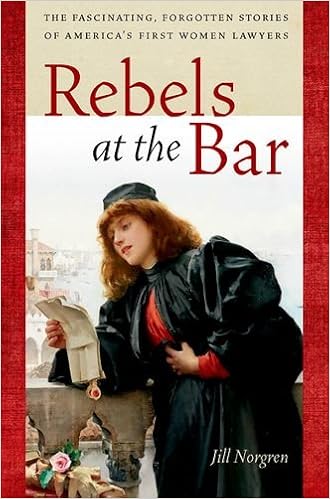
Rebels at the BarTo commemorate Women’s History Month, Brooklyn Law School Associate Librarian Linda Holmes has added some interesting titles in the display case on the first of the library opposite the elevator, including Rebels at the Bar: The Fascinating, Forgotten Stories of America’s First Women Lawyers by Jill Norgren (Call # KF367 .N67 2013). The book recounts the life stories of a small group of nineteenth century women who were among the first female attorneys in the United States. Beginning in the late 1860s, these pioneers, motivated by a love of learning, pursued the radical ambition of entering the then all-male profession of law. They desired recognition as professionals and the ability to earn a good living. One prominent early woman attorney was Belva Lockwood, born in New York State in the Niagara County town of Royalton on October 24, 1830. In 1879, a bill was passed in both houses of Congress and signed by President Rutherford B. Hayes allowing Lockwood to become the first woman to practice before the Supreme Court of the United States. On March 3, 1879, she became the first woman admitted to practice before the United States Supreme Court. One of her first actions was to nominate a black Southern colleague for admissions to the court.

In 1884, Lockwood was nominated for president of the United States by the National Equal Rights Party along with Harriet Stow as the vice presidential candidate. Running against James G. Blaine (Republican) and Grover Cleveland (Democrat) at a time when women were not allowed to vote, she received 4,194 votes. She ran for president again in 1888. Lockwood’s professional life focused on women’s rights and she helped women gain equal property rights and equal guardianship of children. She served as president of the Women’s National Press Association, commissioner of the International Peace Bureau in Berne, president of the White House chapter of the American Woman’s League, a senator for the District of Columbia Federal Women’s Republic, chairman of the committee on industrial police for the National Council for Women, and president of the National Arbitration Society of the District of Columbia. She died on May 19, 1917. In 1983 she was inducted into the National Women’s Hall of Fame and on June 18, 1986, the United States Postal Service issued a memorial stamp. For more on Lockwood, see the entry at the New York State Library at this link.

This post has no comments.
03/01/2013
profile-icon BLS Reference Desk

March is Women’s History Month.  The Library takes this opportunity every year to celebrate “Women and the Law” with books the Library owns on the topic highlighted in the first floor display case.  Some of the titles displayed there this year are:

Baer, Judith A.,  Women in American Law: the Struggle Toward Equality from the New Deal to the Present.

Blakely, Susan Smith, Best Friends at the Bar: the New Balance for Today’s Woman Lawyer.

Brown, Anne Murphy, Legally Mom: Real Women’s Stories of Balancing Motherhood & Law Practice.

Craig, Judi, Women Attorneys Speak Out! How Practicing Law is Different for Women than for Men.

Epstein, Phyllis Horn, Women-at-Law: Lessons Learned Along the Pathways to Success.

Fletman, Abbe F., The Woman Advocate.

Kuersten, Ashlyn K., Women and the Law: Leaders, Cases, and Documents.

Lockwood, Karen M., The Road to Independence: 101 Women’s Journeys to Starting their Own Law Firms.

Salkin, Patricia E., Pioneering Women Lawyers: From Kate Stoneman to the Present.

Sherman, Lisa G., Sisters-in-Law: An Uncensored Guide for Women Practicing Law in the Real World.

Slotkin, Jacquelyn Hersh, It’s Harder in Heels: Essays by Women Lawyers Achieving Work-Life Balance.

Snyder, Theda C., Women Rainmakers’ Best Marketing Tips.

If you would like to look at any of the titles on display, please inquire at the first floor reference desk.

This post has no comments.
Field is required.