The Brooklyn Law School logo

BLS Library Blog

Showing 10 of 12 Results

03/05/2018
profile-icon BLS Reference Desk

Courts have cited the Administrative Procedure Act, Pub. L. 79–404 enacted on June 11, 1946, in blocking the Trump administration’s attempts to end policies from the Obama era. These include actions to undermine the Deferred Action for Childhood Arrivals program (New York v. Trump), a delay in a regulation requiring oil and gas companies to reduce methane leaks (Sierra Club v. Zinke), and postponement of a rule that would give low-income families more access to housing in wealthier neighborhoods (Open Communities Alliance v. Carson). In each instance, Trump policy changes have hit the same stumbling block: Courts say the administration has not followed the proper steps in enacting them, citing a 1940s-era law that’s become a key weapon in the legal battle over the president’s agenda. Under that law, the Administrative Procedure Act, federal agencies are required to provide a reasoned justification for their policy decisions and offer the public an opportunity to weigh in when they are creating new regulations, making notable changes to existing rules, or scrapping them altogether. In other words, rescission of the former policies require that the government provide notice and comment, otherwise there would be a violation of Section 553 of the APA.

Congress passed the Administrative Procedure Act in 1946 amid the rise of communism and fascism in Europe, hoping to place checks on the vast bureaucracy created by the New Deal and “avoid dictatorship and central planning,” as one legal expert explained. Under the law, federal agencies must provide a reasoned analysis for making policy changes to avoid “arbitrary and capricious” rule-making. The Administrative Procedure Act requires that agencies go through a process known as “notice and comment” before issuing, amending or repealing “substantive rules.” As part of that process, the agency must publish proposed actions in the Federal Register and then give the public at least 30 days to submit feedback. When it finalizes its proposal, the agency must respond to issues raised by the public comments and must explain why it settled upon the course of action that it chose. The explanation must show why the agency’s action is reasonable and not “arbitrary” or “capricious.”

Brooklyn LawA black and white sign with white text

Description automatically generated School students may want to review Informal Rulemaking, a CALI lesson (password required), which examines the procedural steps that an administrative agency must follow in order to create a valid “informal” rule. This lesson is intended for students who have studied these issues in class and wish to further refine their knowledge.

This post has no comments.
12/13/2017
profile-icon BLS Reference Desk

Network neutrality is in danger. Yet it is not what those of us who care about democracy and a free marketplace of ideas seek. We need to be fighting to wrest access to the internet out of the hands of large corporations who currently dominate it. The debate makes clear that it is time to start treating the internet like a utility. Most regions of the US are dominated by only one or two major internet service providers. A marketplace with so few choices is not a free market. The net neutrality debate makes clear that it is time to start treating internet like a utility rather than pretending that monopolistic internet service providers operate in a free market.

Current FCC chairman, Ajit Pai, voted against those rules when he was a commissioner. He has supported “light-touch” regulations that instead require Internet Service Providers (ISPs) to disclose any blocking or prioritization of their own content or from their partners. Now more than twenty Internet experts, including the “father of the internet” Vint Cerf and Tim Berners-Lee, inventor of the World Wide Web, say in a letter that they are concerned that rules written to replace the current ones are based “on a flawed and factually inaccurate understanding of Internet technology”. They mentioned “major problems” the FCC had with its online comment system. The FCC received 23 million comments on the issue of net neutrality, but millions of them were fake submissions. Nearly a half-million comments came from Russian email addresses. Last week, the agency’s general counsel rejected an open letter by New York Attorney General Eric Schneiderman’s (D) request for information about comments filed in the agency’s net neutrality records and whether some were filed under stolen identities.

The FCC is expected to pass the new regulations, with the three Republicans on the commission saying they support the measure.  The FCC, the letter noted, has also not “held a single open public meeting to hear from citizens and experts about the proposed Order” ― a break from “established practice.” Congress should cancel the agency’s vote, the experts say, because the FCC’s “rushed and technically incorrect proposed Order to abolish net neutrality protections without any replacement is an imminent threat to the Internet we worked so hard to create.” Democratic lawmakers have consistently opposed the repeal and are continuing their quest to keep the net neutrality rules in place. A letter by thirty-nine senators urged Pai  to “abandon this radical and reckless plan to turn the FCC’s back on consumers and the future of the free and open Internet.” On December 7, Rep. Sean Maloney (D-N.Y.) introduced H.R. 4585 to prohibit the FCC from relying on the Notice of Proposed Rulemaking in the matter of restoring internet freedom to adopt, amend, revoke, or otherwise modify any rule of the Commission. Rep. Mike Doyle (D-Penn.) announced that he will introduce legislation to reverse the repeal if the FCC votes on it.
net

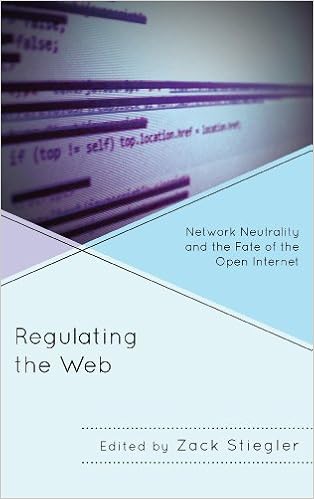
It is unlikely that the three Republican commissioners will switch sides. The FCC is an independent agency. The courts have generally allowed the FCC to classify services as it wishes. One issue is  whether the FCC has the authority to make a U-turn and reduce broadband ISPs to an information service. A court could challenge the FCC’s reversal ruling that the agency is behaving in an arbitrary or unreasonable manner. It will be hard to convince a court that broadband service is no longer a utility subject to regulation. Courts will serve as the real check on an FCC trying to create a closed off and more expensive web. See Brooklyn Law Library’s online version of Regulating the Web: Network Neutrality and the Fate of the Open Internet which brings together a diverse collection of scholars who examine the net neutrality policy and surrounding debates. The book contributes to discourse about net neutrality so we may continue toward preserving a truly open Internet structure in the US.

This post has no comments.
03/07/2017
profile-icon BLS Reference Desk

The new administration in Washington vows to reduce federal regulations and Steve Bannon, the chief White House strategist, argues for a “deconstruction of the administrative state” and the possible dismantling of the New Deal. The argument for this retrenchment of regulatory law is that regulations are unnecessary and costly, detrimental to business and a hindrance to the growth of jobs in the economy. Recently C-SPAN aired the 1982 PBS documentary The Regulators: Our Invisible Government which focused on regulation of air pollution in the national parks. Although dated, the film has current relevance as a teaching tool for law students and others interested in regulatory law as it details the process of turning general language in a 1977 amendment to the Clean Air Act into specific regulations. The 50 minute video tells the behind-the-scenes negotiations and debates between Environmental Protection Agency (EPA) regulators and environmental and industry interests. See video (also available at this link) below.

The Brooklyn Law School Library has in its collection two books with very differing views of the administrative state. The latest, Law’s Abnegation: From Law’s Empire to the Administrative State by Adrian Vermeule (available in print at Call No. KF5425.V47 2016 and electronically via ProQuest Ebook Central), is a theoretically informed and lawyerly interpretation of the law of the modern administrative state. The author demonstrates how legal doctrine really works by using cases familiar to most administrative lawyers. Law’s Abnegation can be read with and compared to Is Administrative Law Unlawful? by Philip Hamburger (Call No. K3400.H253 2014). The two books represent extreme views on the status of administrative law in America. Hamburger answers the title question of his book with a strong affirmative. Vermeule, who reviewed Hamburger’s book in his terse one-word title, No, 93 Texas Law Review 1547 (2015), follows up and expands on his views in his book.

This post has no comments.
11/21/2012
profile-icon BLS Reference Desk
The annual Presidential Thanksgiving pardon of a turkey is a relatively new tradition that began in 1989 when George H.W. Bush granted the first official pardon. This year, President Obama will pardon one of two turkeys, either Cobbler or Gobbler, to become the 24th turkey to receive the honor of the presidential pardon. Rumors of turkey pardons stretch back to President Abraham Lincoln who spared a turkey meant for Christmas dinner when his son Tad argued the turkey had as much a right to live as anyone. President John F. Kennedy spared a turkey not as an official pardon on November 19, 1963, shortly before his assassination, saying “Let’s just keep him.” In 1987, President Ronald Reagan deflected questions about pardoning Oliver North in the Iran-contra case by joking about pardoning the turkey that was already heading to a petting zoo.
 

The Brooklyn Law School Library collection includes a 75 page pamphlet The Thanksgiving Turkey Pardon, The Death of Teddy’s Bear, and the Sovereign Exception of Guantánamo. In it, the author sees the annual presidential reprieve as more than a lark but as “a symbolic pardoning act which, through public performance, establishes and manifests the sovereign’s position at the helm of the state by highlighting . . . his power to control matters of life and death.” These rituals raise troubling thoughts on the exercise of US sovereignty, from Teddy Roosevelt’s big-stick era to the holding of prisoners at Guantanamo.

The Encyclopedia Smithsonian says that the first Thanksgiving service known to be held by Europeans in North America occurred on May 27, 1578 in Newfoundland, although earlier Church-type services were probably held by Spaniards in La Florida. In 1941, the US Senate amended H.J. Res. 41, making the Fourth Thursday in November a national legal holiday for Thanksgiving.

This post has no comments.
01/10/2012
profile-icon BLS Reference Desk

This week marks the 10th anniversary of the No Child Left Behind Act of 2001 (Pub. L. No. 107–110) which President George W. Bush signed into law on January 8, 2012 changing how school districts educate America’s students. In remarks on signing the bill made at a public school in Ohio, President Bush said:

The fundamental principle of this bill is that every child can learn, we expect every child to learn, and you must show us whether or not every child is learning. I read a quote one time from a young lady in New York. She said, ‘‘I don’t ever remember taking an exam. They just kept passing me along. I ended up dropping out in the seventh grade. I basically felt nobody cared.’’

The story of children being just shuffled through the system is one of the saddest stories of America. ‘‘Let’s just move them through.’’ It’s so much easier to move a child through than trying to figure out how to solve a child’s problems.

Recent reports question whether No Child Left Behind (NCLB) has lived up to that promise. For example, the January 2010 report Test, Punish, and Push Out: How Zero Tolerance and High-Stakes Testing Funnel Youth into the School to Prison Pipeline provides an overview of zero-tolerance school discipline and high-stakes testing, how they relate to each other, and how NCLB have made school discipline even more punitive. The report explores:

  • The common origins and ideological roots of zero tolerance and high-stakes testing
  • The current state of zero-tolerance school discipline across the country, including local, state, and national data
  • How high-stakes testing affects students, educators, and schools
  • How zero tolerance and high-stakes testing have become mutually reinforcing, combining to push huge numbers of students out of school; and
  • Successful grassroots efforts to eliminate harmful discipline and testing practices.

A November 2011 Justice Policy Institute report Education Under Arrest: The Case Against Police in Schools note that at the same time that No Child Left Behind has become part of school systems, zero tolerance policies and the use of SROs have only grown in popularity. According to the U.S. Department of Justice, the number of school resource officers increased 38 percent between 1997 and 2007. Some cities, like New York City, employ more officers in schools than many small cities’ entire police force.

The Brooklyn Law School Library has in its collection several books dealing with NCLB including No Child Left Behind: A Guide for Professionals by Mitchell L. Yell and Erik Drasgow (Call #LB2806.22 .Y45 2005). See also Many Children Left Behind: How the No Child Left Behind Act Is Damaging Our Children and Our Schools edited by Deborah Meier and George Wood (Call #LB2806.22 .M36 2004) which says that far from improving public schools and increasing the ability of the system to serve poor and minority children, the law is doing exactly the opposite.

This post has no comments.

The Securities and Exchange Commission announced that it filed a record 735 enforcement actions and collected some $2.8 billion in sanctions in the fiscal year that ended September 30 with 146 of these actions being taken against investment advisors, a 30% increase over 2010. The previous year, it brought 677 cases collecting slightly more in penalties — $2.85 billion. The record number of enforcement actions is a result of the enforcement division undergoing its most “significant” reorganization in 2009 and 2010 since being established in the early 1970s. The number of enforcement actions against advisors and broker-dealers also increased, going from 112 in 2010 to 146 at the end of September. The chart below from the SEC website shows Year-by-Year SEC Enforcement Actions 2002 to 2011. 

SEC Chairman Mary Schapiro boasts of increased enforcement in a statement announcing the enforcement results: “We continue to build an unmatched record of holding wrongdoers accountable and returning money to harmed investors. I am proud of our Enforcement Division’s many talented professionals and their efforts that resulted in a broad array of significant enforcement actions, including those related to the financial crisis and its aftermath.”

Increased fines are not the only measure of the effectiveness of an agency’s enforcement efforts. A recent article reports that in the case of U.S. Securities and Exchange Commission v. Citigroup Global Markets Inc. pending in the U.S. District Court for the Southern District of New York, US District Judge Jed S. Rakoff is considering whether to approve Citigroup’s proposed settlement of $285 million ($95 million plus $190 million in disgorgement and interest) with the SEC. Expressing doubts about whether the agreement is sufficient for alleged misdeeds over mortgage-related securities in a deal where Citibank made a $160 million profit and caused its customers to lose $700 million, Judge stopped short of saying he would reject the settlement withholding his approval of the settlement which allows Citibank to avoid prosecution without any admission of wrongdoing. He ridiculed the SEC’s decision to describe the crime as “negligence” instead of intentional fraud, questioning whether a bank making a profit of $160 million by causing losses of $700 million to its customers can conceivably be described as an accident. See Judge Rakoff’s his questions about the proposed settlement in his Order dated October 27 and Citbank’s memorandum in response.

For in depth research on this topic, see the Brooklyn Law School Library resource from its subscription to BNA, the Corporate Practice Series Portfolio No. 77-4th, The SEC Enforcement Process: Practice and Procedure in Handling an SEC Investigation which discusses practice and procedure in handling both informal and formal investigations by the SEC’s Division of Enforcement, including responding to subpoenas, producing documents, and testimony; when and whether companies should conduct internal investigations; the Wells process and settlement discussions; remedies; and consent decrees. The portfolio also examines related issues, including disclosure of an SEC investigation and issues arising out of parallel civil and criminal inquiries.

This post has no comments.
07/19/2011
profile-icon BLS Reference Desk

Across the narrows from the most eastern point in the US is Roosevelt Campobello International Park in New Brunswick, Canada. The site’s two unique qualities are that it served as the summer home of US President Franklin Delano Roosevelt even though it is actually in Canada; and second, it the only park in the world owned by two countries and administered by a joint commission in their name. The park is owned, funded and staffed by the Roosevelt Campobello International Commission, established by the Roosevelt Campobello International Park Act (Pub.L. 88-363) on July 7, 1964 pursuant to an agreement between the United States and Canada.

Made up of five turn-of-the-century cottages, the Park centerpiece is the FDR summer home, a magnificent two story 34-room residence where as President, FDR returned to his summer home for three brief visits: in 1933, 1936, and 1939. Before that, Franklin, Eleanor, and their growing family spent summers from 1909 to 1921 the year he fell ill with the polio virus at the age of 39. This tragic event occured one year after the former New York State Senator and Governor ran unsuccessfully for vice-president. In that campaign, FDR, who had been Assistant Secretrary of the Navy, faced accusations by the publisher of the Providence Journal that he had mishandled the Navy’s first national gay sex scandal. For more, see William N. Eskridge, Jr., Law and the Construction of the Closet: American Regulation of Same-Sex Intimacy, 1880-1946, 82 Iowa L. Rev. 1007 at 1049 (1997). On the eve of the election, FDR filed a $500,000 libel suit against the paper’s publisher but did not pursue it.

In addition to the Roosevelt Cottage are the Prince, Hubbard, Wells-Shober and Johnston Cottages redone and furnished to provide overnight accommodations for conference participants in the Park. At the Edmund S. Muskie Visitor Center, there are panels, displays, and a short video of the Roosevelt story from the time Franklin Roosevelt and his parents first visited Campobello through his battle with polio, his presidency, and the establishment of the Park. There are also major flower gardens, and a network of wooded paths, including a 2,800-acre natural area with sand beaches, walking bogs and vistas from ocean headlands. 

A passport or official photo ID is required to get back into the United States after visiting the park. More information about the park, including hours of operation and border crossing tips, can be found at the Roosevelt Campobello International Commission website.

This post has no comments.
10/16/2010
profile-icon BLS Reference Desk

On October 13, 2010, the President signed into law the Plain Writing Act of 2010 (Public Law No: 111-274) which requires that federal agencies use “plain writing” in every “covered document” issued to the public. Covered documents include any document that would be relevant to getting federal benefits of any type, finding out about federal benefits, or learning how to comply with federal requirements. Included are letters, publications, forms, notices, or instructions but, unfortunately, not regulations. That regulations are excluded is unfortunate given that the language of most regulations is almost unreadable. However, instructions for complying with federal regulations are among those “covered documents,” so it possible that the net effect will be some reduction in that paperwork burden. The complexity of regulations and the way they are written combine to make it difficult for individuals and business to understand. Whether or the new law makes compliance easier remains to be seen. Section 4 of the Act states the responsibility of federal agencies: 

Not later than 9 months after the date of enactment of this Act, the head of each executive agency to: (A) designate one or more senior officials within the agency to oversee the agency’s implementation of this Act; (B) communicate this Act’s requirements to the agency’s employees; (C) train agency employees in plain writing; (D) establish a process for overseeing the agency’s ongoing compliance with this Act’s requirements; (E) create and maintain a plain writing section of the agency’s website that is accessible from its homepage; and (F) designate one or more agency points-of-contact to receive and respond to public input on (i)the implementation of this Act; and (ii) the agency reports required under section 5.”

According to H. Rept. 111-432, the history of the effort to implement plain language dates back to 1979 when President Carter issued Executive Order 12174 encouraging agencies to draft forms ‘‘to elicit information in a simple, straightforward fashion.’’ The title of the original bill, H.R. 946, was the Plain Language Act of 2009 when Rep. Bruce L. Braley of Iowa introduced it in February 2010. The Committee on Oversight and Government, chaired by Brooklyn Rep. Edolphus “Ed” Towns, reported the bill to the House in March 2010 and changed its name to the Plain Writing Act.

The new law is not retroactive so that regulations in effect at the time of its enactment, along with instructions for implementing them, need not be rewritten unless they are being “substantially revised”. Furthermore, the new law becomes effective one year after the date of its enactment in order to give federal agencies time to comply. Congressman Braley issued a press release with three before-and-after examples of plain language in federal documents.

This post has no comments.
09/23/2009
profile-icon BLS Reference Desk

In New York to attend the UN General Assembly, Dominican Republic President Leonel Fernández spoke at Brooklyn Law School to discuss constitutional reform measures he is introducing in his country. Library Director Victoria Szymczak hosted President Fernandez and his wife, First Lady Margarita Cedeño de Fernández in the Moot Court Room where Dean Joan G. Wexler introduced the President to speak about how he is preparing the Caribbean nation to meet the challenges of the 21st century. Dean Wexler told the assembled guests about Fernández’ being born in Santo Domingo and having moved to the US to spend his childhood in Washington Heights. The Dean went on to explain that Fernández started his Law Studies in the Universidad Autonoma de Santo Domingo where he graduated at the top of his class and that he became active in the Dominican Liberation Party in 1973. She also spoke about his first presidential term from 1996 to 2000 after which he was unable to run for a second term, as the constitution did not allow it. After a change in the constitution, Fernández was sworn in for a second term in 2004 and was re-elected to another term in 2008.

President Fernández spoke about the independence movement in Latin America, which took place about 200 years ago in 1809 when most Latin American countries became free from Spanish rule. He noted that the DR declared its independence from Haiti in 1844. Citing a novel titled The Feast of the Goat by Peruvian writer Mario Vargas Llosa about dictator Rafael Trujillo, Fernández spoke about the military dictatorship from the 1930s until Trujillo’s assassination in 1961. He also spoke about the 1963 democratically elected government of Juan Bosch which ended with the 1965 US invasion which President Lyndon B. Johnson justified based on fears that the DR was turning into “a second Cuba”. Except for the period of authoritarian rule under Joaquin Balaguer until 1978, he said, the DR has moved toward representative democracy.

Fernández’ address about the DR’s new constitution, which has been ongoing for the past several months, stressed his view that it was a continuation of a liberal social democratic tradition that has been growing since the end of the dictatorships. He stated that the process included public consultation and that its content came from the bottom up rather than from the top down. In the Q&A after the President’s remarks, BLS students questioned key provisions of the new constitution, notably Article 30 of the constitution which would introduce the inviolability of life from “conception to death” and thus outlaw a woman’s choice of abortion even in cases of rape, incest or a threat to her life. Fernández stated that this clause was the result of the country’s large Roman Catholic population. Another questioner raised the issue of the new constitution’s impact on Haitians living in the DR and their ability to become Dominican citizens. Fernández said that the widely-held view that Dominicans exploit Haitian workers was unjustified as Haitians emigrate to the DR for a better life and are likely to have lower standards of living than native Dominicans just as Dominicans who emigrate to New York have compared to native New Yorkers. Fernández remarked that it appeared that BLS students were well informed on the the issues that he addressed.

This post has no comments.
03/11/2009
profile-icon BLS Reference Desk

The development this week on the use of presidential signing statements is welcome news. Presidential signing statements, official pronouncements issued by the President contemporaneously to the signing of a bill into law the White House, have been used as far back as 1830 by President Jackson when he raised objections to an appropriations bill. A history of the use of signing statements is laid out in detail in a September 2007 CRS Report entitled Presidential Signing Statements: Constitutional and Institutional Implications.

The extensive use of signing statements during the Bush Administration drew criticism that led to the American Bar Association voting unanimously to investigate whether President Bush exceeded his constitutional authority in reserving the right to ignore laws enacted during his term of office. See Recommendation by the American Bar Association, Task Force on Presidential Signing Statements and the Separation of Powers Doctrine in SARA, the BLS Library catalog.

This week’s Memorandum for the Heads of Executive Departments and Agencies on the Subject of Presidential Signing Statements by President Obama directs executive branch departments and agencies to seek the advice of the Attorney General before relying on signing statements issued prior to March 9, 2009.

The memo also describes legitimate uses of signing statements and sets out principles that the administration will adhere to in order to avoid abusive use of signing statements. Specifically, paragraph 3 of the memo states:

To promote transparency and accountability, I will ensure that signing statements identify my constitutional concerns about a statutory provision with sufficient specificity to make clear the nature and basis of the constitutional objection.

President Obama has not ended the practice of issuing signing statements as can be seen from his statement issued on signing H.R. 1, the American Recovery and Reinvestment Act of 2009 (Public Law 111-5). The statement is more of a rhetorical signing statement than one seeking to modify the meaning of the statute like those of the prior administration. A Jurist report refers to Congressional critics including Senate Judiciary Committee Chairman Patrick Leahy (D-VT) and ranking Republican member Arlen Specter (R-PA) who said that Bush’s signing statements impermissibly intruded upon Congress’s power to write and enact laws under Article I of the Constitution which vests legislative powers exclusively to the Congress.

This post has no comments.
Field is required.