The Brooklyn Law School logo

BLS Library Blog

Showing 8 of 8 Results

12/03/2021
profile-icon Sue Silverman

A climate change demonstration in Erlangen, Germany.

Unsplash/Markus Spiske: A climate change demonstration in Erlangen, Germany.

Whenever you are researching an issue, whether for a paper or a note, one of the most efficient ways to get started is to find a research guide. The BLS librarians have created dozens of research guides, available on the library’s homepage (just click on the Research Guides tab), including guides on Career Resources, Paper Topic Selection and Development for International and Foreign Law, Federal Legislative History Research, New York Civil Practice, Researching Copyright Law, and Antitrust and Competition law. 

Our latest guide summarizes resources for researching climate change and environmental law . This guide includes links to books, treatises, databases, major environmental treaties, blogs and news sources for researching U.S. and international climate change and environmental law. As noted in a recent report issued by the UN Environment Programme , there has been a rapid increase in climate change litigation with over 1,500 cases filed in 38 countries as of July 2020. Our research guide includes links to climate change litigation databases and other resources that will assist students researching this burgeoning field of law. 

Find our Climate Change and Environmental Law Guide under the Research Guides tab at brooklaw.edu/library. Happy Researching! 


This post has no comments.
03/01/2019
profile-icon Sue Silverman

A recent ruling by a court in Australia is garnering international attention for considering the impact on climate change as a factor in its dismissal of an appeal by a coal mining company against a decision denying its application to establish an open-cut coal mine.

The decision, Gloucester Resources Limited v Minister for Planning [2019] NSWLEC 7, referred specifically to the impact that increased greenhouse gas emissions (GHG) would have on climate change, noting that “the GHG emissions of the coal mine and its coal product will increase global total concentrations of GHGs at a time when what is now urgently needed, in order to meet generally agreed climate targets, is a rapid and deep decrease in GHG emissions. These dire consequences should be avoided.” Gloucester Resources Limited v Minister for Planning [2019] NSWLEC 7, para. 699.

While the impact of GHG emissions on climate change was not the sole factor relied upon by the court in issuing its decision, the inclusion of GHGs’ impact is noteworthy. In an article on Bloomberg, Martijn Wilder, an environmental lawyer at Baker McKenzie, noted that this was “one of the first times a mine has been rejected on climate grounds.” James Thornhill, Coal Developers Take Note: Climate Change Killed This Coal Mine, Bloomberg (Feb. 8, 2019), https://www.bloomberg.com/news/articles/2019-02-08/coal-developers-take-note-climate-change-killed-this-coal-mine.

David Morris, the chief executive of the Environmental Defenders Office which had joined the case noted that while this is a “case-specific” judgment that will not be binding on future decisions, “it will weigh heavily on the minds of decision makers [who assess fossil fuel projects]”. Michael McGowan and Lisa Cox, Court rules out Hunter Valley coalmine on climate change grounds, The Guardian (Feb. 7, 2019), https://www.theguardian.com/australia-news/2019/feb/08/court-rules-out-hunter-valley-coalmine-climate-change-rocky-hill.

Judge Preston, who authored the decision, also notably rejected the “market substitution” assumption, an argument that was rejected by the 10th Circuit as irrational in WildEarth Guardians v. US Bureau of Land Management, 870 F.3d 1222 (10th Cir., 2017). The market substitution assumption is an assumption that approving the proponent’s coal leases “would not result in higher national GHG emissions than… declining to issue the leases because the same amount of coal would be sourced from elsewhere even if the leases were not issued.” Gloucester Resources Limited at para. 542. Judge Preston noted that

“[There is a] logical flaw in the market substitution assumption. If a development will cause an environmental impact that is found to be unacceptable, the environmental impact does not become acceptable because a hypothetical and uncertain alternative development might also cause the same unacceptable environmental impact.” Id. at para. 545.
 

For more on climate change litigation, see Alice Venn, Courts can play a pivotal role in combating climate change, The Conversation, (Oct. 12, 2018), https://theconversation.com/courts-can-play-a-pivotal-role-in-combating-climate-change-104727 and check out the following:

Sophie Marjanac, Lindene Patton, Extreme Weather Event Attribution Science and Climate Change Litigation: An Essential Step in the Causal Chain?, 36 J. Energy & Nat. Resources L. 265 (2018).

Marc Zemel, The Rise of Rights-Based Climate Litigation and Germany’s Susceptibility to Suit, 29 Fordham Envtl. L. Rev. 484 (2018).

Daniel Bodansky, Jutta Brunnée and Lavanya Rajamani, International Climate Change Law (Oxford Univ. Press, 2017).

This post has no comments.
02/08/2018
profile-icon BLS Reference Desk

Officials at the European Union (EU) have declared that, if the US does indeed withdraw from the Paris Agreement in 2020, there will be no future trade deals between the two blocs. In June 2017, the US President announced his intention to withdraw from the Paris Agreement. The move can only take effect in 2020, according to the rules of the agreement. He has also backed away from policies designed to deliver on US commitments to the accord. France’s Foreign Minister, Jean-Baptiste Lemoyne, told the French Parliament that “one of our main demands is that any country who signs a trade agreement with [the] EU should implement the Paris agreement on the ground. No Paris agreement, no trade agreement,” he added. “The US knows what to expect.” The use of the word “implementation” suggests that the trading partners need to have not just signed, but ratified the Paris agreement. That means that it would not only the US that is excluded, but 23 other countries including Russia. The US is clearly the target of this proposal.

Paris

For more on the Paris Climate Agreement, see Brooklyn Law School Library’s e-book The Paris Agreement on Climate Change: Analysis and Commentary edited by Daniel Klein et als. Signed in December 2015, the agreement came into force on November 4, 2016, a whole four years before the original intended date of 2020. The e-book combines a comprehensive legal appraisal and critique of the new Agreement with a practical and structured commentary to all its Articles. Part I discusses the general context for the Paris Agreement, detailing the scientific, political, and social drivers behind it, providing an overview of the preexisting regime, and tracking the history of the negotiations. It examines the evolution of key concepts such as common but differentiated responsibilities, and analyses the legal form of the Agreement and the nature of its provisions. Part II comprises individual chapters on each Article of the Agreement, with detailed commentary of the provisions which highlights central aspects from the negotiating history and the legal nature of the obligations. It describes the institutional arrangements and considerations for national implementation, providing practical advice and prospects for future development. Part III reflects on the Paris Agreement as a whole: its strengths and weaknesses, its potential for further development, and its relationship with other areas of public international law and governance. The book is an invaluable resource for academics and practitioners, policy makers, and actors in the private sector and civil society, as they negotiate the implementation of the Agreement in domestic law and policy.

This post has no comments.
03/22/2011
profile-icon BLS Reference Desk

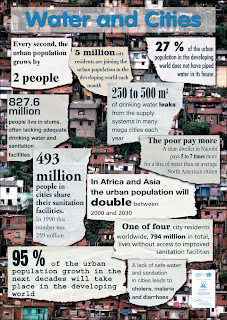
In 1993, a United Nations General Assembly resolution designated March 22 as World Day for Water, to focus attention on the importance of freshwater and advocate for the sustainable management of freshwater resources. Each year since then, World Water Day has focused on a different aspect of freshwater. This year, the 19th annual World Water Day, the Republic of South Africa is hosting a conference called Water for Cities: Responding to the Urban Challenge. The conference program brochure states that for the first time in human history most of the world’s population lives in cities: 3.3 billion people. The urban landscape continues to grow and 38% of the growth is represented by expanding slums. City populations are increasing faster than city infrastructure can adapt. The objective of WWD 2011 is to focus international attention on the impact of rapid urban population growth, industrialization and uncertainties caused by climate change, conflicts and natural disasters on urban water systems.
 
Internationally, nearly one billion people lack access to safe water and 2.5 billion do not have improved sanitation according to Water.org, a U.S.-based nonprofit organization committed to providing safe drinking water and sanitation to people in developing countries. And at the same time, the US Geological Survey estimates that the average American home uses between 80-100 gallons of water just for indoor use.

The Brooklyn Law School Library collection has Unquenchable: America’s Water Crisis and What To Do About It by Robert Jerome Glennon (Call #TD223 .G578 2009) which shows that the water crisis is not confined to the third world. This book has frightening and comical examples of how Americanws waste water from manufactured snow for tourists in Atlanta to trillions of gallons flushed down the toilet each year. State and local governments diverts supplies from one area to another to keep water flowing from the tap. Some time soon, water shortages will threaten not only the environment, but every aspect of American life: we face shuttered power plants and jobless workers, decimated fisheries and contaminated drinking water. New demands for water needed for ethanol and energy production, will only worsen the crisis. This book proposes market-based solutions that value water as both a commodity and a fundamental human right. When we recognize how valuable water is, we will begin to conserve it

This post has no comments.
01/26/2011
profile-icon BLS Reference Desk

On Friday, January 28 at 6PM, the Brooklyn Law School Environmental Law Society (ELS) and the Street Vendor Project (SVP) will host a meeting to discuss ways that law students can represent street vendors at the Environmental Control Board when vendors receive tickets, and how students can get involved in helping to pass the newly introduced bill which will dramatically lower the civil penalties which vendors face. New York City Councilman Stephen Levin from Brooklyn has sponsored two bills that would reduce the vending fines to pre-2005 levels. Intro 434 and Intro 435, which now each have 17 co-sponsors at City Council, would provide relief to street vendors during difficult times. When the bills come to a hearing, BLS probono students will testify and submit written testimony.

According to Lee Miller, co-chair of land use programs for ELS, the event to be held on Friday in Room 605 will have food from Kwik Meal (the best street meat in NYC!). Lee says that the Street Vendor Pro-Bono Project is a new public interest opportunity for BLS students that started last semester. The ELS is sponsoring and funding the pro-bono project in its first year. The groups cross-promote and work collaboratively to tie vending and sidewalk culture issues to environmental programs. Their objectives include lifting the cap on vending permits and licenses and reducing the fines associated with vending violations. 

Students who participate in this pro-bono project have the opportunity to advocate on behalf of New York City-based street vendors. They analyze violations by the Department of Health, the Parks Department and the Police Department, and defend the vendor before the Environmental Control Board (ECB), the administrative tribunal that handles civil violations issued by City agencies. Preparation for these cases involves direct interaction with street vendors, site visits, evidence gathering, and an analysis of Administrative Code provisions and the Rules of the City of New York. Students will refine their legal research and oral argument skills as they present their defenses before administrative law judges at the ECB.

A recent case involves a street vendor operating for the past three years at the corner of 86th and Lexington, Paty’s Taco Truck. Last summer, New York City Councilwoman Jessica Lappin from the Upper East Side introduced a bill to revoke permits of food trucks if they receive three parking tickets. Although the bill is stalled, the street vendor has been targeted for enforcement of a traffic law which prohibits the selling of “merchandise” (not food) from a metered parking spot. The vendor’s truck has been towed three times and all three tickets were dismissed by the traffic court. It is not clear if the law applies to food vendors as the vending laws in New York City consistently distinguish between “food” vendors and “general merchandise vendors”.

This post has no comments.
04/22/2010
profile-icon BLS Reference Desk

Forty years ago, on April 22, 1970, US Senator Gaylord Nelson (WI) planned the first Earth Day to spread awareness and appreciation for our environment. That led to the creation of the United States Environmental Protection Agency and the passage of the Clean Air, Clean Water, and Endangered Species Acts. Ten years later, Sen. Nelson wrote an article Earth Day ’70: What It Meant, 6 EPA J. 6 (1980), a PDF version of which is available to BLS Library patrons at this HeinOnline link. In its print collection, the BLS Library has Not in Our Backyard: The People and Events That Shaped America’s Modern Environmental Movement by Marc Mowrey and Tim Redmond (Call #GE180 .M68 1993), an excellent book that highlights many of the lesser-known characters and events that comprise the US Environmental Movement.

Today, Earth Day is celebrated in more than 175 countries. The PBS series, American Experience recently aired “Earth Days”, a documentary on the origins of Earth Day and the modern environmental movement. Informative and thought-provoking, it is accessible online here.

This post has no comments.
03/26/2010
profile-icon BLS Reference Desk

Listen to this episode on BrooklynWorks.

This podcast is of a conversation with two officers of Environmental Law Society (ELS) at Brooklyn Law School. ELS is a student organization with interests in environmental law, international law, the laws of war and bio-terrorism, real estate law, land use and zoning laws. The ELS officers talk about their efforts to create opportunities for its members by hosting events where students can meet with leading experts in a variety of fields. They also discuss their plans for the upcoming year. ELS recently sponsored Irena Salina’s award-winning documentary investigation into an important political and environmental issue of the 21st Century – The World Water Crisis. The documentary is called Flow: How Did a Handful of Corporations Steal Our Water? 

ELS showed the film during the same week when the United Nations sponsored World Water Day on March 22. Starting in 1993, the United Nations General Assembly by resolution designated March 22 of each year as the World Day for Water. 

This post has no comments.
11/06/2009
profile-icon BLS Reference Desk

I recently attended excellent programs at International Law Weekend 2009. Professor Claire Kelly moderated the highly useful program: “Trade and Climate Change.” Many Brooklyn Law School students were members of the audience. At this program, Laura Campbell of Environmental Law International discussed two current U.S. climate change bills: H.R. 2454 (which the House passed on June 26, 2009) and S. 1733 (which is the focus of current Senate hearings). These two bills would require an 83% reduction (from 2005 levels) in emissions of gases that promote global warming by 2050. Ms. Campbell noted that the Senate bill sets a 20% reduction goal by 2020, as compared to the House bill’s 17% reduction goal by 2020. Another panelist, Professor Steve Charnovitz, recommended that the U.S. Congress pass legislation to allow “fast track” negotiation of environmental treaties. He also suggested that there should be a moratorium on climate tariffs and charges pending negotiation of international principles to address burden sharing, unequal carbon prices and “free riders.”

Research Tips:
1) BLS Library’s subscription database, CQ Weekly, is an excellent tool to track developments regarding these U.S. climate change bills. If a member of the Brooklyn Law School community wishes to obtain a copy of an article about these bills (“Climate Bill Sponsors Commence Public Hearings, Private Negotiations”) published in the November 2, 2009 issue of CQ Weekly, feel free to e-mail: refdesk@brooklaw.edu.
2) BLS Library owns a recently published book recommended during this program: Global Warming and the World Trading System (2009) by Gary Clyde Hufbauer, program panelist Steve Charnovitz and Jisun Kim.
3) For further information, see the 2009 WTO/UNEP report: Trade and Climate Change

This post has no comments.
Field is required.