The Brooklyn Law School logo

BLS Library Blog

Showing 10 of 11 Results

05/01/2018
profile-icon BLS Reference Desk

 A group of people walking in a street holding a banner

Description automatically generatedMay 1st is International Labour Day and in Greece it is called ‘Protomagia’ (literally meaning the first day of May). It is an urban holiday when people traditionally go to the countryside for picnics, to fly kites and to gather wild flowers. On this day there many parades and other festivities throughout the country. It is a national holiday which means that everything is closed, with the exception of cafes and food venues.

The custom of Protomagia has its roots in ancient Greece as a celebration of spring, nature, and flowers. Flower wreaths, typically made from hand picked wild flowers, are hung on the doors of many homes in a way to welcome nature and all things good. Maios (May) the last month of Spring took its name from the Goddess Maja, a goddess who took her name from the ancient word Maia, the nurse and mother. May, according to Greek folklore, has two meanings: The good and the bad, rebirth and death. The custom celebrates the final victory of the summer against winter as the victory of the life against death go back to the ancient years and culminate at the first day of May. This day was also dedicated to the goddess of agriculture Dimitra and her daughter Persephone, who on this day emerges from the under world and comes to earth. Her coming to earth from Hades marks the blooming of nature and the birth of summer.

May 1st is International Workers’ Day, also known as Labour Day in some places, a celebration of laborers and the working classes that is promoted by the international labor movement, anarchists, socialists, and communists and occurs every year on the 1st of May. The date was chosen as International Workers’ Day by the Second International to commemorate the Haymarket affair, which occurred in Chicago on 4 May 1886. Being a traditional European spring celebration, May Day is a national public holiday in many countries, but in only some of those countries is it celebrated specifically as “Labour Day” or “International Workers’ Day”. The earliest May Day celebrations appeared in pre-Christian times, with the Floralia, festival of Flora, the Roman goddess of flowers, held April 27 during the Roman Republic era.


This post has no comments.
04/02/2018
profile-icon BLS Reference Desk

A book cover of a company

Description automatically generated

The Brooklyn Law School Library New Books List for April 1, 2018 has 42 print titles and 30 e-book titles. Among them is one e-title The Rise of the Working-Class Shareholder: Labor’s Last Best Weapon by David Webber, a rare good-news story for American workers. Combining legal rigor with inspiring narratives of labor victory, Webber shows how workers can wield their own capital to reclaim their strength. When the CEO of the supermarket chain Safeway cut wages and benefits, starting a five-month strike by 59,000 unionized workers, he was confident he would win. But where traditional labor action failed, a novel approach was more successful. With the aid of the California Public Employees’ Retirement System, a $300 billion pension fund, workers led a shareholder revolt that unseated three of CEO’s boardroom allies. In the book, the author uses cases such as Safeway’s to shine a light on labor’s most potent remaining weapon: its multitrillion-dollar pension funds. Outmaneuvered at the bargaining table and under constant assault in Washington, state houses, and the courts, worker organizations are beginning to exercise muscle through markets. Shareholder activism has been used to divest from anti-labor companies, gun makers, and tobacco; diversify corporate boards; support Occupy Wall Street; force global warming onto the corporate agenda; create jobs; and challenge outlandish CEO pay. Webber argues that workers have found in labor’s capital a potent strategy against their exploiters. He explains the tactic’s surmountable difficulties even as he cautions that corporate interests are already working to deny labor’s access to this powerful and underused tool.

This book could be the modern bible of the movement to harness labor’s capital for working-class interests. It is a riveting and thoughtful book that is not only a fast and fun read, but contributes wonderfully to a new and ongoing conversation about inequality, dark money, and populism in the electorate. On Wednesday, April 18 at 4pm, Brooklyn Law School will host a Book Talk with David Webber, Professor of Law, Boston University School of Law to discuss the book. It is sponsored by the Center for the Study of Business Law and Regulation.
This post has no comments.
06/26/2013
profile-icon BLS Reference Desk

Unpaid internships suffered a setback this month when US District Court Judge William H. Pauley III ruled in Glatt v. Fox Searchlight Pictures that the defendant violated minimum wage and overtime laws when it failed to pay interns who worked on the movie Black Swan. The lead plaintiff is a Georgetown University law school student. The decision, the first to adopt this argument, rigorously applied the Department of Labor six-part test where internships in the for-profit private sector are viewed as employment relationships for which the federal minimum wage and overtime rules will apply, unless the intern is truly receiving training. The six criteria are:

(1) The internship is similar to training that would be given in an educational environment; 
(2) The internship experience is for the benefit of the intern; 
(3) The intern is not replacing employees and works under close supervision; 
(4) The sponsor of the intern does not derive immediate benefit from intern’s activities and at times, its operations may actually be impeded; 
(5) The intern is not entitled to a job at the conclusion of the internship; 
(6) The sponsor and the intern understand the intern is not entitled to wages for the time spent in the internship. 

While not every factor weighed strongly in favor of finding the plaintiffs entitled to pay, Judge William H. Pauley III concluded that the plaintiffs “were classified improperly as unpaid interns and are ‘employees’ covered by the FLSA,” and that “[t]he benefits they may have received—such as knowledge of how a production or accounting office functions or references for future jobs—are the results of simply having worked as any other employee works, not of internships designed to be uniquely educational to the interns and of little utility to the employer.” 

For more on the decision, see the Bloomberg BNA article Judge Rules Fox Searchlight Interns Are FLSA Employees, Certifies Class Action which concludes by noting that “In the past few years, unpaid interns of for-profit, private sector employers have brought several wage and hour suits in New York courts. The district court’s ruling here is the first to find that such interns are employees under the FLSA.” The article cites to another case from the Southern District of New York, Wang v. The Hearst Corporation, where Judge Harold Baer ruled differently in denying partial summary judgment on the employee issue and finding various factual disputes concerning DOL’s unpaid intern criteria.


Another class action, Bickerton v. Rose, which a former intern filed in New York Supreme Court last year, alleged that she regularly worked at least 25 hours per week without pay as an intern for The Charlie Rose show. The case ended when Rose and his production company agreed to pay up to $250,000 as a settlement without admitting any wrongdoing.

This post has no comments.
10/25/2011
profile-icon BLS Reference Desk

A settlement agreement filed in the US District Court for the Southern District of New York in Lacovara v. Hard Rock Cafe International (USA), Inc. ends a proposed class action complaint that Hard Rock Café locations in New York failed to pay certain gratuities to hourly private event food and beverage service workers. The settlement fund of $230,000 will go to 469 servers who worked at Hard Rock Café’s 57th Street and Time Square locations. The lead plaintiff, who worked as a bartender for Hard Rock from October 2009 to June 2010, brought the suit last October, claiming the restaurant’s New York locations misappropriated an 18-20 percent gratuity fee that was charged to customers during private parties, in violation of state labor laws. 

In preparing a class on Administrative Law for the Advanced Legal Research class at Brooklyn Law School, we found that earlier this year, the Wage and Hour Division of the Department of Labor (DOL) issued a Final Rule interpreting the Fair Labor Standards Act (FLSA). The new regulations, which became effective May 5, 2011, made significant changes to tip credit regulations. The new regulation provides employers must provide employees with proper notice in order to use the tip credit. The must pay their tip employees wages of at least $2.13 per hour. However, the amount of tip credit they using against actual tips plus the actual cash wage they pay must equal the minimum wage of $7.25. A “tipped employee” is defined as one who is engaged in an occupation in which the employee customarily and regularly receives more than $30 a month in tips, 29 U.S.C. § 203(t). A tip is a sum presented by a customer as a gift or gratuity in recognition of some service performed for the customer, 29 C.F.R. § 531.52. It is distinguished from payment of a charge, if any, made for the service. Whether a tip is to be given, and its amount, are matters determined solely by the customer, and generally he or she has the right to determine who shall be the recipient of the gratuity. The FLSA now address ownership of tips even in cases where employers already pay at least the full minimum wage in cash. The amended regulations state that tips “are the property of the employee whether or not the employer has taken a tip credit.” 29 C.F.R. § 531.52

In June, the National Restaurant Association and other organization filed a complaint against the Labor Department over the agency’s new tip-credit-notice regulation, claiming that it failed to provide employers with sufficient notice to comment and comply with the new rule and that the new rule is arbitrary, capricious, an abuse of discretion, and contrary to established law. If successful, the lawsuit would nullify the new rule.

This post has no comments.
09/03/2011
profile-icon BLS Reference Desk

Organized labor has had a series of setbacks since the midterm elections of 2010. In Wisconsin, legislation rolled back public employee collective-bargaining rights. Ohio passed a similar measure, although it faces a public referendum in November. The summer saw high unemployment, attacks on public employee unions and federal policymakers focused on austerity not job creation. 

This summer the NLRB made a series of pro-union decisions. In July, it ruled in Mas-Tech, Inc. and Joseph Guest and Direct TV, Inc. and Joseph Guest (Westlaw password required), Cases 12-CA-24979 and 12-CA-25055, that the employer violated the NLRA when it terminated employees who appeared on a television newscast wearing their uniforms and made disparaging statements about MasTec. The board ruled that employers committed unfair labor practices when they (1) fired nonunionized employees who appeared on a television newscast in their work uniforms and made disparaging comments about their employer; (2) disciplined an employee for using the company’s email system to solicit employees for union activity at work; and (3) fired employees for discussing terms and conditions of their employment through social networking websites such as Facebook and Twitter.

The NLRB also denied a motion to dismiss unfair labor practice charges against Boeing, in The Boeing Company and International Association of Machinists and Aerospace Workers District Lodge 751, Affiliated With the International Association of Machinists and Aerospace Workers (Westlaw password required), Case 19-CA-32431, accused of retaliating against workers in its Washington state plant by adding a second jetliner assembly line to its nonunion South Carolina facility. 

In rule making news, the NLRB just published a final rule requiring employers to post notices informing their employees of their rights as employees under the NLRA.

In advance of Labor Day 2011, the 2nd annual CUNY-sponsored study of unionization trends in New York City and State, The State of the Unions 2011, reports on the strength of organized labor in New York showing unionization rates among immigrants and by industry in the City and State. NYC has higher union density (23% of the workforce in 2010-11) than any ther major US city, and New York State (with24%) ranks first among the 50 states. Over the past decade, erosion of union membership has been far more limited in NY than nationally. Key findings include: 

  • Private-sector unionism in New York is twice the national average.
  • Unionized employees in NY are older, better paid, and more educated than their non-union counterparts in NY and the US.
  • A majority of New York City’s union members are female, reflecting high union density in the education and health care fields, which employ women in higher numbers than men.
  • NYC differs from the nation in that non-college educated, blue-collar workers are highly unionized in industries like construction, telecommunications, building services, hotels, urban transit, and home health care.
  • Women, African Americans, and workers born in Puerto Rico are overrepresented in the highly unionized public sector, and thus have higher unionization rates than other groups.

For more, see the Brooklyn Law School Library catalog record for the 2010 study by the Center for Economic and Policy Research entitled The Unions of the States.

This post has no comments.
05/27/2011
profile-icon BLS Reference Desk

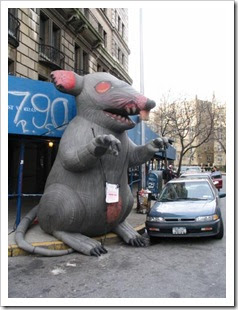
In New York City, inflatable rat balloons are commonplace signs of labor disputes where unions picket work sites using non-union workers. Whether the rat balloon is a form of picketing that is illegal under Section 8(b)(4)(ii)(B) of the National Labor Relations Act has been unclear. That provision makes it illegal for anyone to threaten, coerce, or restrain any person engaged in commerce or in an industry affecting commerce. A new NLRB ruling in Sheet Metal Workers International Association, Local 15, AFL–CIO and Galencare, Inc., d/b/a Brandon Regional Medical Center and Energy Air, Inc. states that the display of an inflatable rat does not violate Section 8(b)(4)(ii)(B).
 

The case began in 2003, when union members mounted an inflated rat balloon on a flatbed trailer and positioned the trailer on public property in front of the hospital worksite where the employer hired Workers Temporary Staffing (WTS), a labor supply company, to provide employees for the project. The rat balloon measured about 16-feet tall and 12-feet wide, and had a sign captioned “WTS” attached to the rat’s abdomen. In 2006, the Board issued a decision ruling that a mock funeral staged by the union in front of the hospital was unlawfully coercive. Now, the Board has ruled on the display of the inflatable rat balloon. 

The Board relied on First Amendment principles in its ruling citing the US Supreme Court’s decision in Snyder v. Phelps, 562 U.S.__ (March 2, 2011), which affirmed First Amendment protection of picketing by church members of a military funeral, adjacent to a public street, with placards communicating the members’ belief that God hates the United States for its tolerance of homosexuality.Two years ago, the New Jersey Supreme Court in State v. DeAngelo, 197 N.J. 478 (2009), struck down a municipal ordinance which banned the use of inflatable balloons, as well as banners and streamers, except in connection with grand openings. The court said the ban was not “content-neutral” since it allowed balloons to be used in one circumstance, grand openings, while prohibiting them in others, including union-related disputes.

The Brooklyn Law School Library maintains a series of research guides one of which by Librarian Jean Davis, the Administrative Law Research Guide, notes that behind the BLS firewall, researchers can access components of the CCH Internet Research Network for the NLRB Case Handling Manual. A record for the Manual is included in the library’s catalog SARA which links to the Westlaw Database Identifier CCH-NLRBCHM.

This post has no comments.
09/05/2010
profile-icon BLS Reference Desk

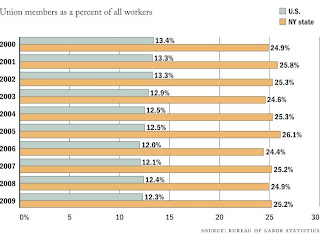
Just before Labor Day 2010, Crain’s New York Business looks at the state of unions in New York and the nation. An article by Greg David, Unions in New York: a Labor Day Update, says that unions remain strong in New York but in the rest of the country they do not. New York remains the most unionized state in the country with almost twice the percentage of workers organized as elsewhere in the country. Last year, members of unions comprised 25.2% of the workforce in the New York State. New York has been the most unionized state in the nation for years except for 2006, when Hawaii bested New York by a third of a percentage point.

This chart, compiled from data maintained by the Bureau of Labor Statistics, shows the comparison of union membership as a percentage of all workers in the US as compared to New York.


Nationally, unions now represent only 12.3% of workers and that number has declined over the last 10 years. According to a Press Release from the U.S. Census Bureau, the number of unionized public sector workers outnumbered the number of organized private sector workers in 2009, the first time that has happened. Highlights from the 2009 data include these items:

  • More public sector employees (7.9 million) belonged to a union than did private sector
    employees (7.4 million), despite there being 5 times more wage and salary workers in the private sector.
  • Workers in education, training, and library occupations had the highest unionization rate at 38.1 percent.
  • Black workers were more likely to be union members than were white, Asian, or Hispanic workers.
  • Among states, New York had the highest union membership rate (25.2 percent) and North Carolina had the lowest rate (3.1 percent).

Brooklyn Law School Library subscribes to Crain’s New York Business in print.

This post has no comments.
12/09/2009
profile-icon BLS Reference Desk

An article in BNA’s US Law Week (available on the BLS Library’s E-Journals & Databases A-Z list) reports that the US Court of Appeals for the Second Circuit, with Brooklyn Law School’s former Dean and current Eastern District of New York Judge David G. Trager, sitting by designation, allowed the Equal Employment Opportunity Commission (EEOC) to seek more information about how UPS Inc. handles religious exemptions to its nationwide ban on beards for certain employees. The November 19 decision, Equal Employment Opportunity Commission v. United Parcel Service Inc., reversed the lower court’s refusal to enforce the EEOC’s subpoena after concluding that “how religious exemptions to the UPS Appearance Guidelines are (or are not) granted nationwide was not relevant to the charges being investigated.” Before the ruling by the Second Circuit, employers cited the EEOC v. UPS lower court ruling for the proposition that an EEOC subpoena must be limited to what was relevant to the underlying charge.

At issue for UPS was its Uniform and Personal Appearance Guideline prohibiting employees in public-contact positions from wearing any facial hair below the lower lip. Until 1999, UPS did not place employees who wore facial hair below the lower lip in public-contact positions. In 1999, UPS adopted a formal religious accommodation policy that allowed employees an exemption from the Appearance Guidelines for religious reasons. The suit on which the Second Circuit ruled involved the EEOC’s investigation of two cases, one from Buffalo and the other from Dallas, with a Muslim job applicant who alleged that he was denied a public-contact driver position because he refused to shave his beard and a current UPS employee, who claimed that he was denied a public-contact driver position because he refused to shave his beard and that when he requested a religious accommodation form and an accommodation, he was denied both. 

The EEOC subpoena sought (1) all documents related to the Appearance Guidelines and a list of all jobs which are subject to the Guidelines; (2) identifying information for all job applicants denied employment because of their refusal to adhere to the Appearance Guidelines since January 1, 2004; (3) identifying information for all employees who requested a religious accommodation exemption from the Appearance Guidelines and the outcomes of those requests since January 1, 2004; and (4) identifying information for all employees who were terminated for reasons relating to the Appearance Guidelines since January 1, 2004.

An employer’s obligation to make reasonable accommodations to the religious views of its prospective and current employees is one of the most contentious and difficult areas for employees and employers to navigate. In a diverse and religiously pluralistic society, conflict is bound to occur not only about appearances but also about religious beliefs. Consider the case of Buonanno v. AT&T Broadband, LLC, 313 F.Supp.2d 1069, 93 Fair Empl.Prac.Cas. (BNA) 1204 (D.Colo. 2004) where the employer workplace diversity initiatives included acceptance of gays and lesbians that one employee found offensive on the basis of religion. The employee told his employer that his sincerely held religious beliefs against homosexuality conflicted with his employer’s requirement that he sign a code of conduct that contains a diversity policy requiring each employee to “fully recognize, respect and value” differences among co-workers. He claimed that there was a conflict because he claimed he cannot value any “difference” that is “contrary to God’s word.” The District Court awarded $146,269 to the former AT&T Broadband worker after the company fired him for refusing to sign the diversity policy. 

In reviewing that decision, an article entitled The Duty of Accommodation and the Workplace Religious Freedom Act of 2003: From Bad Policy to Worse Law at 55 Labor Law Journal 155 (Fall 2004) (Call #P L12 and online in ProQuest Central in the Library’s A-Z list) captures some of the difficulties in serving both the interests of employees in the exercise of their religious beliefs and the interests of employers in the exercise of their legitimate managerial prerogatives. With the Second Circuit broadening the subpoena powers of the EEOC in the enforcement of Title VII religious accommodation duty, employers face even more of a challenge when dealing with religious views in the workplace.

This post has no comments.
09/07/2009
profile-icon BLS Reference Desk

The US Department of Labor web site on the History of Labor Day states that “Labor Day, the first Monday in September, is a creation of the labor movement and is dedicated to the social and economic achievements of American workers. It constitutes a yearly national tribute to the contributions workers have made to the strength, prosperity, and well-being of our country.” It goes on to say: “The vital force of labor added materially to the highest standard of living and the greatest production the world has ever known and has brought us closer to the realization of our traditional ideals of economic and political democracy.“

Sadly, there remains a large segment of the labor force that does not share in many of those social and economic achievements. A new report, Broken Laws, Unprotected Workers: Violations of Employment and Labor Laws in America’s Cities states that more than two-thirds of low-wage workers were paid less than what they were legally owed for the work they did. The report is based on a survey conducted the National Employment Law Project (which is part of Brooklyn Law School’s Public Service Law Program). The survey of more than 4,000 workers in New York City, Chicago and Los Angeles exposes a world of work in which the core protections that many Americans take for granted—the right to be paid at least the minimum wage, the right to be paid for overtime hours, the right to take meal breaks, access to workers’ compensation when injured, and the right to advocate for better working conditions—are failing significant numbers of workers.

The Executive Summary states:

In 2008, we conducted a landmark survey of 4,387 workers in low-wage industries in the three largest U.S. cities—Chicago, Los Angeles, and New York City. We used an innovative, rigorous methodology that allowed us to reach vulnerable workers who are often missed in standard surveys, such as unauthorized immigrants and those paid in cash. Our goal was to obtain accurate and statistically representative estimates of the prevalence of workplace violations. All findings are adjusted to be representative of front-line workers (i.e. excluding managers, professional or technical workers) in low wage industries in the three cities—a population of about 1.64 million workers, or 15 percent of the combined workforce of Chicago, Los Angeles and New York.

The report makes three major findings:

  • Finding 1: Workplace Violations Are Severe and Widespread in Low-Wage Labor Markets
  • Finding 2: Job and Employer Characteristics Are Key to Understanding Workplace Violations
  • Finding 3: All Workers Are at Risk of Workplace Violations

The section of the report dealing with solutions states that everyone has a stake in addressing the problem of workplace violations and identifies three key principles that should drive the development of a strong policy agenda at the federal, state and local levels.

  1. Strengthening government enforcement of employment and labor
  2. Updating legal standards for the 21st century labor market
  3. Establishing equal status for immigrants in the workplace

This post has no comments.
08/07/2009
profile-icon BLS Reference Desk

Last week marked the 19th anniversary of the signing of the Americans with Disabilities Act. On July 26, 1990, President George H.W. Bush signed into law the Americans with Disabilities Act of 1990 issuing this Signing Statement. Since then, the act has brought about changes to public spaces and buildings making them more accessible to disabled persons. It also changed laws to require employers to make accommodations for workers who have special needs due to a disability.

To mark the anniversary, the US Department of Labor issued a news release announcing that it has re-named and re-launched DisabilityInfo.gov as Disability.gov. According to the release:

The site now offers comprehensive information about programs and services to better serve the more than 50 million Americans with disabilities, their family members, veterans, employers, educators, caregivers and anyone interested in disability-related information. The new Web site integrates content from 22 federal agencies and will be managed by the Labor Department. The former site was revamped with social media tools to encourage interaction and feedback, and new ways to organize, share and receive information. Visitors can sign up for personalized news and updates, participate in online discussions and suggest resources for the site. New features include a Twitter feed, Really Simple Syndication feeds, a blog, social bookmarking and a user-friendly way to obtain answers to questions on such topics as finding employment and job accommodations. Additional tools will be added during the months ahead.

The site is organized into 10 subject areas: benefits, civil rights, community life, education, emergency preparedness, employment, health, housing, technology and transportation. By selecting a category, visitors are directed to useful information on federal and state government programs and services, news and events, grants and funding opportunities, and more.

The BLS Library has a great deal of material on the Americans with Disabilities Act of 1990 which can be found in SARA, the library’s online catalog. The most recent acquisitions is Reassignment Under the ADA: Must an Employer Hire a Minimally Qualified, Disabled Employee Over a More Qualified, Non-Disabled Applicant?: A Legal Research Guide by Amy R. Stein (Call #KF3469 .S75 2009). This volume is part of a series of Legal Research Guides published by William S. Hein & Co. and is described in a Hein release that lists other legal research guides published by Hein.

Another recent item in the BLS collection is Understanding the Americans with Disabilities Act by William D. Goren (Call #KF480 .G67 2006) with these chapters: Concepts underlying the ADA and key definitions — Essential functions of the job — Concept of undue hardship and reasonable accommodation in the employment context — Treatment of alcoholics and drug addicts — Preemployment medical exams/disability-related inquiries — The ADA and health insurance — ADA and the public sector (Title II) — Places of public accommodations and commercial facilities — The ADA and the health-care provider — The interrelationship between the ADA and other laws — Remedies and procedural issues — ADA and sports — Hot areas — Are you ready to rock and roll with your ADA case?

This post has no comments.
Field is required.