

Congress has not enacted the Military Readiness Enhancement Act in the House and Senate version of bills (H.R. 1283 and S. 3065) to repeal Don’t Ask, Don’t Tell and replace it with a policy of nondiscrimination on the basis of sexual orientation. Instead, it will address the issue as part of the larger National Defense Authorization Act for Fiscal Year 2011 in H.R. 5136 and S.3454. The issue of gays in the military is very much in the news as today marks the 17th anniversary of the passage of the National Defense Authorization Act for Fiscal Year 1994 (P.L. 103-160). Subtitle G (Policy concerning homosexuality in the armed forces) of that law is codified at 10 U.S.C. § 654. The history of the passage of the current law is more fully described in an item in SARA, Brooklyn Law School Library’s catalog, a recent Congressional Research Service report called “Don’t Ask, Don’t Tell”: The Law and Military Policy on Same-Sex Behavior by David F. Burrelli. Today the Pentagon released its Report of the Comprehensive Review of the Issues Associated with a Repeal of “Don’t Ask, Don’t Tell”.
“Don’t Ask, Don’t Tell“, which is not the name of the law, is the policy proposed by Bill Clinton during the 1992 presidential campaign to lift the ban on gays in the military. Opponents of gays in the military including senior military officials were successful in defeating President Clinton’s proposal by including Section 654 which bipartisan majorities in Congress passed in 1993 and President Clinton signed into law on November 30, 1993. Opponents prefer to call the law “The Military Personnel Eligibility Act of 1993.” See Statement of Elaine Donnelly, President of the Center for Military Readiness (CMR), an anti-gay group opposing changes to Section 654. Among the board members of CMR is noted American conservative activist Phyllis Schaffley.
The “Don’t Ask, Don’t Tell” policy is not contained in any Presidential Executive Order but is implemented by two Department of Defense Directives: DoD Instruction 1332.14 (“Enlisted Administrative Separations”) and 1332.30 (“Separation of Regular and Reserve Commissioned Officers”). These directives stopped the military from asking about sexuality in recruitment forms and interviews but did not stop investigations into whether those serving in the military were gay. According to the Servicemember’s Legal Defense Network, an advocacy organization for LGBT military personnel, the Pentagon has dismissed more than 12,500 service members because of their sexual orientation since 1994. 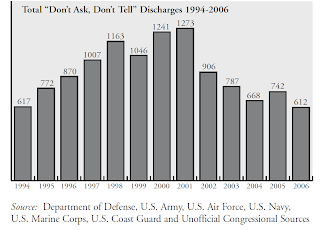
 Consult SARA, the BLS Library catalog for further reading on the Genocide Convention where you will find
  For BLS library materials on habeas corpus, see the SARA catalog for
  Federman (Call # KF9011 .F43 2006) with chapters on Understanding habeas corpus — Habeas corpus in the new American state, 1789-1915 — Bodily inventions: the habeas petitioner and the corporation, 1886 — Habeas corpus as counternarrative: the rise of due process, 1923-1953 — Confessions and the narratives of justice, 1963-1979 — Future dangerousness and habeas corpus, 1982-2002 — Habeas corpus and the narratives of terrorism, 1996-2002.
A recent Jurist article Despite Claims, ICC Prosecution of Bush, Blair Would Be Illegal by Jesse Oppenheim, Brooklyn Law School Class of 2013, questions whether the International Criminal Court (ICC) has to file war crimes charges against former US President George W. Bush and former UK Prime Minister Tony Blair for invading Iraq. The article comes in response to Archbishop Desmond Tutu’s suggestion that the two former leaders “should be treading the same path as some of their African and Asian peers who have been made to answer for their actions in The Hague.” The ICC hears cases on genocide, crimes against humanity, and war crimes. It was established ten year ago in 2002 when the Rome Statute became a binding treaty with sixty signatories including the United States, the minimum number required to bring it into force. Since then, three states—Israel, Sudan and the United States—have informed the UN Secretary General that they no longer intend to become states parties and have no legal obligations arising from signing the Statute.
Since the establishment of the ICC in 2002, the Court has heard 16 cases with only one having been completed: that of rebel leader Thomas Lubanga from the Democratic Republic of the Congo who was sentenced earlier this year to 14 years in prison for his part in war crimes in his home country. The other cases all involve situations involving African nations. Oxford Reports on International Law has on its web site a module to view a list of the decisions of the ICC. The Brooklyn Law School Library has in its collection The Annotated Digest of the International Criminal Court (Call #KZ6316 .A48) in its International Collection.
Critics have argued that the Court applies “selective justice” to Africa and is “a pro-western, anti-African court.” The newly appointed chief prosecutor, Fatou Bensouda, a Gambian national, says the ICC has sought justice for millions of victims in Africa. “Again and again we hear criticisms about our so-called focus on Africa and about the court being an African court, having an African bias. Anti-ICC elements have been working very hard to discredit the court and to lobby for non-support and they are doing this, unfortunately with complete disregard for legal arguments.”
Commenting on blog posts requires an account.
Login is required to interact with this comment. Please and try again.
If you do not have an account, Register Now.