The Brooklyn Law School logo

BLS Library Blog

Showing 10 of 12 Results

A black background with a black square

Description automatically generated with medium confidence

Whether you are tracing a statute’s history for your summer internship or for a paper you are writing, you will want to use a new tool the library recently acquired, Proquest’s Legislative Insight.  Often researching legislative histories can be cumbersome and time consuming.   Legislative Insight promises to streamline the process by digitizing and by publishing online the majority of full text publications associated with a legislative history.  These documents include all versions of enacted and related bills, Congressional Record excerpts, and committee hearings, reports, and documents.  Legislative Insight also includes other related material such as committee prints, CRS reports and Presidential signing statements. Furthermore, Legislative Insight offers a research citation page that not only links to the full text of the associated primary source publications, but allows the user to do a Search Within from that very page that searches the full text of all the associated publications with one-click.

To access Legislative Insight from off-campus, you first need to implement the proxy instructions.

This post has no comments.

Today marks the 80th anniversary of the signing into law of the Social Security Act by President Franklin Delano Roosevelt. In his Statement Upon Signing the Social Security Bill on August 14, 1935, FDR said: “Today, a hope of many years standing is in large part fulfilled…We have tried to frame a law which will give some measure of protection to the average citizen and to his family against the loss of a job and against poverty-ridden old age.”

The act survived a series of constitutional challenges to become a linchpin of retirement planning. Three Social Security cases made their way to the Supreme Court during its October 1936 term. One case, Helvering vs. Davis, 301 U.S. 619 (1937), challenged the old-age insurance program. The two others, Steward Machine Company vs. Davis, 301 U.S. 548 (1937) and Carmichael vs. Southern Coal & Coke Co., 301 U.S. 495 (1937), challenged the unemployment compensation program of the Social Security Act. The Court issued rulings on all three on the same day, May 24, 1937.

In 1965, thirty years after passage of the Social Security Act, President Lyndon Johnson signed the Social Security Act Amendments, popularly known as Medicare, a national health insurance program for the elderly. Companion legislation created Medicaid, providing health care for people on welfare. Later, Medicaid was broadened into a more comprehensive program financing health care for low-income persons. Today, Social Security retirement benefits currently average $1,335 per month. The average disabled worker and aged widow or widower receives slightly less. For 65 percent of elderly beneficiaries, these benefits provide the majority of their cash income. For 36 percent of them, the benefits provide 90 percent or more of their income. For 24 percent of them, it is the sole source of income. This leaves little room for cuts for beneficiaries.

The Brooklyn Law School Library has a wide range of practice materials related to the Social Security Act including The Social Security Act Sourcebook by ABA Publishing (Call # KF3644.581935 .A2 2013) in the Main Collection and the 6th edition of Social Security Claims and Procedures by Harvey L. McCormick (Call # KF3649 .M272 2009) on Reserve at the Circulation Desk.
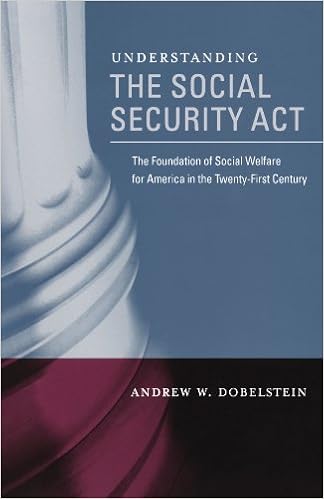
Understanding SSAAdditionally, the BLS Library has in its collection Understanding the Social Security Act: The Foundation of Social Welfare for America in the Twenty-First Century by Andrew Dobelstein (Call # KF3649 .D63 2009). With so many social welfare policy experts failing to grasp the sheer size and intricacy of the Social Security Act, this book takes readers step by step to provide the kind of comprehensive view of the U.S. social welfare system that is essential for any would-be reformers to master. Since being signed into law in 1935, the Social Security Act has institutionalized the country’s social welfare undertakings into a massive package administered by a sprawling federal agency and state-level organizations that must implement its programs. This is the first complete guide to every entitlement authorized by the Social Security Act, drawing on the author’s 38 years of research, teaching, and community service to explain in accessible, straightforward writing the origins, development, and ins and outs of their practical administration. By showing how the United States’ unique social welfare philosophy is reflected by the Social Security Act, this book provides a foundation for examining how its social welfare programs are bonded into a major social welfare enterprise. Students and scholars of policy and government, as well as public servants, whose work involves the real-life implications of the Social Security Act, will find this sweeping yet detailed overview an indispensable aid.

This post has no comments.

Today is the fiftieth anniversary of the enactment of the Voting Rights Act of 1965 guaranteeing voting rights for black citizens. It was a huge step toward protecting the right to vote for all Americans. President Lyndon Johnson’s signing of the Voting Rights Act began to address America’s long history of denying black Americans the right to vote. For 100 years, the 15th Amendment, which guarantees the right to vote regardless of “race, color, or previous conditional of servitude” was made useless by tactics like secret ballots, poll taxes, literacy tests and other practices that made it impossible for most blacks to vote. When these laws were in place, black voting plummeted throughout the south. According to the Constitutional Rights Foundation, in Mississippi alone the percentage of black voting-age men who were registered to vote fell from 90% during the Reconstruction period after the 15th Amendment’s passage to about 6% in 1892. By 1940, only about 3% of eligible blacks in the south were registered to vote.

After decades of state and local officials acting to disenfranchise African Americans through the use of both legal and illegal tactics, there was little action from Congress. But the passage of the Civil Rights Act of 1964, along with the reaction to the violence inflicted on voting-rights protesters marching from Selma to Montgomery, Alabama, in March 1965, prompted federal legislators to respond. Together with other laws, the Voting Rights Act outlawed literacy tests and gave the U.S. Department of Justice authority to challenge the use of poll taxes in state and local elections. Passage of the 24th Amendment in 1964 already barred the use of poll taxes in national elections. Section 2 of the Voting Rights Act essentially restated the 15th Amendment, prohibiting any voting rules or procedures that discriminate on the basis of race or color. Amendments to the law in 1975 extended its protections to members of a language minority group, such as speakers of Spanish or Native American languages. Additional amendments in 1982 permitted citizens challenging voting regulations under Section 2 to prove only that, in the “totality of the circumstance of the local electoral process,” the rules abridge voting rights.

The original Voting Rights Act provided for special intervention in jurisdictions where racial discrimination is believed to be greatest. Under Section 5, those parts of the country identified by a formula established in Section 4 must obtain “pre-clearance” from the DOJ or the U.S. District Court of the District of Columbia before making any changes to its voting laws. However, the Supreme Court in Shelby County v. Holder, 570 U.S. 2 (2013), struck down the Section 4 formula, leaving Section 5 intact but requiring legislators to redraw its coverage before further enforcement. Since then, several amendments have been proposed but Congress has not yet acted.

Now, fifty years later, the nation still faces restrictions on voting rights. Voting rights cases are taking place in North Carolina, and in Ohio and Wisconsin, where two other voting lawsuits ended only recently. And one day before the Voting Rights Act turned 50 years old, U.S. 5th Circuit Court of Appeals ruled in Veasey v. Abbott that the Texas voter ID law had a “discriminatory effect” that violates the federal law that prohibits racial discrimination. In the months and years ahead, the fate of the Voting Rights Act will be decided in Congress and in the courts. But its legacy as the singular triumph of the civil rights movement will remain strong.

Latinos and VRAThe Brooklyn Law School Library has many titles in its collection on the subject of the Voting Rights Act. The latest is Latinos and the Voting Rights Act: The Search for Racial Purpose by Henry Flores (Call # KFT1620.85.A6 F56 2015). It explores the role race and racism played in the Texas redistricting process and the creation and passage of the state’s Voter Identification Law in 2011. In addition to reviewing the redistricting history of the state, the book provides an analysis of court decisions concerning the Tenth Amendment to the Constitution, the Voting Rights Act, and a thorough discussion of the Shelby County decision. Flores brings together scholarly research and the analysis of significant Supreme Court decisions focusing on race to discuss Texas’ election policy process. This is the first book that speaks specifically to the effects of electoral politics and Latinos. Flores concludes that the tense race relations between Anglos and Latinos in Texas affected both the redistricting process and the creation of the Voter ID Bill.

This post has no comments.
11/17/2014
profile-icon BLS Reference Desk

from Third Branch News Blogcourt2

A 225th anniversary ceremony honoring the first-ever federal court session held under the U.S. Constitution and Judiciary Act, was held Nov. 4th in the ceremonial courtroom of the U.S. District Court for the Southern District of New York.

The ceremony honored a court session held Nov. 3, 1789, in the Royal Exchange Building in Manhattan.  The session, conducted by Judge James Duane, occurred three months before the U.S. Supreme Court also met in the Royal Exchange, which no longer exists. The 1789 session gives the Southern District of New York claiming rights as the nation’s “Mother Court”—although the first sitting was not momentous, adjourning immediately without hearing any cases.

The Library recently acquired the book, The Mother Court: Tales of Cases That Mattered in America’s Greatest Trial Court. It is the first book to chronicle the history of the US District Court for the Southern District of New York, the most influential District court in the United States. It gives first-hand insight into the evolution of our justice system where it has been, where it is now and where it is going. It provides an anatomy of what a trial is all about in an American courtroom, featuring the most famous trials of the period in the greatest court in the nation.

This post has no comments.

Thurgood Marshall

The BLS Library recently added to its collection Thurgood Marshall: Race, Rights, and the Struggle for a More Perfect Union by Charles L. Zelden (Call #KF8745.M34 Z45 2013). This 232 page biography, accompanied by primary sources that present Marshall in his own words, will help students learn what Marshall did (and did not do) during his life, why those actions were important, and what effects his efforts had on the larger course of American history. The book has content as follows: Introduction: The Struggle for a More Perfect Union; Chapter 1 – The Education of Thurgood Marshall; Chapter 2 – “Thurgood’s Coming”; Chapter 3 – Social Engineer Lawyer; Chapter 4 – Going for the “Whole Hog”; Chapter 5 – All Deliberate Speed Means S-L-O-W; Chapter 6 – “I AM the Establishment”; Chapter 7 – Not Only the Robe Was Black; Chapter 8 – How Do You Feel About Writing Dissents?; Postscript: Thurgood Marshall, Activist Judge; and an Appendix of Documents.

Today, August 30, 2014 marks the anniversary of the confirmation by the Senate in 1967 of Thurgood Marshall (1908-1993) as a Supreme Court justice. As the Court’s 96th justice and its first African American justice serving from 1967 to 1991, he was one of the most influential legal actors of his time. Before being appointed to the Supreme Court by President Lyndon Johnson, Marshall was a lawyer for the National Association for the Advancement of Colored People (NAACP), Federal Judge (1961-1965), and Solicitor General of the United States (1965-1966). He won twenty-nine of thirty-two cases before the Supreme Court including the landmark case of Brown v. Board of Education, which ruled that segregated public schools were unconstitutional. Marshall spent his career fighting racial segregation and legal inequality, and his time on the court establishing a record for supporting the “voiceless American.”

Marshall was an outspoken liberal on a court dominated by conservatives. In his twenty-four year tenure, he voted to uphold gender and racial affirmative action policies in every case in which they were challenged. He dissented in every case in which the Supreme Court failed to overturn a death sentence and opposed all efforts to narrow or burden the right of women to obtain abortions. No justice has been more forceful in opposing government regulation of speech or private sexual conduct. Nor has any justice been more egalitarian in terms of advancing a view of the Constitution that imposes positive duties on government to provide important benefits to people such as education, legal services, and access to courts regardless of their ability to pay for them. The legacy of change that he left behind continues to affect American society today.

This post has no comments.
12/13/2013
profile-icon BLS Reference Desk

Nicholas Parrillo is an Associate Professor of Law at Yale Law School who teaches administrative law, legislation, and American legal history. He recently published an article in the Yale Law Journal on legislative history, which according to the Legal History Blog, “relates the rise of the use of legislative history to the expansion of the federal bureaucracy and the emergence of a specialized regulatory bar.”

Here is the abstract of his article posted on SSRN:

A generation ago, it was common and uncontroversial for federal judges to rely upon legislative history when interpreting a statute. But since the 1980s, the textualist movement, led by Justice Scalia, has urged the banishment of legislative history from the judicial system. The resulting debate between textualists and their opponents — a debate that has dominated statutory interpretation for a generation — cannot be truly understood unless we know how legislative history came to be such a common tool of interpretation to begin with. This question is not answered by the scholarly literature, which focuses on how reliance on legislative history became permissible as a matter of doctrine (in the Holy Trinity Church case in 1892), not on how it became normal, routine, and expected as a matter of judicial and lawyerly practice. The question of normalization is key, for legislative history has long been considered more difficult and costly to research than other interpretive sources. What kind of judge or lawyer would routinize the use of a source often considered intractable?
Drawing upon new citation data and archival research, this Article reveals that judicial use of legislative history became routine quite suddenly, in about 1940. The key player in pushing legislative history on the judiciary was the newly expanded New Deal administrative state. By reason of its unprecedented manpower and its intimacy with Congress (which often meant congressmen depended on agency personnel to help draft bills and write legislative history), the administrative state was the first institution in American history capable of systematically researching and briefing legislative discourse and rendering it tractable and legible to judges on a wholesale basis. By embracing legislative history circa 1940, judges were taking up a source of which the bureaucracy was a privileged producer and user — a development integral to judges’ larger acceptance of agency-centered governance. Legislative history was, at least in its origin, a statist tool of interpretation.

This post has no comments.
07/03/2012
profile-icon BLS Reference Desk

Image

Whether you are tracing a statute’s history for your summer internship or for a paper you are writing, you will want to use a new tool the library recently acquired, Proquest’s Legislative Insight.  Often researching legislative histories can be cumbersome and time consuming.   Legislative Insight promises to streamline the process by digitizing and by publishing online the majority of full text publications associated with a legislative history.  These documents include all versions of enacted and related bills, Congressional Record excerpts, and committee hearings, reports, and documents.  Legislative Insight also includes other related material such as committee prints, CRS reports and Presidential signing statements. Furthermore, Legislative Insight offers a research citation page that not only links to the full text of the associated primary source publications, but allows the user to do a Search Within from that very page that searches the full text of all the associated publications with one-click.

To access Legislative Insight from off-campus, you first need to implement the proxy instructions.

(Image credit: Wally Gobetz, Washington DC: Capitol Hill: United States Capital, Flickr Photostream (June 6, 2009), www.flickr.com/photos/wallyg/3777337913/lightbox/)

This post has no comments.
08/03/2011
profile-icon BLS Reference Desk

Patrons at Brooklyn Law School Library can access the print and electronic versions of Legal Reference Services Quarterly’s latest Volume No. 30, Issues 1 and 2 (2011), a Special Issue: Determining Legislative Intent in State Courts: Selected Methods and Sources. Two articles that relate to legislative history in jurisdictions in the metropolitan tri-state are “Connecticut Legislative History” by Janis Fusaris (of the University of Connecticut School of Law Library), 30 Legal Ref. Services Q. 17 (2011), and “Using Legislative Histories to Determine Legislative Intent in New Jersey” by Barbara H. Garavaglia (of the University of Michigan Law Library), 30 Legal Ref. Services Q. 71 (2011). Linda Holmes, Associate Librarian at Brooklyn Law School has created a LibGuide on New York State Legislative History Research briefly describes the sources that one should consult when compiling the legislative history of a New York State statute.

This post has no comments.
02/25/2011
profile-icon BLS Reference Desk

The BLS Library recently completed its successful series of Spring 2011 Lunch and Learn Workshops.  The fourth and final session on February 23, 2011 covered New York State Legislative History research.  This presentation followed one on February 16th on Federal Legislative History research.  While federal legislative histories are sometimes easier to compile because there are many documents produced by Congress and Congressional committees, such as debates in the Congressional Record, hearings and reports in print, online and in microfiche, New York State legislative history research can be more difficult to track down because of the paucity of some documents produced by the New York State Legislature.

However, things have begun to improve in the last decade.  The New York State Assembly and Senate now provide live coverage on the Internet and on cable television of floor proceedings; the New York State Archives makes bill jackets available online since 1996 and Westlaw has a New York legislative history database, for example.

The BLS Library gets requests for assistance with legislative history research from students, alumni and even from inmates.  We recently had a request from an inmate who was doing research for his parole hearing.  He needed a sponsor’s memorandum from 1975 dealing with the necessity of the parole board to provide reports to inmates on why they were denied parole.  Of course, we were happy to help and provided a copy of the memorandum from the 1975 New York Legislative Annual.

To learn more about New York Legislative History, view the PowerPoint presentation by clicking here.

This post has no comments.

Questions on statutory research and federal legislative history are among the most frequent at the Brooklyn Law School Library Reference Desk. The library receives Federal public and private laws in “slip” (paper) form and shelves the slip laws chronologically by public or private law number. The slip laws are arranged on the shelves in the Statutory Collection on the second floor. Other print sources include the United States Statutes at Large, 1845- (Stat. – KF 50 U658), the United States Code Congressional and Administrative News (“USCCAN”) (Stat. – KF 48 W45) USCCAN includes the session laws published in United States Statutes at Large, selected reports, Presidential signing statements, and Presidential veto messages, and references to other legislative history materials. It is arranged by public law number. 

There are two commercial codifications of US statutes: (1) West’s United States Code Annotated (Stat. – KF 62 1927 W45) which offers West digest topic and key number references and provides references to West publications such as USCCAN and Corpus Juris Secundum as well as citations to legislative history materials published in USCCAN; and (2) Lexis’ United States Code Service (Stat. – KF62 1972 .L38) which includes annotations from courts, and provides references to Lawyers Cooperative publications such as American Jurisprudence and American Law Reports. The official United States Code (Stat. – KF 62 1994 A2), which does not include annotations from courts, is available on the GPO Access website

Also on the internet are recently enacted laws at THOMAS which includes public laws from the 93rd to the 111th Congresses. The U.S. Government Printing Office Web Site includes public laws from the 104th to the 111th Congresses. To find compiled legislative histories in the BLS Library collection, students can search SARA using Library of Congress Subject Headings for Legislative History Research, for example, Legislative Histories — United States; Legislative Histories — United States – Bibliography. The Bluebook Rules for legislative materials are found in Rule 12 (Statutes) and Rule 13 (Legislative Materials).

Students interested in learning more about legislative history research can register for a Hein Legislative History Webinar taking place on Thursday, November 18 2:00pm to 2:45pm. Registration on the use of Hein’s database materials for conducting legislative histories is free at this site.

This post has no comments.
Field is required.