

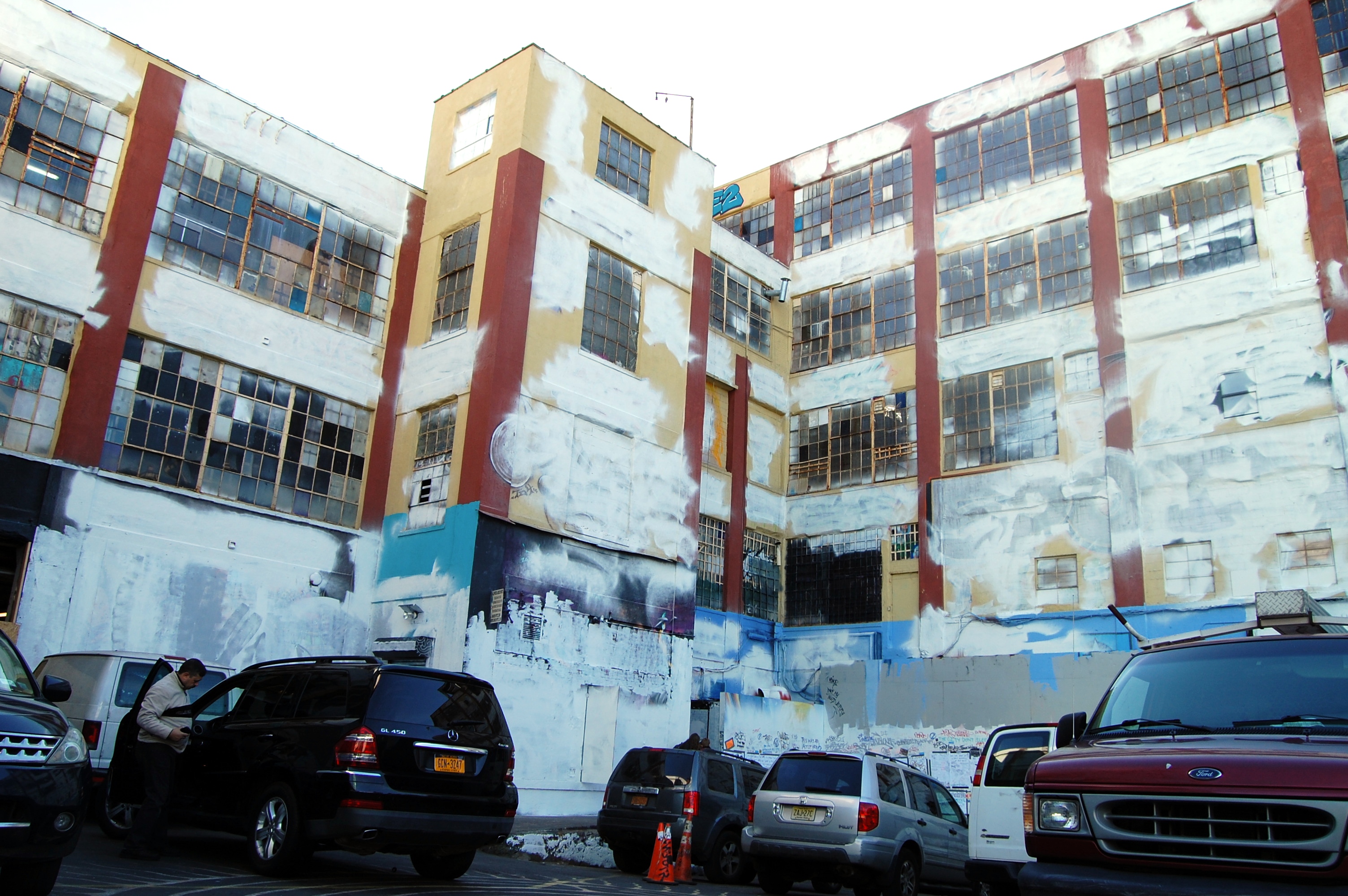
 An October 2013 blog post on the BLS Library Blog, Visual Artist Rights Act in Federal Court, discussed a federal law suit brought by a group of plaintiff artists, under the Visual Artist Rights Act of 1990, against a defendant real estate developer in the US District Court for the Eastern District of New York. Now nine of the artists, whose spray-paint artwork known as 5Pointz in Long Island City was whitewashed to make way for a residential development, have filed a new federal lawsuit seeking punitive damages. Over 18 months ago, the property owner used “the cover of night” to mutilate what had for years transformed Long Island City “from a virtual wasteland into an attractive place for residential development,” according to the complaint.
The artist-plaintiffs, led by Maria Castillo of Sunnyside, Queens, say they had free reign of 5Poinz through a 1993 deal with property owner Gerald Wolkoff and his company G&M Realty. With only three conditions that there be no politics, no religion, no sex, the artists worked for free retaining the copyrights of their work. One of the artists, Jonathan Cohen, the curator of 5Pointz, was given an office in 2002 and leave to commission works from others. After sale of the buildings to make way for a housing development, Cohen, facing an eviction proceeding, fired back with a federal complaint in October 2013. He reached a settlement with the defendant requiring him to vacate by Nov. 30. The court ruled on the artists’ motion for an injunction on November 20, but the owners obliterated the art the night before.
The new complaint contends that “the whitewashing was entirely gratuitous and unnecessary” and that the defendants “were far from ready to demolish the buildings in question.” It calls the whitewashing “the replacement of something beautiful with something profoundly ugly”. The plaintiff artists, from NYC and other parts of New York, as well as London, Germany, North Carolina and South Carolina, also seek compensation for the unlawful destruction of their work in violation of the Visual Artists Rights Act, 17 U.S.C. §106A et seq. (“VARA”). In 1990, Congress passed The Visual Artists Rights Act (VARA) to broaden copyright protections to include artists, recognizing the “moral rights” of artists in a way that the United States had not previously done.
Before the whitewashing of 5Pointz, artists came from around the world to be featured there, and the “Graffiti Mecca” was the site of several photo shoots, films, music videos and television shows. With the Museum of Modern Art’s P.S. 1 site nearby, visitors were “inexorably drawn” to check out the more than 350 works at 5Pointz. Subway passengers on the 7 train also saw the artwork on their daily commute
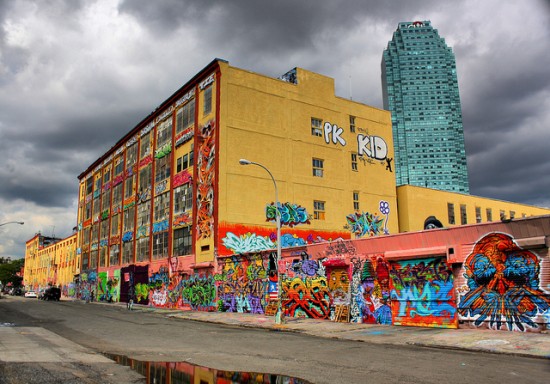

A BLS Library Blog post titled VARA and a Whitewashed Graffiti Mecca discussed a federal law suit brought by a group of plaintiff artists, under the Visual Artist Rights Act of 1990, against a defendant real estate developer in the US District Court for the Eastern District of New York. The NY Times now reports Graffiti Artists Awarded $6.7 Million for Destroyed 5Pointz Murals. Judge Frederic Block made the award on Monday to 21 graffiti artists whose works were destroyed in 2013 at the 5Pointz complex in Long Island City, Queens. Eric Baum, a lawyer for the artists, hailed the judgment, calling it “a victory not only for the artists in this case, but for artists all around the country.” Although 5Pointz no longer physically exists, the jury trial determined that the 5Pointz artists were entitled to legal redress for the work’s destruction. Significantly, this lawsuit was the first of its kind; never had a court examined whether the work of an “exterior aerosol artist,” as the trial judge wrote in a November 20, 2013, opinion, “is worthy of any protection under the law.” Congress enacted VARA in 1990 to afford visual artists two so-called “moral rights” under then-existing copyright law: the rights of attribution and integrity.
Brooklyn Law School Library’s One Search gives access to Graffiti and the Visual Artists Rights Act by Amy Wang, 11 Washington Journal of Law Technology & Arts 141 (2015) which has in-depth discussion of claims under VARA, examining case law in Cohen v. G&M Realty L.P., 988 F. Supp. 2d 212 (E.D.N.Y. 2013).
Commenting on blog posts requires an account.
Login is required to interact with this comment. Please and try again.
If you do not have an account, Register Now.