The Brooklyn Law School logo

BLS Library Blog

Showing 10 of 10 Results

04/30/2019
profile-icon Eric Yap

“Over 400 pages of reading bliss, this is one you don’t want to miss” ~Anonymous 


A white document on a table

Description automatically generated

Mueller Report

An open book with black text

Description automatically generated

Level 8 of Guess The Redacted Content Game

A shelf with books on it

Description automatically generated

Hot Off the Press

Now that we are into the thicket of law school exams, the library has provided some welcome diversions: puzzles, origami, and a Kindness Wall where students can leave encouraging notes for their peers. But what better way to destress than to play the “guess the redacted content” game?

Fresh off the press, the Report on the Investigation into Russian Interference in the 2016 Presidential Election, better known as the Mueller Report, is now in the library’s Reserve Collection (Call No. JF1083 .M84 2019)   

So take a break from deciphering the Rule Against Perpetuities and stop by the Circulation Desk. Flip through the Mueller Report and let your imagination run wild. Who are the subjects of the redacted ongoing investigations? Which classified secrets have been withheld from the eager public? What tasty tidbits in the grand jury materials were deemed verboten?

Maybe, just maybe, the Mueller Report will inspire you because of what it is: an impeccably researched and drafted legal document. It’s the stuff lawyers do. Someday, perhaps, you too will get to work on a legal project so monumental that it will have redactions galore when released to the public. One can only dream (but don’t dream for too long, IRAC awaits.)  


This post has no comments.

Last month, the Library of Congress launched an online searchable database of Congressional Research Service reports (CRS reports).  CRS reports are written by experts in a particular field. They present a legislative perspective on topics such as agriculture policy, banking regulation, the environment, veteran’s affairs, etc.   

Founded over a century ago, the Congressional Research Service’sA screenshot of a web page

Description automatically generated purpose is to provide Congress with authoritative and confidential research and analysis on the issues before both chambers.  The reports used to be available for a fee, but the Consolidated Appropriations Act of 2018 changed that.  The Act directs the Library of Congress to  make CRS reports publicly available online.   You can access the CRS Reports at crsreports.congress.gov.

I ran a couple of test searches on the platform.  A search of the term “environment” retrieved 93 results.  A search for the term “trade” retrieved 102 results.  Like other online tools, there are filters on the left you can use to narrow your result list.  These filters include: topics, authors, and date.  You can also search within your results to retrieve a more refined list.

This post has no comments.
03/29/2018
profile-icon BLS Reference Desk

A logo of a congress

Description automatically generated

All non-confidential reports of the Congressional Research Service must be made publicly available online through a Government Publishing Office website within 90 to 270 days under the 2018 omnibus appropriations act that was passed by Congress and signed by the President last week. Buried in the 2,232-page fiscal 2018 omnibus spending bill is a much-debated provision to require the Library of Congress to post all the lawmaker-requested reports on a central website.

AVAILABILITY OF CRS REPORTS THROUGH LIBRARY OF CONGRESS WEBSITE.
(1) WEBSITE.— (A) ESTABLISHMENT AND MAINTENANCE.—The Librarian of Congress, in consultation with the CRS Director, shall establish and maintain a public website containing CRS Reports and an index of all CRS Reports contained on the website, in accordance with this subsection.
(B) FORMAT.—On the Website, CRS Reports shall be searchable, sortable, and downloadable, including downloadable in bulk.
(C) FREE ACCESS.—Notwithstanding any other provision of law, the Librarian of Congress may not charge a fee for access to the Website.
(2) UPDATES; DISCLAIMER.—The Librarian of Congress, in consultation with the CRS Director, shall ensure that the Website—(A) is updated contemporaneously, automatically, and electronically to include each new or updated CRS Report released on or after the effective date of this section; (B) shows the status of each CRS Report as new, updated, or archived; … Any CRS Report may be reproduced and distributed in its entirety without permission from CRS. However, as a CRS Report may include copyrighted images or material from a third party, you may need to obtain the permission of the copyright holder if you wish to copy or otherwise use copyrighted material.’’

The move is the culmination of more than two decades of efforts to encourage, cajole or coerce Congress into making the reports broadly available to the public. Finally, Congress will make the non-confidential reports available to every American for free. See Long-Proprietary Congressional Research Reports Will Now Be Made Public by Charles S. Clark, March 23, 2018.

This post has no comments.

Govinfo 

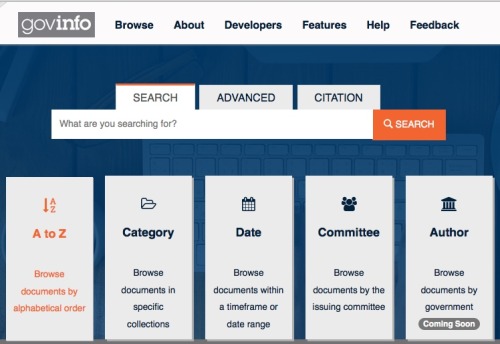
The U.S. Government Publishing Office (GPO) has launched a beta version of its new GovInfo web site.  After it completes its beta phase, Govinfo will replace FDsys, the federal government website currently providing  free public access to over 50 different collections of federal government information, including the United States Code, the Code of Federal Regulations, Congressional materials, and selected federal case law.   Users of GovInfo can browse by A-Z list, by category, by date, and by congressional committee content.  To see a list of collections available on Govinfo, visit here.

This post has no comments.
02/13/2016
profile-icon BLS Reference Desk

This month, the U.S. Government Publishing Office issued a press release announcing the launch of www.govinfo.gov, designed to replace the Federal Digital System (FDsys) in 2017. A Government Publishing Office’s spokesman has called it “the Google for government documents.” See Roll Call article from February 3, 2016. The site is currently in beta and users are encouraged to share suggestions with the U.S. GPO for further improvements. The site is a mobile-friendly, easy-to-use navigation system to information on the three branches of government. It currently offers more than 1.5 million titles, with more added each day. The alphabetized list of collections available includes the Federal Register and the CFR; congressional calendars, bills, hearings, committee reports; the U.S. Code; court opinions; the federal budget and many more government publications. Searchers can use a Google like box and then use the facets to find results. Alternatively, users can choose a category to search, limiting a search to just bills, or just regulatory documents, etc. If users are only looking for documents from a specific Congressional committee, they can choose that selection.

govinfo

For a Q&A to learn about the differences between FDsys and govinfo, read the post published on the site In Custodia Legis by the Law Librarians of Congress Meet govinfo, GPO’s Next Generation of Access to Federal Government Information.

This post has no comments.
04/11/2010
profile-icon BLS Reference Desk

The Law Library Blog at Stanford’s Robert Crown Law Library reports that researchers can get around the 8 cents per page that Congress allows the federal courts to charge for printing documents in the PACER database. Princeton University’s Center for Information Technology Policy has developed a Firefox plug-in called RECAP (PACER spelled backward) designed to make more court documents available to the public at no cost. Users who want to install RECAP must use Firefox.

“RECAP helps users exercise their rights under copyright law, which expressly places government works in the public domain. It also helps users advance the public good by contributing to an extensive and freely available archive of public court documents,” Harlan Yu, a Princeton graduate student, said in a blog post marking the public beta release.

It is possible that if RECAP becomes successful and PACER loses revenue, the federal courts could move to ban it. Until then, RECAP is a cost effective research tool. Another potential problem is that the RECAP developers plan to make the source code available so that it may be easy to seed the Internet Archive with “official court documents” that had been modified in some way. 

The way it works is simple: when you log in to the federal court system and pay with a credit card to download a document, the RECAP plug-in automatically and transparently forwards a copy to the Internet Archive, where it becomes available for free to the next person who wants to read it. See the video Watch RECAP in Action
 

The effort is a collaborative one, with others benefiting from your purchases, while you benefit from theirs. For more information on RECAP see Erika Wayne’s article More than One Document a Minute.

This post has no comments.
11/04/2009
profile-icon BLS Reference Desk

For the last decade, GPO Access, the online version of the US Government Printing Office, has provided free electronic access to documents produced by the Federal Government. This free service, funded by the Federal Depository Library Program, arose out of Public Law 103-40, known as the Government Printing Office Electronic Information Enhancement Act of 1993. GPO Access has been the online source for the US Code, bills, committee reports, hearings, the Federal Register and Code of Federal Regulations, and other documents; most materials are available in PDF back to the mid-1990s. However, GPO Access’s primitive search engine was generally useful for retrieving known citations.

Now, the Federal Digital System (FDsys – accent on the D) is the new advanced digital system that will enable GPO to manage Government information from all three branches of the US Government. The migration of information from GPO Access into FDsys will be complete in 2009. Until then GPO Access will contain all content. FDsys (http://fdsys.gpo.gov/) is currently available in beta format. It currently offers more than 150,000 of the same congressional and executive documents as GPO Access, with advanced search capabilities and a more user-friendly interface. It is also the only source for the Daily Compilation of Presidential Documents which replaced the former Weekly Compilation earlier this year.

GPO has made available brief FDsys video tutorials, including an FDsys overview, simple search, advanced and citation search, and browsing. The FDsys tutorials are:

  • FDsys Overview – This video is a brief overview on the background of FDsys.
  • FDsys Simple Search – This is a video tutorial on how to perform simple searches within the system and filter your results.
  • FDsys Advanced Search – This is a video tutorial on how to perform advanced searches and citation searches within the system.
  • FDsys Browse – This is a video tutorial on how to browse for government publications within FDsys.

This post has no comments.
04/04/2009
profile-icon BLS Reference Desk

As part of its education program, the US Government Printing Office (GPO) now uses YouTube to further its mission of Keeping America Informed on the three branches of the Federal Government. For nearly 200 years, GPO has worked with libraries throughout the country to provide free, open and permanent access to the documents of our democracy through the Federal Depository Library Program. The public can visit any of the 1,250 Federal depository libraries throughout the country and access information on virtually any topic. 

This five minute video “U.S. Government Printing Office: Working with Libraries” is one that GPO has posted on YouTube along with ten others. See the full list at GPO Printer’s Videos

This post has no comments.
02/13/2009
profile-icon BLS Reference Desk

There is more news about open access to government documents in today’s NY Times article An Effort to Upgrade a Court Archive System to Free and Easy. The article highlights the efforts of Carl Malamud of the Public Resources.Org to make court proceedings and legal records freely available to citizens and taxpayers and to overcome barriers to open access to documents published by the government. Malamud has been a long time advocate of open access to government documents with successes in posting online free CRS reports as well as the records of the Securities and Exchange Commission and the Patent and Trademark Office. For more, see the December 12, 2008 Wired Magazine article Online Rebel Publishes Millions of Dollars in U.S. Court Records for Free about Carl Malamud and his open access efforts.

Malamud’s most recent open access efforts deals with Public Access to Court Electronic Records (PACER), the fee based and outdated electronic public access service of United States federal court documents. PACER is managed by the Administrative Office of the United States Courts and allows users to obtain for a fee case and docket information from the United States district courts, United States courts of appeals, and United States bankruptcy courts. Malamud, using $600,000 in contributions in 2008, bought a 50-year archive of papers from the federal appellate courts and placed them online. He was ready to take on the larger database of district courts, which, with the help of the Government Printing Office (GPO), had opened a free trial of PACER at 17 libraries around the country. Mr. Malamud urged fellow activists to go to those libraries, download as many court documents as they could, and send them to him for republication on the Web, where Google could retrieve them. One of the activists managed to download an estimated 20 percent of the entire database consisting of 19,856,160 pages of text before the GPO suspended the program. For now, the 50 years of appellate decisions remain online and Google-friendly with the 20 million pages of lower court decisions available in bulk form, but not yet easily searchable.

The open access movement is gaining strength. Last year on October 14, Open Access Day, at Harvard’s Berkman Center for Internet & Society, Stephen Schultze conducted a presentation on Open Access to Government Documents with some statistics about the income the PACER system generates for the courts. A PDF version of the slides used in that presentation are available here.

This post has no comments.
11/13/2007
profile-icon BLS Reference Desk

Two new Web sites have similar missions: making secret and hard-to-find government documents, revealed through FOIA requests and other means, available to the public in order to promote government transparency.

The first and more sophisticated, GovernmentDocs.org, is being officially launched tomorrow. It will provide a database of FOIA responses and other government documents contributed by a number of public interest organizations. The site’s goal is to become a central repository of government documents. A key feature of the site is that every document, while provided in PDF, is also run through an OCR process so that its text is fully searchable. Every page of every document is given a unique URL, so users can link directly to a key page from their blogs or Web sites. Registered users can add comments to documents and highlight important parts. The primary backer of the site is Citizens for Responsibility and Ethics in Washington (CREW), with support from the Project on Government Oversight, Public Citizen, Electronic Frontier Foundation and the Sunlight Foundation.

The second site, GovernmentAttic.org, describes itself as “rummaging in the government attic.” Like the other site, its purpose is to provide access to government documents unavailable elsewhere, most obtained through FOIA requests. Documents are listed by name under general headings. There appears to be no search mechanism.


Source: Robert Ambrogi’s LawSites posted Wednesday, November 7, 2007

This post has no comments.
Field is required.