
Texts:
See guide box: How Do I Find U.S. State Constitutions? on a different page of this guide.

 The New York State Constitution
by
In SARA catalog record for the ebook, click: ACCESS ONLINE VERSION - EBSCO.
The New York State Constitution
by
In SARA catalog record for the ebook, click: ACCESS ONLINE VERSION - EBSCO.
Guides:
Jerome Hall Law Library, Indiana University Maurer School of Law Library, State Legislative History Research Guides Inventory - On the map, click a state to find links to online legislative history research guides for the state.
Reference Guides to the State Constitutions of the United States:
 The New York State Constitution
by
The New York State Constitution
by
New York Research Guide:
 New York Legal Research
by
Includes: Ch. 5: Statutes, Constitutions, Local Law and Court Rules and Ch. 6: Legislative History.
BLS Library will obtain the forthcoming 5th ed. of this guide in Feb. 2026.
New York Legal Research
by
Includes: Ch. 5: Statutes, Constitutions, Local Law and Court Rules and Ch. 6: Legislative History.
BLS Library will obtain the forthcoming 5th ed. of this guide in Feb. 2026.
There have been cases in which young citizens allege that their U.S. state constitutions grant them the right to a safe, stable climate and current laws and/or practices violate this right.
Held v. Montana (2020) [source: U.S. Climate Change Litigation database]
The judge in Held v. Montana ruled in favor of the plaintiffs and stated that Montana’s “MEPA Limitation” provision was unconstitutional.

Photo by Robin Loznak, courtesy of Our Children's Trust
For more in-depth information about this case see this section of the BLS Climate Change and Environmental Law research guide, created by BLS Reference Librarian/Adjunct Professor Sue Silverman.
Links to additional pertinent cases are available in the U.S. Climate Change Litigation database provided by the Sabin Center for Climate Change Law at Columbia Law School and Arnold & Porter:
Selected Commentary:
Older Source:
 State Constitutional Law: Litigating Individual Rights, Claims, and Defenses
by
Excerpt from this ebook's description: This source gathers and compares "constitutional case law from all 50 states, and contrast[s] prevailing federal rulings with more protective state decisions."
State Constitutional Law: Litigating Individual Rights, Claims, and Defenses
by
Excerpt from this ebook's description: This source gathers and compares "constitutional case law from all 50 states, and contrast[s] prevailing federal rulings with more protective state decisions."
Brennan Center for Justice at NYU School of Law virtual panel recording on YouTube: Abortion Rights and the Future of State Constitutions (Sept. 19, 2023)
This panel discussed the effects of Dobbs v. Jackson Women’s Health Org., "and its implications for state courts and constitutions."
Brennan Center for Justice at NYU School of Law resources under issue: Reproductive Rights. Includes:
Center for Reproductive Rights: After Roe Fell: Abortion Laws By State (updated "in real time") - "Examines laws, constitutions, and court decisions on abortion—and assigns each state, territory, and the District of Columbia to one of five categories: Expanded Access, Protected, Not Protected, Hostile, and Illegal."
Center for Reproductive Rights: The World's Abortion Laws (updated "in real time")
Congressional Research Service: Laura Deal, State Laws Restricting or Prohibiting Abortion (updated July 21, 2025)
Lexis+: Overturning Roe v. Wade and the Future of Abortion Rights (updated through Apr. 2023) Tip: Log in to your Lexis+ account, then click the recommended link.
Lexis+ description: "In Dobbs v. Jackson Women’s Health Org., the Supreme Court, with a 6-3 majority, overturned decades of existing caselaw governing the right to an abortion. This pamphlet is an overview of the current constitutional status of abortion rights in each state, including a brief discussion of case law from each state’s highest court, and, where applicable, constitutional provisions that exclude a right to abortion from a state’s constitution. Also included are statutes that indicate individual states’ support of the right of choice to terminate a pregnancy."
When searching BLS Library's SARA catalog for materials, relevant subjects to search are:
 Sedition: How America's Constitutional Order Emerged from Violent Crisis
by
In SARA catalog record, click: ACCESS ONLINE VERSION - JSTOR. Publisher's summary: "Sedition comprehensively addresses constitutional breakdown at the state level, which has been a constant in American history with consequences for the country that cannot be overstated."
Sedition: How America's Constitutional Order Emerged from Violent Crisis
by
In SARA catalog record, click: ACCESS ONLINE VERSION - JSTOR. Publisher's summary: "Sedition comprehensively addresses constitutional breakdown at the state level, which has been a constant in American history with consequences for the country that cannot be overstated."
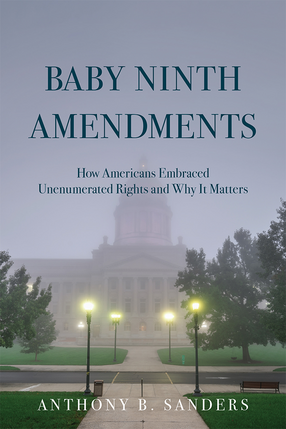 Baby Ninth Amendments: How Americans Embraced Unenumerated Rights and Why It Matters
by
This is an open-access ebook.
Excerpt from this ebook's description: "[S]cholars are divided on whether the Ninth Amendment itself actually does protect unenumerated rights, and the Supreme Court has almost entirely ignored it. Regardless of what the Ninth Amendment means, two-thirds of state constitutions have equivalent provisions, or "Baby Ninth Amendments," worded similarly to the Ninth Amendment. This book is the story of how the "Baby Ninths" came to be and what they mean. Unlike the controversy surrounding the Ninth Amendment, the meaning of the Baby Ninths is straightforward: they protect individual rights that are not otherwise enumerated. They are an "etcetera, etcetera" at the end of a bill of rights. This book argues that state judges should do their duty and live up to their own constitutions to protect the rights "retained by the people" that these "etcetera clauses" are designed to guarantee."
Baby Ninth Amendments: How Americans Embraced Unenumerated Rights and Why It Matters
by
This is an open-access ebook.
Excerpt from this ebook's description: "[S]cholars are divided on whether the Ninth Amendment itself actually does protect unenumerated rights, and the Supreme Court has almost entirely ignored it. Regardless of what the Ninth Amendment means, two-thirds of state constitutions have equivalent provisions, or "Baby Ninth Amendments," worded similarly to the Ninth Amendment. This book is the story of how the "Baby Ninths" came to be and what they mean. Unlike the controversy surrounding the Ninth Amendment, the meaning of the Baby Ninths is straightforward: they protect individual rights that are not otherwise enumerated. They are an "etcetera, etcetera" at the end of a bill of rights. This book argues that state judges should do their duty and live up to their own constitutions to protect the rights "retained by the people" that these "etcetera clauses" are designed to guarantee."
 The Dead Hand's Grip: How Long Constitutions Bind States
by
In SARA catalog record for this ebook, click: ACCESS ONLINE VERSION - EBSCO.
Excerpt from this book's description: "Adam R. Brown examines constitutional specificity--or length--as a new way to evaluate how different polities govern citizens and regulate themselves."
The Dead Hand's Grip: How Long Constitutions Bind States
by
In SARA catalog record for this ebook, click: ACCESS ONLINE VERSION - EBSCO.
Excerpt from this book's description: "Adam R. Brown examines constitutional specificity--or length--as a new way to evaluate how different polities govern citizens and regulate themselves."
 Who Decides?: States As Laboratories of Constitutional Experimentation
by
This book is a sequel to U.S. Court of Appeals Judge Jeffrey S. Sutton's prior book: 51 Imperfect Solutions: States and the Making of American Constitutional Law. Excerpt from this book's description: "Who Decides makes the case that American Constitutional Law should account for the role of the state courts and state constitutions, together with the federal courts and the federal constitution, in assessing the right balance of power among all branches of government."
Who Decides?: States As Laboratories of Constitutional Experimentation
by
This book is a sequel to U.S. Court of Appeals Judge Jeffrey S. Sutton's prior book: 51 Imperfect Solutions: States and the Making of American Constitutional Law. Excerpt from this book's description: "Who Decides makes the case that American Constitutional Law should account for the role of the state courts and state constitutions, together with the federal courts and the federal constitution, in assessing the right balance of power among all branches of government."
 51 Imperfect Solutions: States and the Making of American Constitutional Law
by
In SARA catalog record for this ebook, click: ACCESS ONLINE VERSION - EBC. 1 copy available.
Excerpt from this ebook's description: "In 51 Imperfect Solutions, U.S. Court of Appeals Judge Jeffrey S. Sutton argues that American Constitutional Law should account for the role of the state courts and state constitutions, together with the federal courts and the federal constitution, in protecting individual liberties."
51 Imperfect Solutions: States and the Making of American Constitutional Law
by
In SARA catalog record for this ebook, click: ACCESS ONLINE VERSION - EBC. 1 copy available.
Excerpt from this ebook's description: "In 51 Imperfect Solutions, U.S. Court of Appeals Judge Jeffrey S. Sutton argues that American Constitutional Law should account for the role of the state courts and state constitutions, together with the federal courts and the federal constitution, in protecting individual liberties."